

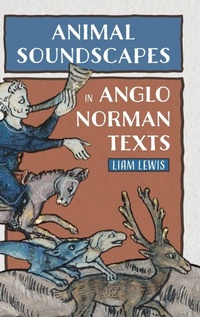
Animal Soundscapes in Anglo-Norman Texts
Published on 25. January 2022
Book
Hardback
216 pages
978-1-84384-622-2 (ISBN)
Description
A redefinition of the animal's relationship to sound and language in French texts from medieval England.
The barks, hoots and howls of animals and birds pierce through the experience of medieval texts. In captivating episodes of communication between species, a mandrake shrieks when uprooted from the ground, a saint preaches to the animals, and a cuckoo causes turmoil at the parliament of birds with his familiar call. This book considers a range of such episodes in Old French verse texts, including bestiaries, treatises on language, the Life of Saint Francis of Assisi and the Fables by Marie de France, aiming to reconceptualize and reinterpret animal soundscapes. It argues that they draw on sound to produce competing perspectives, forms of life, and linguistic subjectivities, suggesting that humans owe more to animal sounds than we are disposed to believe. Texts inviting readers to listen and learn animal noises, to seek spiritual consolation in the jargon of birds, or to identify with the speaking wolf, create the conditions for an assertion of human exceptionalism even as they simultaneously invite readers to question such forms of control. By asking what it means for an animal to cry, make noise, or speak in French, this book provides an important resource for theorizing sound and animality in multilingual medieval contexts, and for understanding the animal's role in the interpretation of the natural world.
The barks, hoots and howls of animals and birds pierce through the experience of medieval texts. In captivating episodes of communication between species, a mandrake shrieks when uprooted from the ground, a saint preaches to the animals, and a cuckoo causes turmoil at the parliament of birds with his familiar call. This book considers a range of such episodes in Old French verse texts, including bestiaries, treatises on language, the Life of Saint Francis of Assisi and the Fables by Marie de France, aiming to reconceptualize and reinterpret animal soundscapes. It argues that they draw on sound to produce competing perspectives, forms of life, and linguistic subjectivities, suggesting that humans owe more to animal sounds than we are disposed to believe. Texts inviting readers to listen and learn animal noises, to seek spiritual consolation in the jargon of birds, or to identify with the speaking wolf, create the conditions for an assertion of human exceptionalism even as they simultaneously invite readers to question such forms of control. By asking what it means for an animal to cry, make noise, or speak in French, this book provides an important resource for theorizing sound and animality in multilingual medieval contexts, and for understanding the animal's role in the interpretation of the natural world.
Reviews / Votes
Liam Lewis's monograph on animal sounds in Anglo-Norman literature offers more than a welcome contribution to medieval studies. Lewis's book successfully identifies a broadly shared Anglo-Norman understanding of animals and humans as creatures with ineluctably shared destinies. * ECOZONE@: EUROPEAN JOURNAL OF LITERATURE, CULTURE AND ENVIRONMENT * This book, populated as it is with noisy and verbose animal life, is a pleasure to read. It makes a valuable contribution to both theoretical animal studies and medieval literary studies. * H-NET *More details
Series
Language
English
Place of publication
Cambridge
United Kingdom
Publishing group
Boydell & Brewer Ltd
Target group
Professional and scholarly
Product notice
Cloth over boards
Illustrations
4 b/w illus.
Dimensions
Height: 240 mm
Width: 161 mm
Thickness: 16 mm
Weight
487 gr
ISBN-13
978-1-84384-622-2 (9781843846222)
Copyright in bibliographic data and cover images is held by Nielsen Book Services Limited or by the publishers or by their respective licensors: all rights reserved.
Schweitzer Classification
Person
Liam Lewis is Lecturer in French at the University of Liverpool, and has taught at the University of Oxford and L'Universite de Paris III Sorbonne-Nouvelle. He has a PhD from the University of Warwick.
Content
List of Illustrations
Acknowledgements
List of Abbreviations
Introduction
Sound Milieus: Memory and Sound in Philippe de Thaon's Bestiary
Sound Zones: Linguistic Subjectivity in Bibbesworth's Tretiz de langage
Soundscape and Form-of-Life: The Life of Saint Francis of Assisi
Soundscape Perspectives: Mouths, Muzzles, and Beaks in Marie de France's Fables
Coda: 'Sumer is icumen in', Response and Recall
Bibliography
Index
Acknowledgements
List of Abbreviations
Introduction
Sound Milieus: Memory and Sound in Philippe de Thaon's Bestiary
Sound Zones: Linguistic Subjectivity in Bibbesworth's Tretiz de langage
Soundscape and Form-of-Life: The Life of Saint Francis of Assisi
Soundscape Perspectives: Mouths, Muzzles, and Beaks in Marie de France's Fables
Coda: 'Sumer is icumen in', Response and Recall
Bibliography
Index