

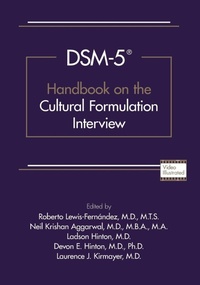
DSM-5 (R) Handbook on the Cultural Formulation Interview
Published on 5. July 2015
Book
Paperback/Softback
364 pages
978-1-58562-492-8 (ISBN)
Description
DSM-5 Handbook of the Cultural Formulation Interview
provides the background, context, and detailed guidance necessary to train
clinicians in the use of the Cultural Formulation Interview (CFI),
which was created as part of the 2007-2013 DSM revision process. The purpose
of the CFI-and this unique handbook-is to make it easier for providers to
account for the influence of culture in their clinical work to enhance
patient-clinician communication and improve outcomes. Cultural psychiatry as
a field has evolved enormously from the days when it was principally
concerned with epidemiological and clinical studies of disease prevalence;
it now examines a multitude of issues, primary among them the differing
patient, family, and practitioner models of illness and treatment
experiences within and across cultures. The editors, all of whom have been
intimately involved in the evolution of the field, have designed the book
and accompanying videos for maximum instructional and clinical
utility.
The Handbook boasts many strengths and useful
features, including:
* A detailed description of each of the three CFI components: a core
16-item questionnaire, which can be applied in any clinical setting with any
patient by any mental health clinician; an informant version of the core CFI
used to obtain information from caregivers; and 12 supplementary modules
that expand on these basic assessments. This material facilitates
implementation of the CFI by clinicians.
* Over a dozen clinical
vignettes are included to illustrate use of the three components, and the
Handbook also includes multiple videos that demonstrate the application of
portions of the core CFI, and several supplementary modules.
*
Strategies for incorporating the CFI into clinical training are identified
and discussed, furthering the objective of developing culturally-sensitive
and astute practitioners.
* The theoretical bases of the CFI are
explored, raising questions for discussion and identifying areas for further
research.
The CFI is a valuable tool for all patients, not just those
judged to be culturally different. The CFI has been called the single most
practically useful contribution of cultural psychiatry and medical
anthropology to clinical psychiatry, primary care, and medicine in
general. DSM-5 Handbook on the Cultural Formulation Interview is
the only book on the market that equips readers with the skills and insight
to incorporate the CFI into practice, making it a critically important
addition to the clinical literature.
provides the background, context, and detailed guidance necessary to train
clinicians in the use of the Cultural Formulation Interview (CFI),
which was created as part of the 2007-2013 DSM revision process. The purpose
of the CFI-and this unique handbook-is to make it easier for providers to
account for the influence of culture in their clinical work to enhance
patient-clinician communication and improve outcomes. Cultural psychiatry as
a field has evolved enormously from the days when it was principally
concerned with epidemiological and clinical studies of disease prevalence;
it now examines a multitude of issues, primary among them the differing
patient, family, and practitioner models of illness and treatment
experiences within and across cultures. The editors, all of whom have been
intimately involved in the evolution of the field, have designed the book
and accompanying videos for maximum instructional and clinical
utility.
The Handbook boasts many strengths and useful
features, including:
* A detailed description of each of the three CFI components: a core
16-item questionnaire, which can be applied in any clinical setting with any
patient by any mental health clinician; an informant version of the core CFI
used to obtain information from caregivers; and 12 supplementary modules
that expand on these basic assessments. This material facilitates
implementation of the CFI by clinicians.
* Over a dozen clinical
vignettes are included to illustrate use of the three components, and the
Handbook also includes multiple videos that demonstrate the application of
portions of the core CFI, and several supplementary modules.
*
Strategies for incorporating the CFI into clinical training are identified
and discussed, furthering the objective of developing culturally-sensitive
and astute practitioners.
* The theoretical bases of the CFI are
explored, raising questions for discussion and identifying areas for further
research.
The CFI is a valuable tool for all patients, not just those
judged to be culturally different. The CFI has been called the single most
practically useful contribution of cultural psychiatry and medical
anthropology to clinical psychiatry, primary care, and medicine in
general. DSM-5 Handbook on the Cultural Formulation Interview is
the only book on the market that equips readers with the skills and insight
to incorporate the CFI into practice, making it a critically important
addition to the clinical literature.
Reviews / Votes
One of the greatest challenges in the field of cultural psychiatry over the past two decades-since the Outline for Cultural Formulation was published in DSM-IV-has been the need to develop a clinically effective set of questions that mental health practitioners could use to reliably describe the cultural context of psychological distress and psychiatric symptoms. This volume, the product of a DSM-5 work group dedicated to this challenge since 2007, comprises a major step forward. It includes a core, 16-item Cultural Formulation Interview, along with 12 supplementary modules on subjects such as the patient-clinician relationship, immigrants and refugees, children and adolescents, and caregivers. Its widespread use by clinicians and students should lead to more sensitive interactions with patients and their families in diverse and multicultural settings, as well as to more effective, person-centered clinical care." - Ronald Wintrob, M.D., Clinical Professor of Psychiatry and Human Behavior, Warren Alpert School of Medicine, Brown University"This companion piece to the Cultural Formulation Interview (CFI), which had its debut in the DSM-5, provides a high level overview of the CFI and its supplementary modules as well as a wonderfully practical guide for their implementation in clinical practice. The editors, a team of expert cultural psychiatrists led by Roberto Lewis-Fernandez, have assembled chapters that in aggregate, illuminate the principles of serious engagement with 'culture' as a means of re-contextualizing the lived experience of mental illness. The handbook highlights the clinical utility of the CFI for diagnostic assessment and as a tool for rendering treatment optimally relevant and acceptable to any patient. Within the CFI approach, culture is recast as not exotica or mere descriptor, but rather as fluid, dynamic, multi-dimensional, and intrinsic to patient understandings, values, and needs that, in turn, invariably shape the arc of treatment seeking and illness. This comprehensive overview of the CFI-and all that this approach entails-is an invaluable guide to navigating culture in the clinical encounter." - Anne E. Becker, M.D., PhD., Vice Chair and Maude and Lillian Presley Professor of Global Health and Social Medicine, Department of Global Health and Social Medicine, Harvard Medical School
More details
Language
English
Place of publication
VA
United States
Target group
Professional and scholarly
US School Grade: College Graduate Student and over
Product notice
Paperback (trade)
Illustrations
2 Figures; 26 Tables, unspecified
Dimensions
Height: 181 mm
Width: 265 mm
Thickness: 18 mm
Weight
588 gr
ISBN-13
978-1-58562-492-8 (9781585624928)
Copyright in bibliographic data and cover images is held by Nielsen Book Services Limited or by the publishers or by their respective licensors: all rights reserved.
Schweitzer Classification
Other editions
Additional editions
Roberto Lewis-Fernández | Neil K. Aggarwal | Ladson Hinton
DSM-5® Handbook on the Cultural Formulation Interview
E-Book
05/2015
1st Edition
American Psychiatric Association Publishing
€52.99
Available for download
Persons
Roberto Lewis-Fernandez, M.D., M.T.S., is a
Professor of Psychiatry at Columbia University Medical Center and is the
Director of the New York State Center of Excellence for Cultural Competence
and of the Hispanic Treatment Program at the New York State Psychiatry
Institute, New York, New York.
Neil Krishan Aggarwal, M.D., M.B.A.,
M.A., is Assistant Professor of Clinical Psychiatry at Columbia
University and Research Scientist at the New York State Psychiatric
Institute, New York, New York
Ladson Hinton, M.D., is a
Professor of Psychiatry at the University of California Davis School of
Medicine, Sacramento, California
Devon E. Hinton M.D., Ph.D.,
is Associate Professor of Psychiatry at Massachusetts General Hospital,
Harvard Medical School, Boston, Massachusetts
Laurence J. Kirmayer,
M.D., is James McGill Professor and Director of the Division if
Social and Transcultural Psychiatry at McGill University, Montreal, Quebec,
Canada
Professor of Psychiatry at Columbia University Medical Center and is the
Director of the New York State Center of Excellence for Cultural Competence
and of the Hispanic Treatment Program at the New York State Psychiatry
Institute, New York, New York.
Neil Krishan Aggarwal, M.D., M.B.A.,
M.A., is Assistant Professor of Clinical Psychiatry at Columbia
University and Research Scientist at the New York State Psychiatric
Institute, New York, New York
Ladson Hinton, M.D., is a
Professor of Psychiatry at the University of California Davis School of
Medicine, Sacramento, California
Devon E. Hinton M.D., Ph.D.,
is Associate Professor of Psychiatry at Massachusetts General Hospital,
Harvard Medical School, Boston, Massachusetts
Laurence J. Kirmayer,
M.D., is James McGill Professor and Director of the Division if
Social and Transcultural Psychiatry at McGill University, Montreal, Quebec,
Canada
Content
Contributors
Foreword
Preface
Video
Guide
Introduction
Chapter 1. Cultural Formulation Before
DSM-5
Chapter 2. The Core and Informant Cultural Formulation Interviews
in DSM-5
Chapter 3. Supplementary Modules
Chapter 4. Clinical
Implementation of the Cultural Formulation Interview
Chapter 5. Cultural
Competence in Psychiatric Education Using the Cultural Formulation
Interview
Chapter 6. Conclusion: The Future of Cultural
Formulation
Appendix A: Cultural Formulation Interview (CFI)-Core
Version
Appendix B: Cultural Formulation Interview (CFI)-Informant
Version
Appendix C: Supplementary Modules to the Core Cultural
Formulation Interview (CFI)
Index
Foreword
Preface
Video
Guide
Introduction
Chapter 1. Cultural Formulation Before
DSM-5
Chapter 2. The Core and Informant Cultural Formulation Interviews
in DSM-5
Chapter 3. Supplementary Modules
Chapter 4. Clinical
Implementation of the Cultural Formulation Interview
Chapter 5. Cultural
Competence in Psychiatric Education Using the Cultural Formulation
Interview
Chapter 6. Conclusion: The Future of Cultural
Formulation
Appendix A: Cultural Formulation Interview (CFI)-Core
Version
Appendix B: Cultural Formulation Interview (CFI)-Informant
Version
Appendix C: Supplementary Modules to the Core Cultural
Formulation Interview (CFI)
Index