

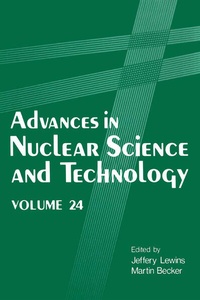
Advances in Nuclear Science and Technology
Volume 24
Published on 31. January 1997
Book
Hardback
XII, 320 pages
978-0-306-45515-5 (ISBN)
Description
Some countries have moved beyond the design and operation of nuclear electricity generating systems to confronting the issue of nuclear waste disposal, whole others are still committed to further nuclear facility construction. Volume 24 chronicles these key developments and examines nuclear reactor accidents at Chernobyl, Bhopal, and TMI. The text also analyzes current international knowledge of neutron interactions; deterministic methods based on mean values for assessing radiation distributions; practical applications of the TIBERE models to explicit computation of leakage terms in realistic reactor geometry; and a technique to deal with the issues of finance, risk assessment, and public perception.
More details
Series
Edition
1997 ed.
Language
English
Place of publication
New York
United States
Publishing group
Springer Science+Business Media
Target group
College/higher education
Professional and scholarly
Research
Illustrations
XII, 320 p.
Dimensions
Height: 241 mm
Width: 160 mm
Thickness: 23 mm
Weight
670 gr
ISBN-13
978-0-306-45515-5 (9780306455155)
DOI
10.1007/b105274
Schweitzer Classification
Other editions
Additional editions
Jeffery Lewins | Martin Becker
Advances in Nuclear Science and Technology
Book
03/2013
Springer
€160.49
Shipment within 15-20 days
Jeffery Lewins | Martin Becker
Advances in Nuclear Science and Technology
E-Book
04/2006
Springer
€149.79
Available for download
Content
Chernobyl and Bhopal Ten Years on.- Transport Theory in Discrete Stochastic Mixtures.- The Role of Neural Networks in Reactor Diagnostics and Control.- Data Testing of ENDF/B-VI with MCNP: Critical Experiments, Thermal-Reactor Lattices, and Time-of-Flight Measurements.- System Dynamics: An Introduction & Applications to the Nuclear Industry.- BN Theory: Advances and New Models for Neutron Leakage Calculation.- Current Status of Core Degradation and Melt Progression in Severe LWR Accidents.