

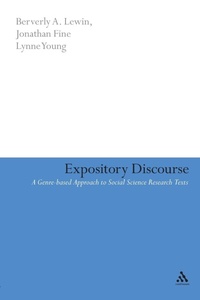
Expository Discourse
Published on 1. August 2005
Book
Paperback/Softback
176 pages
978-0-8264-7925-9 (ISBN)
Description
This volume provides a detailed an explicit account of the genre of social science research articles. While previous literature has analysed some aspects of the research genre separately, this book presents a comprehensive model which characterizes the generic, registerial and discoursal options as they interweave within a text. Another important contribution of the analysis is the formulation of explicit realization statements that relate the abstract categories of move and act (as described by Swales) to the way these units are actually created by lexical and grammatical choices. The realization networks draw on the work of systemic functional linguistics, primarily Halliday, Hasan, Martin and Ventola. The added emphasis in this study is that research texts are ultimately persuasive texts, and genre 'constraints' can be tightened or loosened in response to the rhetorical dimension. The description of the social science research genre is important both for those teaching English to speakers and readers of other languages and for researchers in discourse structure.
For teachers, the detailed analysis of texts and the method for determining realization rules will help in guiding students who must understand and produce research articles. For researchers, the qualitative and quantitative analyses show how the different levels of abstraction, from the genre itself to its moves, acts and wordings, are related to each other. Lastly, this analysis can serve as a model for future descriptions of other academic and professional genres.
For teachers, the detailed analysis of texts and the method for determining realization rules will help in guiding students who must understand and produce research articles. For researchers, the qualitative and quantitative analyses show how the different levels of abstraction, from the genre itself to its moves, acts and wordings, are related to each other. Lastly, this analysis can serve as a model for future descriptions of other academic and professional genres.
More details
Language
English
Place of publication
London
United Kingdom
Publishing group
Bloomsbury Publishing PLC
Target group
Professional and scholarly
Dimensions
Height: 234 mm
Width: 156 mm
Thickness: 10 mm
Weight
281 gr
ISBN-13
978-0-8264-7925-9 (9780826479259)
Copyright in bibliographic data and cover images is held by Nielsen Book Services Limited or by the publishers or by their respective licensors: all rights reserved.
Schweitzer Classification
Other editions
Additional editions
Beverly Lewin | Jonathan Fine | Lynne Young
Expository Discourse
E-Book
08/2005
1st Edition
Continuum International Publishing Group Ltd.
€88.49
Available for download
Persons
Beverly A. Lewin is Instructor of Scientific Writing for Doctoral Candidates, Division of Foreign Languages, Tel Aviv University, Israel. Jonathan Fine is Associate Professor, Department of English, Bar-Ilan University, Israel, where he does research on discourse analysis. Lynne Young is Associate Professor at the School of Linguistics and Applied Language Studies, Carleton University, Canada.
Content
1. A Critical Review of Genre Analysis Introduction II. The Search for; 2. Structure III. Evolution of the Scientific Article: From Witnessing to Constructing Reality IV. Genre Analysis: The Field Until Now V. Scientific Research Texts as a Genre VI. The Emergence of the 'Move' VII. Conclusion; 3. Methods I. Introduction II. Definition of Concepts III. Corpus/Methods IV. Summary; 4. Setting the Stage: Analysis of Introduction Sections I. Introduction II. The Key Moves III. How are Moves Realised in Texts? IV. Authors' Aims in Key Moves V. Distribution and Extent of Moves VI. Sequence of Moves VII. Introductions as Narratives; 5. Inviting Applause: Analysis of Discussion Sections I. Introduction II. The Key Moves III. How are Moves Realised in Text? IV. Getting from Move to Move V. Distribution and Extent of Moves VI. Sequence of Moves VII. What do Moves Accomplish? VIII. Comparison to Discussion Sections in Physical Sciences; 6. The Tie that Binds: Lexical Cohesion I. Background II. Lexical Cohesion and Genre III. A Method of Analysis IV. How Lexical Cohesion Functions; 7. The Cast of Characters in Scientific Terms I. Background II. Systems to Refer to Participants III. Reference Networks in Operation; 8. Signaling Beginnings and Endings I. Background: Boundary Markers II. Boundary Markers in Scientific Texts; 9. Conclusions I. Genre: Interaction Between Obligatory Structures and Authorial Discretion II. Specific Findings for Scientific Research Texts III. Scope of the Present Study IV. Implications