

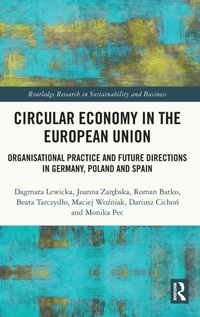
Circular Economy in the European Union
Organisational Practice and Future Directions in Germany, Poland and Spain
1st Edition
Published on 29. December 2023
Book
Hardback
268 pages
978-1-032-53274-5 (ISBN)
Description
Circular Economy in the European Union: Organisational Practice and Future Directions in Germany, Poland and Spain presents the EU's journey towards a circular economy (CE), identifying significant organisational practices in this gradually adopted field among member countries.
The book also aims to develop and propose innovative initiatives and practices for implementing CE across various economic sectors in selected EU countries, such as Poland, Spain and Germany. Covering topics which include the implementation of CE in the EU and worldwide, green employee behaviors, corporate social responsibility in creating pro-environmental attitudes and models of eco-digital factory transformation in SMEs, the book emphasises the importance of innovative, environmentally friendly, low-waste, and low-emission technologies. Consisting of thirteen interconnected chapters, it discusses the challenges and opportunities of CE, the importance of business engagement in addressing social and environmental problems, and provides practical examples of innovative solutions in various sectors.
This volume will be of great interest to students and scholars of circular economy, corporate governance, business ethics and sustainable business, as well as entrepreneurs, managers, government representatives, and non-governmental organisations active in CE.
The book also aims to develop and propose innovative initiatives and practices for implementing CE across various economic sectors in selected EU countries, such as Poland, Spain and Germany. Covering topics which include the implementation of CE in the EU and worldwide, green employee behaviors, corporate social responsibility in creating pro-environmental attitudes and models of eco-digital factory transformation in SMEs, the book emphasises the importance of innovative, environmentally friendly, low-waste, and low-emission technologies. Consisting of thirteen interconnected chapters, it discusses the challenges and opportunities of CE, the importance of business engagement in addressing social and environmental problems, and provides practical examples of innovative solutions in various sectors.
This volume will be of great interest to students and scholars of circular economy, corporate governance, business ethics and sustainable business, as well as entrepreneurs, managers, government representatives, and non-governmental organisations active in CE.
More details
Series
Language
English
Place of publication
London
United Kingdom
Publishing group
Taylor & Francis Ltd
Target group
College/higher education
Postgraduate and Undergraduate Advanced
Illustrations
11 s/w Zeichnungen, 40 s/w Tabellen, 11 s/w Abbildungen
40 Tables, black and white; 11 Line drawings, black and white; 11 Illustrations, black and white
Dimensions
Height: 240 mm
Width: 161 mm
Thickness: 20 mm
Weight
590 gr
ISBN-13
978-1-032-53274-5 (9781032532745)
Copyright in bibliographic data and cover images is held by Nielsen Book Services Limited or by the publishers or by their respective licensors: all rights reserved.
Schweitzer Classification
Other editions
Additional editions
Dagmara Lewicka | Joanna Zarebska | Roman Batko
Circular Economy in the European Union
Organisational Practice and Future Directions in Germany, Poland and Spain
Book
05/2025
1st Edition
Routledge
€67.60
Shipment within 10-20 days
Dagmara Lewicka | Joanna Zarebska | Roman Batko
Circular Economy in the European Union
Organisational Practice and Future Directions in Germany, Poland and Spain
E-Book
12/2023
1st Edition
Taylor & Francis
€60.49
Available for download
Dagmara Lewicka | Joanna Zarebska | Roman Batko
Circular Economy in the European Union
Organisational Practice and Future Directions in Germany, Poland and Spain
E-Book
12/2023
1st Edition
Taylor & Francis
€60.49
Available for download
Persons
Dagmara Lewicka is a Full Professor in the Department of Business and Enterprise Management, Faculty of Management, AGH University of Krakow, Poland. She is an expert in Human Resources Management (HRM), training and development and organisational behaviour with more than 20 years of experience as a consultant and business coach. Her research interests include organisational commitment, engagement, HRM practices, organisational trust, green employee behaviour, and green HRM. She is the author of over 200 publications including 5 monographs.
Joanna Zarebska is an Associate Professor in the Department of Environmental Management and Public Economy, Faculty of Economics and Management, University of Zielona Gora, Poland. In her research she combines aspects of technical (engineering) knowledge with economic sciences (environmental economics) and commodity science (product ecology). Her research interests focus on sustainable development, the circular economy, environmental and natural resource economics, environmental management and its tools (e.g. CP-cleaner production, ISO 14000 series standards and EMAS, LCA-life cycle assessment, eco-labelling of products, ecological design) and municipal waste management and especially packaging. Her scientific output includes more than 100 publications.
Roman Batko is an Associate Professor in the Department of Business and Enterprise Management, Faculty of Management, AGH University of Krakow, Poland. He is an expert in the Future Industry Platform, a certified ADMA auditor, and a Member of the Culture and Media Management Committee of the Polish Academy of Arts and Sciences. He specialises in process management and digital transformation management. His research interests include AI, robotisation, new forms of communication, changes in the labour market, and the creation of technological networks in which the position of the human changes radically. He is the founder and CEO of Energreen, a consulting company whose task is to create digital solutions that change and develop organisations and contribute to the popularisation of the use of renewable energy sources.
Beata Tarczydlo is an Associate Professor in the Department of Business and Enterprise Management, Faculty of Management, AGH University of Krakow, Poland. She specialises in management and marketing, with particular interest in brand management and building a unique brand image. She is the manager of the research project 'Trends in contemporary marketing activities'. Tarczydlo has authored over a hundred scientific publications and actively participates in the transfer of knowledge from science to practice.
Maciej Wozniak is an Assistant Professor in the Department of Business and Enterprise Management, Faculty of Management, AGH University of Krakow, Poland. His research interests cover a wide area of public policy and small and medium-sized enterprises. The findings of his research have been published widely in books and academic journals. He cooperates with foreign universities and has given lectures in Finland, Italy and Spain, among other locations. He has participated in multiple scientific conferences and seminars around the world. He was a coordinator of scientific partners in the Difass project, which covered financial support instruments for small and medium-sized enterprises in the European Union Member States.
Dariusz Cichon is an Assistant Professor in the Department of Business and Enterprise Management, Faculty of Management, AGH University of Krakow, Poland. His PhD thesis was Integrated system of development and management of residential real estate in Poland. He is the President of the Association of Real Estate Administrators and Managers in Krakow, Consultant at the Ministry of Construction, Court expert at the Regional Court in Krakow. He has participated in multiple scientific conferences and seminars around the world. He has authored 5 monographs and more than 50 scientific publications in the field of real estate market.
Monika Pec (MSc. Eng) is a PHD candidate at AGH University of Krakow Poland. A practitioner with 20 years of experience in large corporations, she specialises in the area Human Resource Management, especially in training and development, green product marketing, and sustainable marketing. As a trainer, she focuses on green competences both in product training and soft skills.
Joanna Zarebska is an Associate Professor in the Department of Environmental Management and Public Economy, Faculty of Economics and Management, University of Zielona Gora, Poland. In her research she combines aspects of technical (engineering) knowledge with economic sciences (environmental economics) and commodity science (product ecology). Her research interests focus on sustainable development, the circular economy, environmental and natural resource economics, environmental management and its tools (e.g. CP-cleaner production, ISO 14000 series standards and EMAS, LCA-life cycle assessment, eco-labelling of products, ecological design) and municipal waste management and especially packaging. Her scientific output includes more than 100 publications.
Roman Batko is an Associate Professor in the Department of Business and Enterprise Management, Faculty of Management, AGH University of Krakow, Poland. He is an expert in the Future Industry Platform, a certified ADMA auditor, and a Member of the Culture and Media Management Committee of the Polish Academy of Arts and Sciences. He specialises in process management and digital transformation management. His research interests include AI, robotisation, new forms of communication, changes in the labour market, and the creation of technological networks in which the position of the human changes radically. He is the founder and CEO of Energreen, a consulting company whose task is to create digital solutions that change and develop organisations and contribute to the popularisation of the use of renewable energy sources.
Beata Tarczydlo is an Associate Professor in the Department of Business and Enterprise Management, Faculty of Management, AGH University of Krakow, Poland. She specialises in management and marketing, with particular interest in brand management and building a unique brand image. She is the manager of the research project 'Trends in contemporary marketing activities'. Tarczydlo has authored over a hundred scientific publications and actively participates in the transfer of knowledge from science to practice.
Maciej Wozniak is an Assistant Professor in the Department of Business and Enterprise Management, Faculty of Management, AGH University of Krakow, Poland. His research interests cover a wide area of public policy and small and medium-sized enterprises. The findings of his research have been published widely in books and academic journals. He cooperates with foreign universities and has given lectures in Finland, Italy and Spain, among other locations. He has participated in multiple scientific conferences and seminars around the world. He was a coordinator of scientific partners in the Difass project, which covered financial support instruments for small and medium-sized enterprises in the European Union Member States.
Dariusz Cichon is an Assistant Professor in the Department of Business and Enterprise Management, Faculty of Management, AGH University of Krakow, Poland. His PhD thesis was Integrated system of development and management of residential real estate in Poland. He is the President of the Association of Real Estate Administrators and Managers in Krakow, Consultant at the Ministry of Construction, Court expert at the Regional Court in Krakow. He has participated in multiple scientific conferences and seminars around the world. He has authored 5 monographs and more than 50 scientific publications in the field of real estate market.
Monika Pec (MSc. Eng) is a PHD candidate at AGH University of Krakow Poland. A practitioner with 20 years of experience in large corporations, she specialises in the area Human Resource Management, especially in training and development, green product marketing, and sustainable marketing. As a trainer, she focuses on green competences both in product training and soft skills.
Content
List of Figures
List of Tables
Introduction
Chapter 1. Circular economy in the world and Europe
Chapter 2. Challenges on the road to a recycling society
Chapter 3. Barriers, challenges and opportunities to accelerate the realisation of circular economy
Chapter 4. Sustainable business models
Chapter 5. The eco-digital factory transformation model in small and medium-sized enterprises
Chapter 6. Organisational support for green employee behaviour
Chapter 7. Support for enterprises in circular economy industries
Chapter 8. Brand projects supporting circular economy on the base of clothing sector. A case study of 4F Change and other research results
Chapter 9. Implementing a Circular Economy in the Construction Sector: A Case Study of Porto Office B by Sol e Mar and SAO Investments
Chapter 10. Circular economies in property management
Chapter 11. Circular economies in the plastics, packaging, batteries and electronics
sector. A case study of Kaercher
Chapter 12. E-commerce in the development of green competences of companies, their customers and employees, based on the example of the Strix agency
Chapter 13. The young generation and a circular future
Future Directions
Index
List of Tables
Introduction
Chapter 1. Circular economy in the world and Europe
Chapter 2. Challenges on the road to a recycling society
Chapter 3. Barriers, challenges and opportunities to accelerate the realisation of circular economy
Chapter 4. Sustainable business models
Chapter 5. The eco-digital factory transformation model in small and medium-sized enterprises
Chapter 6. Organisational support for green employee behaviour
Chapter 7. Support for enterprises in circular economy industries
Chapter 8. Brand projects supporting circular economy on the base of clothing sector. A case study of 4F Change and other research results
Chapter 9. Implementing a Circular Economy in the Construction Sector: A Case Study of Porto Office B by Sol e Mar and SAO Investments
Chapter 10. Circular economies in property management
Chapter 11. Circular economies in the plastics, packaging, batteries and electronics
sector. A case study of Kaercher
Chapter 12. E-commerce in the development of green competences of companies, their customers and employees, based on the example of the Strix agency
Chapter 13. The young generation and a circular future
Future Directions
Index