

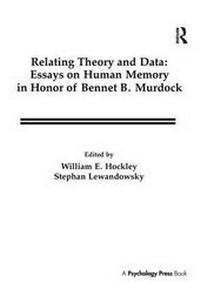
Relating Theory and Data
Essays on Human Memory in Honor of Bennet B. Murdock
Published on 26. August 2016
Book
Paperback/Softback
574 pages
978-1-138-98492-9 (ISBN)
Description
This festschrift represents the proceedings of a conference held in honor of Bennet B. Murdock, one of the foremost researchers and theoreticians on human memory and cognition. A highly renowned investigator respected for both his empirical and theoretical contributions to the field, Murdock summarized and focused a large amount of research activity with his 1974 book Human Memory: Theory and Data. This unique collection of articles addresses many of the issues discussed in his classic text. Divided into five principal sections, its coverage includes: theoretical perspectives on human memory ranging from a biological view to an exposition of the value of formal models; recent progress in the study of processes in immediate memory and recognition memory; and new developments in componential and distributed approaches to the modeling of human memory. Each section concludes with an integrative commentary provided by some of Murdock's eminent colleagues from the University of Toronto. Thus, this book offers a diversity of perspectives on contemporary topics in the discipline, and will be of interest to students and scholars in all branches of cognitive science.
More details
Language
English
Place of publication
London
United Kingdom
Publishing group
Taylor & Francis Ltd
Target group
Professional and scholarly
Dimensions
Height: 229 mm
Width: 152 mm
Weight
1060 gr
ISBN-13
978-1-138-98492-9 (9781138984929)
Copyright in bibliographic data and cover images is held by Nielsen Book Services Limited or by the publishers or by their respective licensors: all rights reserved.
Schweitzer Classification
Other editions
Additional editions
William E. Hockley | Stephan Lewandowsky
Relating Theory and Data
Essays on Human Memory in Honor of Bennet B. Murdock
Book
10/1991
Psychology Press
€234.00
Shipment within 10-20 days
Content
Contents: Part I: Introduction. S. Lewandowsky, W.E. Hockley, Relating Theory and Data: Towards an Integration. Part II: Perspectives on Human Memory. M.C. Corballis, Memory, Growth, Evolution, and Laterality. D.L. Hintzman, Why Are Formal Models Useful in Psychology? L-G. Nilsson, J.M. Gardiner, Memory Theory and the Boundary Conditions of the Tulving-Wiseman Law. E.U. Weber, W.M. Goldstein, J.R. Busemeyer, Beyond Strategies: Implications of Memory Representation and Memory Processes for Models of Judgment and Decision Making. R.S. Lockhart, Varieties of Theoretical Perspectives. Part III: Processes in Immediate Memory. R.G. Crowder, I. Neath, The Microscope Metaphor in Human Memory. A.F. Healy, T.F. Cunningham, A.T. Gesi, R.G. Till, L.E. Bourne, Jr., Comparing Short-Term Recall of Item, Temporal, and Spatial Information in Children and Adults. W.K. Estes, On Types of Item Coding and Source of Recall in Short-Term Memory. A.D. Baddeley, C. Papagno, D. Norris, Phonological Memory and Serial Order: A Sandwich for TODAM. F.I.M. Craik, Peace Pipes Around the TODAM Pole: A Puff for Short-Term Memory. Part IV: Processes in Recognition. G. Mandler, Your Face Looks Familiar but I Can't Remember Your Name: A Review of Dual Process Theory. W.E. Hockley, Recognition Memory for Item and Associative Information: A Comparison of Forgetting Rates. B.A. Dosher, Bias and Discrimination in Cuing of Memory: A Weighted Decisions Model. R. Ratcliff, G. McKoon, Using ROC Data and Priming Results to Test Global Memory Models. N.J. Slamecka, The Analysis of Recognition. Part V: Componential Approaches to Memory. M.S. Humphreys, J.D. Bain, Episodic and Strength Components in Recognition Memory. R.M. Shiffrin, K. Murnane, Composition, Distribution, and Interference in Memory. G.D. Logan, Automaticity and Memory. W. Kintsch, D.M. Welsch, The Construction-Integration Model: A Framework for Studying Memory for Text. E. Tulving, Ben Murdock and Complexity of Memory. Part VI: Distributed Approaches to Memory. J. Metcalfe, Composite Memories. D.J.K. Mewhort, D. Popham, Serial Recall of Tachistoscopic Letter Strings. S. Lewandowsky, Gradual Unlearning and Catastrophic Interference: A Comparison of Distributed Architectures. J.A. Anderson, Why, Having So Many Neurons, Do We Have So Few Thoughts? R.P. Goebel, S. Lewandowsky, Retrieval Measures in Distributed Memory Models.