

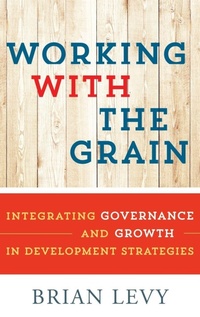
Working with the Grain
Integrating Governance and Growth in Development Strategies
Published on 9. October 2014
Book
Hardback
288 pages
978-0-19-936380-3 (ISBN)
Description
This book builds on cutting-edge scholarship and the author's quarter century of hands-on experience at the World Bank to lay out an innovative with-the-grain approach to integrating governance and growth---as a constructive, hopeful way of engaging the challenging governance ambiguities of our early 21st century world.
A 'with the grain' perspective directs attention away from a 'good governance' pre-occupation with off-the-shelf blueprints and optimal policies, and towards the challenges of initiating and sustaining forward development momentum. This altered angle of vision has powerful implications for how we understand and address the challenges of governance reform and development policymaking---both across countries and over time.
The book distinguishes among four broad groups of countries- according to whether their policies are dominant or competitive, and whether their institutions are personalized or impersonal. It also distinguishes among alternative options for governance reform---'top down' options which aim to strengthen formal institutions, and options which aim to support the emergence of 'islands of effectiveness'. And it explores the 'goodness of fit' between alternative reform options and divergent country contexts---including how narrowly-focused initiatives can achieve results even in a broader sea of institutional dysfunction.
The book examines how, over time, virtuous circles can link inclusive growth, positive expectations and ongoing institutional improvement. Taking the decade-or-so time horizon of practitioners, the aim is to nudge things along---seeking gains that initially may seem quite modest but can, sometimes, give rise to a cascading sequence of change for the better. Sometimes the binding constraint to forward movement can be institutional, making governance reform the priority; at other times, the priority can better be on inclusive growth. Over the longer-run, stability depends also on a broad-based commitment among citizens to the institutional order, as one which offers the hope of a better life for all.
A 'with the grain' perspective directs attention away from a 'good governance' pre-occupation with off-the-shelf blueprints and optimal policies, and towards the challenges of initiating and sustaining forward development momentum. This altered angle of vision has powerful implications for how we understand and address the challenges of governance reform and development policymaking---both across countries and over time.
The book distinguishes among four broad groups of countries- according to whether their policies are dominant or competitive, and whether their institutions are personalized or impersonal. It also distinguishes among alternative options for governance reform---'top down' options which aim to strengthen formal institutions, and options which aim to support the emergence of 'islands of effectiveness'. And it explores the 'goodness of fit' between alternative reform options and divergent country contexts---including how narrowly-focused initiatives can achieve results even in a broader sea of institutional dysfunction.
The book examines how, over time, virtuous circles can link inclusive growth, positive expectations and ongoing institutional improvement. Taking the decade-or-so time horizon of practitioners, the aim is to nudge things along---seeking gains that initially may seem quite modest but can, sometimes, give rise to a cascading sequence of change for the better. Sometimes the binding constraint to forward movement can be institutional, making governance reform the priority; at other times, the priority can better be on inclusive growth. Over the longer-run, stability depends also on a broad-based commitment among citizens to the institutional order, as one which offers the hope of a better life for all.
Reviews / Votes
This is an important and original contribution to growth and development that suggests how to integrate complex parts of the development process. It is a major contribution. * Douglass North, Nobel Laureate in Economic Science, Washington University in St. Louis * If you want to understand how politics, institutions, and policy interact with each other to produce economic success or failure - not over the very long run when we are all dead, but in the shorter run that affects us all - there are few books that pack as much insight as this one. Brian Levy is a practitioner who can theorize as well as any scholar. But the real value added of this book is the practical and pragmatic approach it brings to institutional reform. Dani Rodrik, Albert Hirschman Professor of Social Science, Institute for Advanced Study, Princeton Brian Levy draws on a wealth of experience as a practitioner to provide us with a practical agenda for helping improve the governance of poor countries. His book will be required reading for everyone concerned with the institutional foundations of development. Francis Fukuyama, Olivier Nomellini Senior Fellow, Center on Democracy, Development, and the Rule of Law, Stanford University I finally got to reading Brian Levy's Working With the Grain. It is easily the most underestimated development book of 2014, and should be read alongside William Easterly's Tyranny of Experts (which it both complements and pushes back against). * Ken Opalo, PhD Candidate, Stanford University * Working with the Grain is about getting from the here to there of better governance in developing countries. Building on insights from recent scholarship and practice, this important book eschews recipes in a serious and thought-provoking analysis of how to approach reform initiatives in distinct contexts. * Merilee S. Grindle, Professor of International Development, Kennedy School of Government, and Director, David Rockefeller Center for Latin American Studies, Harvard University *More details
Language
English
Place of publication
New York
United States
Target group
College/higher education
Dimensions
Height: 240 mm
Width: 161 mm
Thickness: 20 mm
Weight
596 gr
ISBN-13
978-0-19-936380-3 (9780199363803)
Copyright in bibliographic data and cover images is held by Nielsen Book Services Limited or by the publishers or by their respective licensors: all rights reserved.
Schweitzer Classification
Other editions
Additional editions
Book
10/2014
Oxford University Press Inc
€70.30
Shipment within 15-20 days
E-Book
08/2014
1st Edition
OUP eBook
€47.49
Available for download
E-Book
08/2014
1st Edition
OUP eBook
€47.49
Available for download
Person
Brian Levy has a sustained track record of both thought leadership and hands-on experience. At the World Bank (where he worked for over two decades), he led the program to scale up support for public sector reform in Africa, and subsequently co-led the effort to mainstream governance and anti-corruption into the organization's operational programs. He has published widely on the interactions between institutions, political economy and development policy. He received his Ph.D in economics from Harvard University in 1983. He currently is on the faculties of the School of Advanced International Studies, Johns Hopkins University, and the University of Cape Town.
Content
Acknowledgements ; Prelude ; Part I: Concepts - a Dynamic Typology ; Chapter 1: The Search for a Useful Development Paradigm ; Chapter 2: Constructing a Typology ; Chapter 3: The Edge of Chaos ; Part II: Countries - the Typology in Action ; Chapter 4: The Dominant Trajectory in Action ; Chapter 5: Personalized Competition in Action ; Chapter 6: Virtuous Circles in Action ; Chapter 7:Patterns of Governance and Growth ; Part III: Addressing Governance Constraints ; Chapter 8: Function versus Form in Public Sector Reform ; Chapter 9: Transparency and Participation - Getting the Fit Right ; Chapter 10: Multi-Stakeholder Governance and the Private Sector ; Part IV: Development Strategies - The Governance Dimension ; Chapter 11: Governance and Development - Deconstructing the Discourse ; Chapter 12: Navigating the Development Knife-Edge ; Bibliography ; Index