

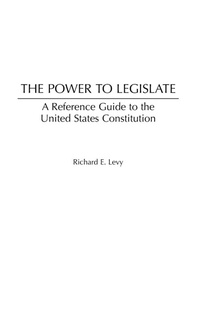
The Power to Legislate
A Guide to the United States Constitution
Published on 1. July 2006
Book
Hardback
238 pages
978-0-313-32284-6 (ISBN)
Description
In a political climate where the machinery of the federal government has grown increasingly complex, The Power to Legislate offers a comprehensive and in-depth analysis of the extent and limitations of legislative power granted by the U. S. Constitution. By examining the historical development of the Constitution as well as judicial precedent set by the Supreme Court, Richard E. Levy develops a systematic account of federal legislative power that is ideal for anyone interested in constitutional history and political science.
Levy focuses his investigation on three distinct, yet related, aspects of federal legislative power: the necessary and proper clause of Article I, the delegation of powers to the various federal institutions, and the deliberative powers of Congress to conduct investigations and interrogations. The Power to Legislate synthesizes these three crucial ideas into a fresh perspective that sheds light on today's controversies.
Levy focuses his investigation on three distinct, yet related, aspects of federal legislative power: the necessary and proper clause of Article I, the delegation of powers to the various federal institutions, and the deliberative powers of Congress to conduct investigations and interrogations. The Power to Legislate synthesizes these three crucial ideas into a fresh perspective that sheds light on today's controversies.
Reviews / Votes
"Levy has written an excellent work that is part of a series on constitutional law and follows a standard arrangement: a brief history of the subtopic, a lengthy analysis of the current state of the law on that topic, a bibliographic essay, a table of cases, and an index. The author focuses on the extent of the power of Congress, particularly the limitations of legislative power granted by the Constitution, as well as judicial precedent set by the Supreme Court. He concentrates on three issues: the legislative authority conferred by the necessary and proper clause of Article 1, the authority of Congress to delegate power to courts and executive agencies, and the power to investigate. Following an introduction, the book is divided into two parts: History of the Federal Legislative Power and Analysis of the Federal Legislative Power. Sections range from The Antebellum Era and The New Deal Crisis and the Demise of Laissez Faire Constitutionalism to Legislative Delegation and Deliberative Powers. Recommended. All levels." - Choice "Levy works on the complex issue of the separation of powers, focusing on the extent of the power of Congress, including the legislative authority conferred by the necessary and proper clause of Article I of the Constitution, the power of the legislature to relegate power to courts and executive agencies, and the power it exercises without explicit authorization in the Constitution, such as the power to investigate. He analyzes the history of federal legislative power from the time of the Articles of Confederation to the new federalism, collective action and federal legislative power, necessary and proper laws such as the ^IMcCulloch^R test, the role of delegation in the separation of powers including the intelligible principle test, and deliberative powers and their external limitations. He includes a table of cases." - Reference & Research Book NewsMore details
Language
English
Place of publication
United States
Publishing group
Bloomsbury Publishing Plc
Target group
College/higher education
Professional and scholarly
Dimensions
Height: 240 mm
Width: 161 mm
Thickness: 18 mm
Weight
531 gr
ISBN-13
978-0-313-32284-6 (9780313322846)
Copyright in bibliographic data and cover images is held by Nielsen Book Services Limited or by the publishers or by their respective licensors: all rights reserved.
Schweitzer Classification
Other editions
Additional editions
E-Book
07/2006
1st Edition
Praeger Publishers Inc
€82.49
Available for download
Person
Richard E. Levy is Professor of Law at the University of Kansas School of Law, where he joined the faculty in 1985. Since joining the faculty at the University of Kansas, Levy has published extensively on issues relating to constitutional law and government institutions and was a Postlewaite Research Fellow from 1996-1999.
Content
SERIES FOREWORD by Jack Stark
FOREWORD by Richard A. Posner
ACKNOWLEDGMENTS
Introduction: Triangulating the Federal Legislative Power
The "Other" Powers of Congress
In Search of the Federal Legislative Power
Notes
Part I: History of the Federal Legislative Power
The Constitutional Transformation of Congress
Congress Under the Articles of Confederation
Congress Under the Constitution
Conclusion
Federal Legislative Power in the Constitutional Order
The Bank Controversy and the Meaning of the Necessary and Proper Clause
Legislative Delegation
Internal Operations of Congress and Inherent Legislative Authority
The Antebellum Era
Dual Sovereignty Theory and Mutual Exclusivity
Inherent Legislative Powers
Constraints on the Deliberative Powers
Conclusion
The Civil War and Reconstruction
Secession and the Sovereignty of States
Reconstruction and Federal Power
Dual Sovereignty and the Scope of the Reconstruction Amendments
Laissez Faire Constitutionalism and Federal Legislative Power
Restricting the Scope of Legislative Power
Legislative Delegations
Deliberative Powers and Laissez Faire Constitutionalism
The New Deal Crisis and the Demise of Laissez Faire Constitutionalism
Reserved Powers, Nondelegation, and the New Deal
The Switch in Time That Saved Nine
Federal Legislative Power as Plenary
Structural Limits in the Era of Plenary Federal Legislative Power
Conclusion
The "New" Federalism and the Future of Federal Legislative Power
The New Federalism and Federal Legislative Power
The No-Commandeering Rule
State Sovereign Immunity
Legislative Delegations and the Rehnquist Court
The State of Federal Legislative Power
Notes
Part II: Analysis of the Federal Legislative Power
Collective Action and the Federal Legislative Power
The Dynamics of Collective Action
Government as Collective Action
The Legislative Power in Collective Action Perspective
Collective Action Among States
Federalism and the Dual Collective
Implications for the Federal Legislative Power
Necessary and Proper Laws
The McCulloch Test and the Enumerated Powers
Overarching Questions
Ends
Appropriate Means
Prohibited Means
Necessary and Proper Laws and the Federal Legislative Power
Legislative Delegation
Delegation and Separation of Powers
The Intelligible Principle Test
Factors Affecting the Intelligible Principle Test
The Nondelegation Doctrine and the Federal Legislative Power
Deliberative Powers
Deliberative Powers and the Deliberative Process
Deliberative Powers in Collective Action Perspective
Intrinsic Limits on Deliberative Powers
External Limitations
Institutional Prerogatives and the Limits of Deliberative Powers
Notes
Conclusion
BIBLIOGRAPHIC ESSAY
TABLE OF CASES
INDEX
FOREWORD by Richard A. Posner
ACKNOWLEDGMENTS
Introduction: Triangulating the Federal Legislative Power
The "Other" Powers of Congress
In Search of the Federal Legislative Power
Notes
Part I: History of the Federal Legislative Power
The Constitutional Transformation of Congress
Congress Under the Articles of Confederation
Congress Under the Constitution
Conclusion
Federal Legislative Power in the Constitutional Order
The Bank Controversy and the Meaning of the Necessary and Proper Clause
Legislative Delegation
Internal Operations of Congress and Inherent Legislative Authority
The Antebellum Era
Dual Sovereignty Theory and Mutual Exclusivity
Inherent Legislative Powers
Constraints on the Deliberative Powers
Conclusion
The Civil War and Reconstruction
Secession and the Sovereignty of States
Reconstruction and Federal Power
Dual Sovereignty and the Scope of the Reconstruction Amendments
Laissez Faire Constitutionalism and Federal Legislative Power
Restricting the Scope of Legislative Power
Legislative Delegations
Deliberative Powers and Laissez Faire Constitutionalism
The New Deal Crisis and the Demise of Laissez Faire Constitutionalism
Reserved Powers, Nondelegation, and the New Deal
The Switch in Time That Saved Nine
Federal Legislative Power as Plenary
Structural Limits in the Era of Plenary Federal Legislative Power
Conclusion
The "New" Federalism and the Future of Federal Legislative Power
The New Federalism and Federal Legislative Power
The No-Commandeering Rule
State Sovereign Immunity
Legislative Delegations and the Rehnquist Court
The State of Federal Legislative Power
Notes
Part II: Analysis of the Federal Legislative Power
Collective Action and the Federal Legislative Power
The Dynamics of Collective Action
Government as Collective Action
The Legislative Power in Collective Action Perspective
Collective Action Among States
Federalism and the Dual Collective
Implications for the Federal Legislative Power
Necessary and Proper Laws
The McCulloch Test and the Enumerated Powers
Overarching Questions
Ends
Appropriate Means
Prohibited Means
Necessary and Proper Laws and the Federal Legislative Power
Legislative Delegation
Delegation and Separation of Powers
The Intelligible Principle Test
Factors Affecting the Intelligible Principle Test
The Nondelegation Doctrine and the Federal Legislative Power
Deliberative Powers
Deliberative Powers and the Deliberative Process
Deliberative Powers in Collective Action Perspective
Intrinsic Limits on Deliberative Powers
External Limitations
Institutional Prerogatives and the Limits of Deliberative Powers
Notes
Conclusion
BIBLIOGRAPHIC ESSAY
TABLE OF CASES
INDEX