

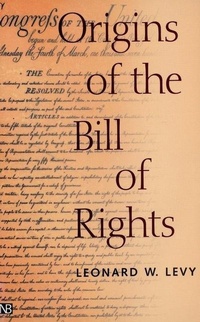
Origins of the Bill of Rights
Published on 8. February 2001
Book
Paperback/Softback
306 pages
978-0-300-08901-1 (ISBN)
Description
Americans resorted to arms in 1775 not to establish new liberties but to defend old ones, explains constitutional historian Leonard W. Levy in this fascinating history of the origins of the Bill of Rights. Unencumbered by a rigid class system, an arbitrary government, or a single established church squelching dissent, colonial Americans understood freedom in a far more comprehensive and liberal way than the English, Levy shows. He offers here a panoramic view of the liberties secured by the first ten amendments to the Constitution-a penetrating analysis of the background of the Bill of Rights the meanings of each provision of the amendments.
In colonial America, political theory, law, and religion all taught that government was limited. Yet the framing and ratification of the Bill of Rights-in effect a bill of restraints upon the national government-was by no means assured. Levy illuminates the behind-the-scenes maneuverings, public rhetoric, and political motivations that led to each provision. The omission of a bill of rights in the original constitution presented the most serious obstacle to its adoption, despite Federalist claims that a bill of rights was unnecessary. Opponents of the Constitution claimed that inclusion of only some liberties-such as the right to habeas corpus and freedom from ex post facto laws-meant that all other liberties would be lost. But, Levy demonstrates, the people of the United States, aided by a persistent James Madison and by traditions of freedom, had the good sense to support both the Constitution and the Bill of Rights.
In colonial America, political theory, law, and religion all taught that government was limited. Yet the framing and ratification of the Bill of Rights-in effect a bill of restraints upon the national government-was by no means assured. Levy illuminates the behind-the-scenes maneuverings, public rhetoric, and political motivations that led to each provision. The omission of a bill of rights in the original constitution presented the most serious obstacle to its adoption, despite Federalist claims that a bill of rights was unnecessary. Opponents of the Constitution claimed that inclusion of only some liberties-such as the right to habeas corpus and freedom from ex post facto laws-meant that all other liberties would be lost. But, Levy demonstrates, the people of the United States, aided by a persistent James Madison and by traditions of freedom, had the good sense to support both the Constitution and the Bill of Rights.
Reviews / Votes
"[Levy's] informative arguments in this important work concern nature and the sources of the Bill of Rights within American democracy, providing understanding for both scholars and citizens. . . . A significant contribution to understanding the Bill of Rights; highly recommended."-Library Journal"Levy's own keen historical account illustrates how legal concepts have changed over time."-Publishers Weekly
"Pulling together a lifetime of scholarship on liberty, Levy offers a vivid account of the various rights and freedoms that Americans care most deeply about."-Akhil Reed Amar, Yale Law School
More details
Series
Edition
Revised edition
Language
English
Place of publication
United States
Target group
College/higher education
Professional and scholarly
Product notice
Paperback (trade)
Illustrations
5 b-w illus.
Dimensions
Height: 197 mm
Width: 127 mm
Thickness: 21 mm
Weight
231 gr
ISBN-13
978-0-300-08901-1 (9780300089011)
Copyright in bibliographic data and cover images is held by Nielsen Book Services Limited or by the publishers or by their respective licensors: all rights reserved.
Schweitzer Classification
Other editions
Additional editions
Leonard W. Levy
Origins of the Bill of Rights
E-Book
10/2008
1st Edition
Yale University Press
€23.95
Available for download
Person
Leonard W. Levy is Mellon Professor Emeritus at the Claremont Graduate School and Distinguished Scholar in Residence at Southern Oregon State College. He is the author of thirty-six books, including Origins of the Fifth Amendment, for which he received a Pulitzer Prize.