

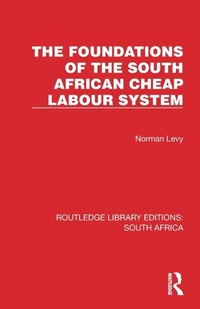
The Foundations of the South African Cheap Labour System
1st Edition
Published on 25. July 2024
Book
Paperback/Softback
368 pages
978-1-032-31158-6 (ISBN)
Description
Originally published in 1982, this was the first in-depth study of the labour system of the South African gold mining industry during the crucial years 1886 to 1906. It provided an insight into the early period but was relevant for much longer, as many of the policies decided upon in the formative years of the industry persisted. The book traces the growth of deep-level mining and covers the conflicts between miners and mine-owners . It discusses the effects on the gold mining industry of the Anglo-Boer War, and the role of the mine-owners in that conflict. It also examines the role of Chinese labour as a strategy in the defence of the labour structure and finally discusses the origins of the racially discriminatory legislation which characterized the Apartheid system.
More details
Series
Language
English
Place of publication
London
United Kingdom
Publishing group
Taylor & Francis Ltd
Target group
College/higher education
General, Postgraduate, and Undergraduate
Dimensions
Height: 216 mm
Width: 140 mm
Thickness: 21 mm
Weight
485 gr
ISBN-13
978-1-032-31158-6 (9781032311586)
Copyright in bibliographic data and cover images is held by Nielsen Book Services Limited or by the publishers or by their respective licensors: all rights reserved.
Schweitzer Classification
Other editions
Additional editions
E-Book
10/2022
1st Edition
Routledge
€41.99
Available for download
E-Book
10/2022
1st Edition
Routledge
€41.99
Available for download
Book
10/2022
1st Edition
Routledge
€171.40
Shipment within 10-20 days
Person
Norman Levy was Head of History at the former Middlesex Polytechnic, UK.
Content
Part 1: The Foundations 1. Calculating the Wage Rate 2. The Black Labour Supply: Early Recruitment and Regulation 3. The Wage Bill: The Agreement of 1890 4. Quasi-official Control: The State and the Chamber of Mines 5. The East Coast Labour Supply: An Alternative Labour Supply 6. Pass Regulations and the Control of Mobility 7. The Formation of a Central Recruiting Organization 8. Manipulating The Wage Rate Part 2: The Randlords' 'Revolution from Above' 9. The Needs of Deep-Level Mining: The Gold Industry and the State 10. The Transition from Boer to British Administration: The Impact of State Intervention Part 3: The Defence of the Labour Structure (1902-6) 11. The Post-War Labour Market 12. The First Defence of the Labour Structure: The Transvaal Labour Commission and the Unskilled Labour Supply 13. The Asian Labour Alternative 14. Racist Legislation and the Introduction of Chinese Labour 15. The Restoration of the Labour Supply.