

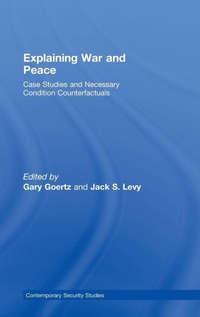
Explaining War and Peace
Case Studies and Necessary Condition Counterfactuals
1st Edition
Published on 14. June 2007
Book
Hardback
362 pages
978-0-415-42232-1 (ISBN)
Description
This edited volume focuses on the use of 'necessary condition counterfactuals' in explaining two key events in twentieth century history, the origins of the First World War and the end of the Cold War.
Containing essays by leading figures in the field, this book analyzes the causal logics of necessary and sufficient conditions, demonstrates the variety of different ways in which necessary condition counterfactuals are used to explain the causes of individual events, and identifies errors commonly made in applying this form of causal logic to individual events. It includes discussions of causal chains, contingency, critical junctures, and 'powder keg' explanations, and the role of necessary conditions in each.
Explaining War and Peace will be of great interest to students of qualitative analysis, the First World War, the Cold War, international history and international relations theory in general.
Containing essays by leading figures in the field, this book analyzes the causal logics of necessary and sufficient conditions, demonstrates the variety of different ways in which necessary condition counterfactuals are used to explain the causes of individual events, and identifies errors commonly made in applying this form of causal logic to individual events. It includes discussions of causal chains, contingency, critical junctures, and 'powder keg' explanations, and the role of necessary conditions in each.
Explaining War and Peace will be of great interest to students of qualitative analysis, the First World War, the Cold War, international history and international relations theory in general.
Reviews / Votes
Giovanni Sartori Award for the Best Book Published in 2007 Developing or Applying Qualitative Methods - Honorable Mention'...an impressive collection of essays that survey the ways in which necessary conditions counterfactuals are used in the logics of causal explanation, particularly in explanations of international conflict. The work represents an important contribution to the study of methods in general and usefully develops some central concepts in qualitative research. The substantive focus also helps to elucidate the more abstract theoretical discussions.'Newsletter of the American Political Science AssociationMore details
Series
Language
English
Place of publication
London
United Kingdom
Publishing group
Taylor & Francis Ltd
Target group
College/higher education
Professional and scholarly
Dimensions
Height: 240 mm
Width: 161 mm
Thickness: 24 mm
Weight
710 gr
ISBN-13
978-0-415-42232-1 (9780415422321)
Copyright in bibliographic data and cover images is held by Nielsen Book Services Limited or by the publishers or by their respective licensors: all rights reserved.
Schweitzer Classification
Other editions
Additional editions
Jack Levy | Gary Goertz
Explaining War and Peace
Case Studies and Necessary Condition Counterfactuals
E-Book
06/2007
Routledge
€77.99
Available for download
Jack Levy | Gary Goertz
Explaining War and Peace
Case Studies and Necessary Condition Counterfactuals
E-Book
06/2007
Routledge
€77.99
Available for download
Jack Levy | Gary Goertz
Explaining War and Peace
Case Studies and Necessary Condition Counterfactuals
Book
06/2007
1st Edition
Routledge
€84.40
Shipment within 15-20 days
Persons
Jack S. Levy is Board of Governors' Professor of Political Science at Rutgers University, President of the International Studies Association (2007-2008), and author of War in the Modern Great Power System 1495-1975. He has also written numerous articles on the causes of war and on decision-making.
Gary Goertz is Professor of Political Science at the University of Arizona. He is the author or co-author of five books and over 25 articles on issues of methodology, international institutions, and conflict studies, including "Necessary Conditions: Theory, Methodology, and Applications," (2003 Rowman & Littlefield) and "Social Science Concepts: A User's Guide" (2006 Princeton University Press).
Gary Goertz is Professor of Political Science at the University of Arizona. He is the author or co-author of five books and over 25 articles on issues of methodology, international institutions, and conflict studies, including "Necessary Conditions: Theory, Methodology, and Applications," (2003 Rowman & Littlefield) and "Social Science Concepts: A User's Guide" (2006 Princeton University Press).
Content
1. Introduction 2. Causal Explanation, Necessary Conditions, and Case Studies 3. The Role of Necessary Conditions in the Outbreak of World War I 4. Contingency, Catalysts and Non-Linear Change: The Origins of World War I 5. Powder Kegs, Sparks and World War I 6. Necessary Conditions and World War I as an Unavoidable War 7. Power, Globalization, and the End of the Cold War: Reevaluating a Landmark Case for Ideas 8. Perestroika without Politics: How Realism Misunderstands the Cold War's End 9. New versus Old Thinking in Qualitative Research 10. Conclusions