

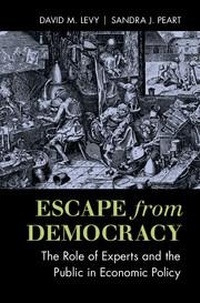
Escape from Democracy
The Role of Experts and the Public in Economic Policy
Published on 24. December 2016
Book
Paperback/Softback
290 pages
978-1-316-50713-1 (ISBN)
Description
The orthodox view of economic policy holds that public deliberation sets the goals or ends, and then experts select the means to implement these goals. This assumes that experts are no more than trustworthy servants of the public interest. David M. Levy and Sandra J. Peart examine the historical record to consider cases in which experts were trusted with disastrous results, such as eugenics, the regulatory use of security ratings, and central economic planning. This history suggests that experts have not only the public interest but also their own interests to consider. The authors then recover and extend an alternative view of economic policy that subjects experts' proposals to further discussion, resulting in transparency and ensuring that the public obtains the best insights of experts in economics while avoiding pitfalls such as expert bias.
Reviews / Votes
'You might think that an age of anticipated global warming is the wrong time to question the popular habit of deference to experts. David M. Levy and Sandra J. Peart argue otherwise in Escape from Democracy, contending that democratic discussion, not hierarchical domination, is the mode appropriate to the public sphere. They trace the eclipse of the democratic tradition in university economics. They illustrate the dangers of runaway authority with two disturbing cases: the eugenics movement, and comparative economics during the Cold War. This is a wise and high-spirited book by two of economics' foremost public intellectuals.' David Warsh, Proprietor of the weekly commentary Economic Principals 'Levy and Peart demonstrate brilliantly the dangers of deferring to experts. When we treat politics like engineering or dentistry we ask the experts to choose for us. This technocratic error is the escape from democracy the authors warn us against. If we are serious about equality, we must be serious about democracy. Theirs is a message - and an analysis - that we, the people, urgently need to hear.' Roger Koppl, Syracuse University 'Levy and Peart are impressively knowledgeable in the primary and secondary classics of history of economics, not to mention statistics, game theory and archival research. They get excited by the subject and have produced an engrossing and relevant volume. As these notes may suggest, their book encourages discussion, even debate.' Joseph Persky, EH.Net 'This is a fascinating and important book ... we have here the beginning of a much-needed and long-overdue conversation.' Charles R. McCann, History of Economic IdeasMore details
Language
English
Place of publication
Cambridge
United Kingdom
Target group
Professional and scholarly
Product notice
Paperback (trade)
Illustrations
13 Tables, black and white; 17 Halftones, color; 15 Halftones, black and white
Dimensions
Height: 228 mm
Width: 151 mm
Thickness: 17 mm
Weight
482 gr
ISBN-13
978-1-316-50713-1 (9781316507131)
Copyright in bibliographic data and cover images is held by Nielsen Book Services Limited or by the publishers or by their respective licensors: all rights reserved.
Schweitzer Classification
Other editions
Additional editions
David M. Levy | Sandra J. Peart
Escape from Democracy
The Role of Experts and the Public in Economic Policy
Book
12/2016
Cambridge University Press
€176.70
Shipment within 15-20 days
Persons
David M. Levy is Professor of Economics at George Mason University, Washington DC. He has worked with Sandra J. Peart at the University of Richmond for fifteen years, and both have co-directed the Summer Institute for the History of Economics and have been honored by the History of Economics Society. Sandra J. Peart is Dean and Professor in the Jepson School of Leadership Studies at the University of Richmond. She is a former president of the History of Economics Society and the president of the International Adam Smith Society.
Content
Acknowledgments; Part I. Introductory Themes: 1. Introduction; Part II. The Discussion Tradition: 2. On 'strongly fortified minds': self-restraint and cooperation in the discussion tradition; 3. The Knightian moment; 4. The rise of new welfare economics: an end to endogenous goals?; Part III. When Linear Models Fail: Two Cases: 5. Experts and eugenics: 'science' privileges a social goal; 6. Expert judgment and Soviet growth; Part IV. An End to Discussion: Secrecy and the Temptation to Bias: 7. Experts and the philosopher's stone: John Law's secret financial alchemy; 8. The consequence of suppressing discussion: imprudence with biased experts; Part V. Getting the Best out of Experts: 9. A revised code of ethics for experts; 10. Mitigating the consequences of factional expertise; 11. Inducing greater transparency; Part VI. Conclusion: 12. Vox populi?