

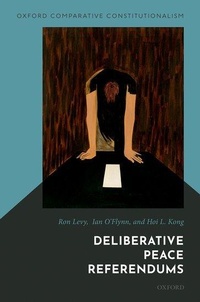
Deliberative Peace Referendums
Published on 25. March 2021
Book
Hardback
244 pages
978-0-19-886703-6 (ISBN)
Description
Peace referendums', which seek to manage conflict between warring groups, are increasingly common. Yet they remain erratic forces-liable as often to aggravate as to resolve tensions. This book argues that, despite their risks, referendums can play useful roles amid armed conflict. Drawing on a distinctive combination of the fields of deliberative democracy, constitutional theory and conflict studies, and relying on comparative examples (eg, from Algeria, Colombia, New Caledonia, Northern Ireland, Papua New Guinea, and South Africa), the book shows how peace referendums can fulfil their promise as genuine tools of conflict management.
Reviews / Votes
Ambitious, precisely argued, comprehensive, and important, Levy, O'Flynn and Kong combine hard-headed realism about the difficulties of deliberating across long-standing and deep divisions in post-conflict contexts (including indigenous-settler relations), with the equally realistic view that the alternatives to deliberative democracy are almost always worse. Their suggestions for 'Deliberative Peace Referendums' provide politically attractive and practical means for generating inclusion, stability, and political legitimacy in post-conflict political transitions. A must-read for deliberative democrats focused on constitution-making as well as for practitioners focused on post-conflict political transitions. * Mark E Warren, Harold and Dorrie Merilees Chair in the Study of Democracy, The University of British Columbia * This impressive book boldly takes deliberative democracy into territory in which it has usually not dared to go. The authors make a strong and nuanced case for the deliberative peace referendum in conflict societies. If properly designed, it has the potential to help produce constitutional settlements that are enduring even in conflict societies racked with controversy about group sovereignty, succession and indigenous settler rights. In the process of presenting their case, the authors make significant contributions to the theory and practice of deliberative democracy, referendums, and peace processes generally. * Dennis F Thompson, Alfred North Whitehead Professor Emeritus Harvard University and author of Just Elections: Creating a Fair Electoral Process in the United States * This ground-breaking study shows how deliberative peace referendums (DPRs) can help find common ground in peace processes - contexts where democratic deliberation is urgently needed and yet hard to succeed. The authors convincingly argue that DPRs can avoid problems of 'ordinary' peace referendums and thus help achieve more sustainable peace settlements. * Maija Setaelae, Professor in Political Science, University of Turku *More details
Series
Language
English
Place of publication
Oxford
United Kingdom
Target group
College/higher education
Product notice
sewn/stitched
Cloth over boards
Dimensions
Height: 239 mm
Width: 157 mm
Thickness: 23 mm
Weight
540 gr
ISBN-13
978-0-19-886703-6 (9780198867036)
Copyright in bibliographic data and cover images is held by Nielsen Book Services Limited or by the publishers or by their respective licensors: all rights reserved.
Schweitzer Classification
Other editions
Additional editions
Ron Levy | Ian O'Flynn | Hoi L. Kong
Deliberative Peace Referendums
E-Book
03/2021
1st Edition
OUP eBook
€69.49
Available for download
Ron Levy | Ian O'Flynn | Hoi L. Kong
Deliberative Peace Referendums
E-Book
03/2021
1st Edition
OUP eBook
€69.49
Available for download
Persons
Ron Levy, Associate Professor of Law, Australian National University College of Law, Ian O'Flynn, Senior Lecturer in Political Theory, Newcastle University, Hoi L. Kong, UBC Professor in Constitutional Law, Peter A. Allard School of Law, University of British Columbia
Author
Associate Professor of LawAssociate Professor of Law, Australian National University College of Law
Senior Lecturer in Political TheorySenior Lecturer in Political Theory, Newcastle University
UBC Professor in Constitutional LawUBC Professor in Constitutional Law, Peter A. Allard School of Law, University of British Columbia
Content
Part I: Introduction 1: Introduction Part II: Foundations 2: Settlement Achievement 3: Designing a Deliberative Peace Referendum 4: Settlement Endurance Part III: Variations 5: Group Sovereignty Conflict 6: Group Secession 7: Indigenous-Settler Conflicts Part IV: Conclusion 8: Conclusion