

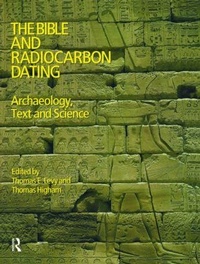
The Bible and Radiocarbon Dating
Archaeology, Text and Science
1st Edition
Published on 1. October 2005
Book
Hardback
464 pages
978-1-84553-056-3 (ISBN)
Description
Over the past several years, a number of Levantine archaeologists working on the Iron Age (ca. 1200 - 586 BCE) have begun to employ high precision radiocarbon dating to solve a wide range of chronological, historical and social issues. The incorporation of high precision radiocarbon dating methods and statistical modelling into the archaeological 'tool box' of the 'Biblical archaeologist' is revolutionizing the field. In fact, Biblical archaeology is leading the field of world archaeology in how archaeologists must deal with history, historical texts, and material culture. A great deal of debate has been generated by this new research direction in southern Levantine (Israel, Jordan, Palestinian territories, southern Lebanon & Syria, the Sinai) archaeology. This book takes the pulse of how archaeology, science-based research methods and the Bible interface at the beginning of the 21st century and brings together a leading team of archaeologists, Egyptologists, Biblical scholars, radiocarbon dating specialists and other researchers who have embraced radiocarbon dating as a significant tool to test hypotheses concerning the historicity of aspects of the Old Testament or Hebrew Bible. As this book "raises the bar" in how archaeologists tackle historical issues as manifest in the interplay between the archaeological record and text, its interest will go well beyond the 'Holy Land.'
More details
Language
English
Place of publication
Sheffield
United Kingdom
Publishing group
Taylor & Francis Ltd
Target group
College/higher education
Product notice
Unsewn / adhesive bound
Paper over boards
Dimensions
Height: 253 mm
Width: 191 mm
Thickness: 32 mm
Weight
1143 gr
ISBN-13
978-1-84553-056-3 (9781845530563)
Copyright in bibliographic data and cover images is held by Nielsen Book Services Limited or by the publishers or by their respective licensors: all rights reserved.
Schweitzer Classification
Other editions
Additional editions
E-Book
12/2014
1st Edition
Routledge
€78.99
Available for download
E-Book
12/2014
1st Edition
Routledge
€78.99
Available for download
Book
10/2005
1st Edition
Equinox Publishing Ltd
€84.00
Shipment within 3-4 weeks
Persons
Thomas E. Levy is Professor of Anthropology and Judaic Studies at the University of California, San Diego (UCSD). Formerly, the Assistant Director of the W.F. Albright Institute of Archaeological Research (one of the American Schools of Oriental Research) and the Nelson Glueck School of Biblical Archaeology of the Hebrew Union College, Jerusalem, he joined the UCSD faculty in 1992 where he has served as Chair of the Department of Anthropology and Director of the Judaic Studies Program. Since 1997 he has been the principal investigator of the Jabal Hamrat Fidan project in southern Jordan. Thomas Higham is Deputy Director of the Oxford Radiocarbon Accelerator Unit, Research Laboratory for Archaeology and the History of Art, Oxford University.
Content
Preface; I. Introduction to the Problems; 1) Radiocarbon Dating and the Iron Age of the Southern Levant: Problems and Potentials for the Oxford Conference - Thomas E. Levy and Thomas Higham; 2) The Debate over the Chronology of the Iron Age in the Southern Levant: Its History, the Current Situation, and a Suggested Resolution - Amihai Mazar; 3) The Low Chronology: Archaeology, History and Bible - Israel Finkelstein; 4) Shishak, King of Egypt: The challenges of Egyptian calendrical chronology - Andrew Shortland; II. Some Methodological Issues; 5) Improving the Resolution of Radiocarbon Dating by Statistical Analysis - Christopher Bronk Ramsey; 6) The Early Iron Age Dating Project: Introduction, Methodology, Progress Report and an Update on the Tel Dor Radiometric Dates - Ilan Sharon, Ayelet Gilboa, Elisabetta Boaretto and A.J. Timothy Jull; III. Jordan in the Iron Age; 7) Lowland Edom and the High and Low Chronologies: Edomite State Formation, the Bible and Recent Archaeological Research in Southern Jordan - Thomas E. Levy, Mohammad Najjar, Johannes van der Plicht, Thomas Higham, and Hendrik J. Bruins; 8) Radiocarbon dating of the Khirbat-en Nahas site (Jordan) and Bayesian Modelling of the Results - Thomas Higham, Johannes van der Plicht, Christopher Bronk Ramsey, Hendrik J. Bruins, Mark Robinson, and Thomas E. Levy; 9) Mesha, the Mishor and the Chronology of Iron Age M DAB - Timothy P. Harrison and Celeste Barlow; IV. Around the Eastern Mediterranean in the Iron Age; 10) Radiocarbon Calibration in the East Mediterranean Region: The East Mediterranean Radiocarbon Comparison Project and the Current State of Play - Sturt W. Manning, Bernd Kromer, Sahra Talamo, Michael Friedrich, Peter Ian Kuniholm and Maryanne W. Newton; 11) A Dendrochronological 14C Wiggle-match for the Early Iron Age of North Greece: A Contribution to the Debate about this Period in the Southern Levant. - Maryanne W. Newton, Peter Ian Kuniholm, and Kenneth A. Wardle; 12) High Precision Dating and Archaeological Chronologies: Revisiting an Old Problem - Sue Sherratt; V. Israel in the Iron Age; 13) Ladder of Time at Tel Rehov: Stratigraphy, Archaeological Context, Pottery and Radiocarbon Dates - Amihai Mazar, Hendrik J. Bruins, Nava Panitz-Cohen and Johannes van der Plicht; 14) Quality Control of Groningen 14C results from Tel Rehov: Repeatability and Intercomparison of Proportional Gas Counting and AMS - Johannes van der Plicht and Hendrik J.Bruins; 15) 14C Results from Megiddo, Tel Dor, Tel Rehov and Tel Hadar: Where do They Lead Us? - Israel Finkelstein and Eli Piasetzky; 16) High or Low: Megiddo and Rehov - Israel Finkelstein; 17) Correlation and Chronology: Samaria and Megiddo Redux - Norma Franklin; 18) Iron-Age 14C Dates from Tel Dan: A High Chronology - Hendrik J. Bruins, Johannes van der Plicht, David Ilan & Ella Werker; 19) Iron I Chronology at Ashkelon: Preliminary Results of the Leon levy Expedition - Daniel Master; 20) Desert Settlement through the Iron Age: Radiocarbon Dates from Sinai and the Negev Highlands - Hendrik J. Bruins and Johannes van der Plicht; VI. Historical Considerations; 21) Stamp-seal amulets and Early Iron Age Chronology - An Update - Stefan Munger; 22) Problems in the Paleographic Dating of Inscriptions - William M. Schniedewind; 23) Some Methodological Reflections on Chronology and History-Writing - William G. Dever; 24) David Did It - Others Did Not: The Creation of Ancient Israel - Baruch Halpern; VII. Conclusion; 25) The view from Mount Nebo - Andrew Sherratt