

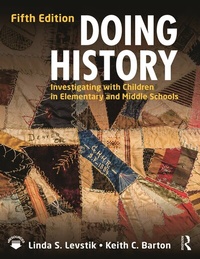
Doing History
Investigating with Children in Elementary and Middle Schools
5th Edition
Published on 23. January 2015
Book
Paperback/Softback
208 pages
978-0-415-73733-3 (ISBN)
Description
Now in its fifth edition, Doing History offers a unique perspective on teaching and learning history in the elementary and middle grades. Through case studies of teachers and students in diverse classrooms and from diverse backgrounds, it shows children engaging in authentic historical investigations, often in the context of an integrated social studies curriculum.
The premise is that children can engage in valid forms of historical inquiry-collecting and analyzing data, examining the perspectives of people in the past, considering multiple interpretations, and creating evidence-based historical accounts. Grounded in contemporary sociocultural theory and research, the text features vignettes in each chapter showing communities of teachers and students doing history in environments rich in literature, art, writing, discussion, and debate. The authors explain how the teaching demonstrated in the vignettes reflects basic principles of contemporary learning theory.
Doing History emphasizes diversity of perspectives in two ways: readers encounter students from a variety of backgrounds, and students themselves look at history from multiple perspectives. It provides clear guidance in using multiple forms of assessment to evaluate the specifically historical aspects of children's learning.
The premise is that children can engage in valid forms of historical inquiry-collecting and analyzing data, examining the perspectives of people in the past, considering multiple interpretations, and creating evidence-based historical accounts. Grounded in contemporary sociocultural theory and research, the text features vignettes in each chapter showing communities of teachers and students doing history in environments rich in literature, art, writing, discussion, and debate. The authors explain how the teaching demonstrated in the vignettes reflects basic principles of contemporary learning theory.
Doing History emphasizes diversity of perspectives in two ways: readers encounter students from a variety of backgrounds, and students themselves look at history from multiple perspectives. It provides clear guidance in using multiple forms of assessment to evaluate the specifically historical aspects of children's learning.
Reviews / Votes
"This book is, bar none, the best collection of ideas on teaching history in meaningful ways to elementary and middle school students. The authors ground engaging teaching examples in relevant theory and draw connections to technology, literature, and the arts. It is a must-have for any history teacher."Christine Woyshner, Temple University, USA
More details
Edition
5th edition
Language
English
Place of publication
London
United Kingdom
Publishing group
Taylor & Francis Ltd
Target group
Professional and scholarly
Dimensions
Height: 280 mm
Width: 210 mm
Weight
517 gr
ISBN-13
978-0-415-73733-3 (9780415737333)
Copyright in bibliographic data and cover images is held by Nielsen Book Services Limited or by the publishers or by their respective licensors: all rights reserved.
Schweitzer Classification
Other editions
New editions
Linda S. Levstik | Keith C. Barton
Doing History
Investigating with Children in Elementary and Middle Schools
Book
09/2022
6th Edition
Routledge
€104.40
Shipment within 10-20 days
Additional editions
Linda S. Levstik | Keith C. Barton
Doing History
Investigating with Children in Elementary and Middle Schools
Book
02/2015
5th Edition
Routledge
€185.70
Article exhausted; check for reprint
Persons
Linda S. Levstik is Professor in the Department of Curriculum and Instruction at the University of Kentucky, USA.
Keith C. Barton is Professor in the Department of Curriculum and Instruction and Adjunct Professor of History at Indiana University, USA.
Keith C. Barton is Professor in the Department of Curriculum and Instruction and Adjunct Professor of History at Indiana University, USA.
Content
Preface
Author Biographies
Chapter 1 Past, Present, and Future: The Sociocultural Context for Studying History
Chapter 2 It's Not Just a Mishap: The Theory Behind Disciplined Inquiry
Chapter 3 There Aren't a Lot of "For Sure" Facts: Building Communities of Historical Inquiry
Chapter 4 To Find Out Things We Didn't Know About Ourselves: Personal Histories
Chapter 5 Tell Me About Yourself: Linking Children to the Past Through Family Histories
Chapter 6 I Think Columbus Went to Hell!: Connections and Controversies in World History
Chapter 7 Camel Dies, Lose Three Turns: Scaffolding Inquiry Into World History
Chapter 8 Rats in the Hospital: Creating a History Museum
Chapter 9 I Have No Experience with This! Historical Inquiry in an Integrated Social Studies Setting
Chapter 10 Why Isn't That in the Textbook? Fiction, Nonfiction, and Historical Thinking
Chapter 11 Oh, Good! We Get to Argue: Putting Conflict in Context
Chapter 12 In My Opinion, It Could Happen Again: How Attitudes and Beliefs Have Changed Over Time
Chapter 13 Nosotros La Gente: Diverse Perspectives in U.S. History
Chapter 14 The Arts Make Us All Part of Humankind: Cognitive Pluralism in History Teaching
and Learning
Epilogue
References
Index
Author Biographies
Chapter 1 Past, Present, and Future: The Sociocultural Context for Studying History
Chapter 2 It's Not Just a Mishap: The Theory Behind Disciplined Inquiry
Chapter 3 There Aren't a Lot of "For Sure" Facts: Building Communities of Historical Inquiry
Chapter 4 To Find Out Things We Didn't Know About Ourselves: Personal Histories
Chapter 5 Tell Me About Yourself: Linking Children to the Past Through Family Histories
Chapter 6 I Think Columbus Went to Hell!: Connections and Controversies in World History
Chapter 7 Camel Dies, Lose Three Turns: Scaffolding Inquiry Into World History
Chapter 8 Rats in the Hospital: Creating a History Museum
Chapter 9 I Have No Experience with This! Historical Inquiry in an Integrated Social Studies Setting
Chapter 10 Why Isn't That in the Textbook? Fiction, Nonfiction, and Historical Thinking
Chapter 11 Oh, Good! We Get to Argue: Putting Conflict in Context
Chapter 12 In My Opinion, It Could Happen Again: How Attitudes and Beliefs Have Changed Over Time
Chapter 13 Nosotros La Gente: Diverse Perspectives in U.S. History
Chapter 14 The Arts Make Us All Part of Humankind: Cognitive Pluralism in History Teaching
and Learning
Epilogue
References
Index