

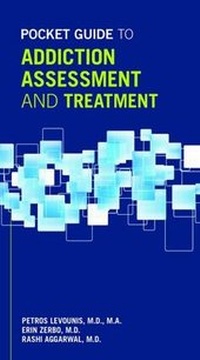
Pocket Guide to Addiction Assessment and Treatment
Will be published approx. on 2. July 2016
Book
Paperback/Softback
380 pages
978-1-58562-512-3 (ISBN)
Description
Ambivalence, poor adherence to treatment, serious
psychiatric and medical comorbidities-the difficulties posed by patients of
substance use disorders are among the most challenging for practitioners to
face. Given that only 10% of patients with these disorders actually receive
specialized addiction treatment, it's clear that physicians in all medical
and surgical specialties need to become comfortable assessing and treating
substance use disorders.
The Pocket Guide to Addiction Assessment
and Treatment is designed specifically to aid a wide range of
clinicians, regardless of their training in addiction, to more confidently
assess and treat this patient population.
The book's practical,
actionable content is divided into three sections-Fundamentals of Addiction,
Substances and Behaviors, and Treatment-that address topics including:
* The neurobiology of addiction
* How to recognize and treat
intoxication, withdrawal from, and addiction to substances such as alcohol,
anabolic-androgenic steroids, benzodiazepines, cannabis, opioids,
stimulants, and tobacco, as well as hallucinogens, inhalants, and
caffeine
* Special issues with psychiatric and medical comorbidities, as
well as with specific populations
* Behavioral addictions, with a
special focus on gambling disorder
* Cognitive-behavioral therapy;
12-step programs; nutrition and exercise; spirituality, mindfulness, and
meditation; and other treatment options, with examples of how each can be
used with patients facing addictions
With an accessible, easily
referenced format, the Pocket Guide to Addiction Assessment and
Treatment serves as a go-to resource for general psychiatrists,
internists, family practitioners, pediatricians, emergency medicine
physicians, psychiatric nurses, residents, medical students, and other
practitioners involved in the addiction treatment field. And because all of
the diagnostic discussions are DSM-5-based, readers can be confident that
they're getting the most relevant and up-to-date guidance on the topic.
psychiatric and medical comorbidities-the difficulties posed by patients of
substance use disorders are among the most challenging for practitioners to
face. Given that only 10% of patients with these disorders actually receive
specialized addiction treatment, it's clear that physicians in all medical
and surgical specialties need to become comfortable assessing and treating
substance use disorders.
The Pocket Guide to Addiction Assessment
and Treatment is designed specifically to aid a wide range of
clinicians, regardless of their training in addiction, to more confidently
assess and treat this patient population.
The book's practical,
actionable content is divided into three sections-Fundamentals of Addiction,
Substances and Behaviors, and Treatment-that address topics including:
* The neurobiology of addiction
* How to recognize and treat
intoxication, withdrawal from, and addiction to substances such as alcohol,
anabolic-androgenic steroids, benzodiazepines, cannabis, opioids,
stimulants, and tobacco, as well as hallucinogens, inhalants, and
caffeine
* Special issues with psychiatric and medical comorbidities, as
well as with specific populations
* Behavioral addictions, with a
special focus on gambling disorder
* Cognitive-behavioral therapy;
12-step programs; nutrition and exercise; spirituality, mindfulness, and
meditation; and other treatment options, with examples of how each can be
used with patients facing addictions
With an accessible, easily
referenced format, the Pocket Guide to Addiction Assessment and
Treatment serves as a go-to resource for general psychiatrists,
internists, family practitioners, pediatricians, emergency medicine
physicians, psychiatric nurses, residents, medical students, and other
practitioners involved in the addiction treatment field. And because all of
the diagnostic discussions are DSM-5-based, readers can be confident that
they're getting the most relevant and up-to-date guidance on the topic.
Reviews / Votes
The editors of this book have in my view achieved most oftheir stated purpose. They have produced a concise yet broad ranging
treatment of the topic of addiction, but it does require readers to have at
least a degree of assumed knowledge. In that regard, one could speculate
that part of their stated target group, medical students and allied health
readers, might find the density of the writing off-putting.
This is a
335-page book which can physically fit in to a back pocket, but other than
the introductory chapters, will lend itself more to use as a reference for
specific topics, and reside on a bookshelf. An Australian readership is
unlikely to find the statistics regarding US drug use patterns and
prevalence of assistance.
Having aired those reservations about the
complete achievement of the editors' ambitions, I would still recommend this
book as a reference, a very useful addition to the medical library of
Australian health practitioners. Its strengths outweigh its limitations. I
would suggest that for medically trained readers its value would be obvious
in emergency departments, detoxification centres, general practice and to
general practice registrars. -- Ken Hazelton, Orange, Australia * Drug and Alcohol Review * This pocket book is one of many such clinical quick
reference guides. It is fairly comprehensive and well organized, making
accessing information easy. It is well suited to the lab coat pocket of
medical students, residents, fellows, and other healthcare providers with
limited knowledge or experience treating this patient population. -- Michael Easton, M.D. * Doody's Book Review *
More details
Language
English
Place of publication
VA
United States
Target group
Professional and scholarly
US School Grade: College Graduate Student and over
Product notice
Paperback (trade)
Illustrations
9 Charts; 5 Figures; 40 Tables, unspecified
Dimensions
Height: 206 mm
Width: 114 mm
Thickness: 20 mm
Weight
312 gr
ISBN-13
978-1-58562-512-3 (9781585625123)
Copyright in bibliographic data and cover images is held by Nielsen Book Services Limited or by the publishers or by their respective licensors: all rights reserved.
Schweitzer Classification
Other editions
Additional editions
Petros Levounis | Erin Zerbo | Rashi Aggarwal
Pocket Guide to Addiction Assessment and Treatment
E-Book
05/2016
1st Edition
American Psychiatric Association Publishing
€50.99
Available for download
Persons
Petros Levounis, M.D., M.A., is Chair of the
Department of Psychiatry at Rutgers New Jersey Medical School, and Chief of
Service at University Hospital in Newark, New Jersey.
Erin Zerbo,
M.D., is Assistant Professor of Psychiatry at Rutgers New Jersey
Medical School in Newark, New Jersey.
Rashi Aggarwal, M.D., is
Associate Professor of Psychiatry at Rutgers New Jersey Medical School in
Newark, New Jersey.
Department of Psychiatry at Rutgers New Jersey Medical School, and Chief of
Service at University Hospital in Newark, New Jersey.
Erin Zerbo,
M.D., is Assistant Professor of Psychiatry at Rutgers New Jersey
Medical School in Newark, New Jersey.
Rashi Aggarwal, M.D., is
Associate Professor of Psychiatry at Rutgers New Jersey Medical School in
Newark, New Jersey.
Content
Contributors
Preface
PART I: Fundamentals of
Addiction
Chapter 1. Neurobiology of Addiction: From Reward to Relief:
The Complex Neuroadaptations Underlying Addiction
Chapter 2. Addiction
Assessment Across Settings of Care: Approaches for the
Twenty-First-Century
Chapter 3. DSM-5 Diagnosis and Toxicology
PART
II: Substances and Behaviors
Chapter 4. Alcohol
Chapter 5.
Anabolic-Androgenic Steroids
Chapter 6. Benzodiazepines
Chapter 7.
Caffeine
Chapter 8. Cannabis
Chapter 9. Hallucinogens and
Dissociative Drugs
Chapter 10. Inhalants
Chapter 11.
Opioids
Chapter 12. Stimulants
Chapter 13. Tobacco
Chapter 14.
Behavioral Addictions: Focus on Gambling Disorder
PART III:
Treatment
Chapter 15. Cognitive-Behavioral Therapy
Chapter 16.
Relapse Prevention
Chapter 17. Motivational Interviewing
Chapter 18.
Twelve-Step Programs and Spirituality
Chapter 19. Mindfulness and
Mentalization
Chapter 20. Diet and Exercise
Index
Preface
PART I: Fundamentals of
Addiction
Chapter 1. Neurobiology of Addiction: From Reward to Relief:
The Complex Neuroadaptations Underlying Addiction
Chapter 2. Addiction
Assessment Across Settings of Care: Approaches for the
Twenty-First-Century
Chapter 3. DSM-5 Diagnosis and Toxicology
PART
II: Substances and Behaviors
Chapter 4. Alcohol
Chapter 5.
Anabolic-Androgenic Steroids
Chapter 6. Benzodiazepines
Chapter 7.
Caffeine
Chapter 8. Cannabis
Chapter 9. Hallucinogens and
Dissociative Drugs
Chapter 10. Inhalants
Chapter 11.
Opioids
Chapter 12. Stimulants
Chapter 13. Tobacco
Chapter 14.
Behavioral Addictions: Focus on Gambling Disorder
PART III:
Treatment
Chapter 15. Cognitive-Behavioral Therapy
Chapter 16.
Relapse Prevention
Chapter 17. Motivational Interviewing
Chapter 18.
Twelve-Step Programs and Spirituality
Chapter 19. Mindfulness and
Mentalization
Chapter 20. Diet and Exercise
Index