

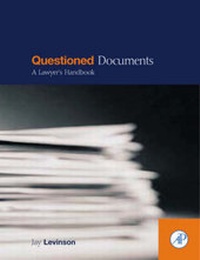
Questioned Documents
A Lawyer's Handbook
Published on 21. September 2000
Book
Hardback
250 pages
978-0-12-445490-3 (ISBN)
Description
Questioned documents are any documents that may be used as evidence in a trial, ranging from handwritten notes to counterfeit currency to contracts. This concise new handbook is designed specifically to aid lawyers involved in cases that involve questioned documents (QD) evidence. It explains the basics of document examination and helps litigators improve the way they present document evidence and question witnesses. It also provides references to professional literature and other legal sources, making it easy to find further information when needed.
Questioned Documents: A Lawyer's Handbook provides analyses applied to many types of investigations and types of documents. It outlines the techniques for determining authenticity, age, ink and paper sources, handwriting identification, equipment used, forgeries, alterations, erasures, and more. In addition to helping the attorneys who mush present the QD evidence and ask the questions, this handbook is also an important resource for the expert witnesses who will be asked those questions at trial.
Questioned Documents: A Lawyer's Handbook provides analyses applied to many types of investigations and types of documents. It outlines the techniques for determining authenticity, age, ink and paper sources, handwriting identification, equipment used, forgeries, alterations, erasures, and more. In addition to helping the attorneys who mush present the QD evidence and ask the questions, this handbook is also an important resource for the expert witnesses who will be asked those questions at trial.
Reviews / Votes
"...a good overview of the many types of examinations conducted by the questioned document examiner."--Danielle P. Seiger, Questioned Document Examiner, Federal Bureau of Investigation
Who would find the book most useful? Well, the title of the book would suggest that the book is mainly meant for lawyers. I am no lawyer; I am a forensic pathologist, and yet I thoroughly enjoyed this book. I would imagine, people like me, who have not been trained in document examination, and yet would like to know something about how documents are compared, would find this book interesting. And this could include forensic pathologists, forensic scientists from other arenas, students, general public and even crime writers who want to weave a story around questioned documents. And for document examiners themselves, this could be a good book not only for recapitulation, but also for sharing some of the author's own experiences. - Internet Journal of Forensic Medicine
More details
Language
English
Place of publication
San Diego
United States
Publishing group
Elsevier Science Publishing Co Inc
Target group
Professional and scholarly
Lawyers, students in law school and forensic document examiners working in law enforcement.
Dimensions
Height: 246 mm
Width: 189 mm
Weight
670 gr
ISBN-13
978-0-12-445490-3 (9780124454903)
Copyright in bibliographic data and cover images is held by Nielsen Book Services Limited or by the publishers or by their respective licensors: all rights reserved.
Schweitzer Classification
Other editions
Additional editions
E-Book
09/2000
Academic Press
€75.95
Available for download
Person
Jay Levinson received his Ph.D. and undergraduate degrees from New York University. From 1972 until 1981 he worked for the U.S. Central Intelligence Agency (CIA) as a document examiner. He is a member of the American Society of Questioned Document Examiners, and was certified as a diplomate by the American Board of Forensic Document Examiners. In 1981 Dr Levinson joined the Israel National Police, first as a document examiner, then as a training officer. He now heads up special projects in the crime laboratory division. Dr Levinson has published more than 80 articles and papers dealing with document examination and forensic science. He has also given instruction in document examination in more than 20 countries and as an invited lecturer at several universities.
Content
1. Introduction
2. Handwriting
3. Typewriters
4. Printers
5. Other Office Machines
6. Cachets & Seals
7. Printing
8. Document Copying
9. Photography
10. Writing Inks and Dyes, Pens and Pencils
11. Paper
12. Erasures, Obliterations and Alterations
13. Office Supplies
14. Fingerprints on Documents
15. Examination Equipment
16. Examples of Materials to be Examined
Appendix I: Courtroom Testimony-Sample Questions
Appendix II: Latin Character Typefont Identification Systems
Appendix III: Arabic Character Typefonts
Appendix IV: Hebrew Character Typefonts
Appendix V: Questioned Document Organizations
Appendix VI: Publications
Index
2. Handwriting
3. Typewriters
4. Printers
5. Other Office Machines
6. Cachets & Seals
7. Printing
8. Document Copying
9. Photography
10. Writing Inks and Dyes, Pens and Pencils
11. Paper
12. Erasures, Obliterations and Alterations
13. Office Supplies
14. Fingerprints on Documents
15. Examination Equipment
16. Examples of Materials to be Examined
Appendix I: Courtroom Testimony-Sample Questions
Appendix II: Latin Character Typefont Identification Systems
Appendix III: Arabic Character Typefonts
Appendix IV: Hebrew Character Typefonts
Appendix V: Questioned Document Organizations
Appendix VI: Publications
Index