

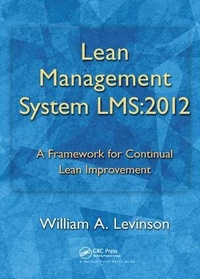
Lean Management System LMS:2012
A Framework for Continual Lean Improvement
1st Edition
Published on 27. July 2017
Book
Hardback
216 pages
978-1-138-43476-9 (ISBN)
Description
The success of a Lean manufacturing program depends far more on organization-wide leverage of Lean manufacturing tools than it does on the tools themselves. To this the organization must add the human relations aspects that earn buy-in and engagement by all members of the workforce, to the extent that workers will react immediately and decisively to the presence of waste.
The synergy of the human and technological aspects of Lean form what Henry Ford called a universal code for the achievement of world-class results in any enterprise, and which he put into practice to deliver unprecedented bottom line results. This book expands upon and systemizes this universal code into a structure or framework that promotes organizational self-audits and continuous improvement.
The book's first section offers a foundation of four simple but comprehensive Lean key performance indicators (KPIs): waste of the time of things (as in cycle time), waste of the time of people, waste of energy, and waste of materials. The Toyota Production System's seven wastes are all measurable in terms of these four KPIs, which also cover the key metrics of Eliyahu Goldratt's theory of constraints: throughput, inventory, and operating expense.
The first section then adds a proactive improvement cycle that sets out to look for trouble by isolating processes for analytical purposes and measuring and then balancing inputs and outputs to force all wastes to become visible. It is in fact technically impossible for any waste of material or energy to hide from what chemical engineers call a material and energy balance. Application of this book's content should therefore satisfy most provisions of the ISO 14001 environmental management system standard and the new ISO 50001 energy management system standard.
The second section consists of an unofficial (and therefore customizable) standard against which the organization
The synergy of the human and technological aspects of Lean form what Henry Ford called a universal code for the achievement of world-class results in any enterprise, and which he put into practice to deliver unprecedented bottom line results. This book expands upon and systemizes this universal code into a structure or framework that promotes organizational self-audits and continuous improvement.
The book's first section offers a foundation of four simple but comprehensive Lean key performance indicators (KPIs): waste of the time of things (as in cycle time), waste of the time of people, waste of energy, and waste of materials. The Toyota Production System's seven wastes are all measurable in terms of these four KPIs, which also cover the key metrics of Eliyahu Goldratt's theory of constraints: throughput, inventory, and operating expense.
The first section then adds a proactive improvement cycle that sets out to look for trouble by isolating processes for analytical purposes and measuring and then balancing inputs and outputs to force all wastes to become visible. It is in fact technically impossible for any waste of material or energy to hide from what chemical engineers call a material and energy balance. Application of this book's content should therefore satisfy most provisions of the ISO 14001 environmental management system standard and the new ISO 50001 energy management system standard.
The second section consists of an unofficial (and therefore customizable) standard against which the organization
More details
Language
English
Place of publication
London
United Kingdom
Publishing group
Taylor & Francis Ltd
Target group
Professional and scholarly
Professional Practice & Development
Dimensions
Height: 254 mm
Width: 178 mm
Weight
453 gr
ISBN-13
978-1-138-43476-9 (9781138434769)
Copyright in bibliographic data and cover images is held by Nielsen Book Services Limited or by the publishers or by their respective licensors: all rights reserved.
Schweitzer Classification
Other editions
Additional editions
E-Book
07/2017
1st Edition
Productivity Press
€52.49
Available for download
E-Book
07/2017
1st Edition
Productivity Press
€52.49
Available for download
Book
08/2012
CRC Press
€58.30
Shipment within 15-20 days
Person
William A. Levinson
Content
Why LMS: 2012? OVERVIEW. The Need for a Lean Management Standard. Lean Key Performance Indicators. Integrated Lean Assessment. LMS: 2012. Lean Management System Requirements. Organizational Responsibility. Lean System Infrastructure and Resources. Product or Service Realization. Measurement and Continual Improvement. DETAILS AND EXPANDED EXPLANATION. Lean Management System (4): Details. Organizational Responsibility (5): Details. Infrastructure and Resources (6): Details. Product or Service Realization (7): Details. Measurement and Continual Improvement (8): Details. Additional Lean Environmental and Energy Practices. Conclusion.