

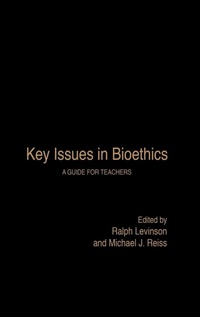
Key Issues in Bioethics
A Guide for Teachers
1st Edition
Published on 27. March 2003
Book
Hardback
200 pages
978-0-415-30914-1 (ISBN)
Description
Young people are increasingly being exposed to the huge and complex ethical dilemmas involved in issues such as genetic modification, animal rights and cloning, and they are bringing their views into the classroom. But how can teachers be sure they are sufficiently well-informed to help their pupils make sense of the diverse and emotive arguments surrounding these issues?
This book holds the answer. Written by leading ethicists, scientists and technologists, it offers a balanced and jargon-free guide to such highly debated topics as:
* cloning
* in vitro fertilisation
* genetic screening and genetic engineering
* farm animal welfare
* the use of animals in medical experiments.
Written specifically for the non-specialist teacher or lecturer, this book offers suggestions on how to approach the teaching of bioethics and provides useful sources of further information. It may also be of interest to undergraduates on science courses.
This book holds the answer. Written by leading ethicists, scientists and technologists, it offers a balanced and jargon-free guide to such highly debated topics as:
* cloning
* in vitro fertilisation
* genetic screening and genetic engineering
* farm animal welfare
* the use of animals in medical experiments.
Written specifically for the non-specialist teacher or lecturer, this book offers suggestions on how to approach the teaching of bioethics and provides useful sources of further information. It may also be of interest to undergraduates on science courses.
Reviews / Votes
'The book succeeds in its aim to allow teachers to be well informed about these complex issues and hence to be confident in running, guiding and supporting work with pupils and helping them to come to views that are well informed and founded on a sound knowledge base. This book is essential reading for all science teachers as the issues involved all feature, to varying degrees, in the curriculum at key stages 3 and 4.' - School Science Review'This is an interesting and thought-provoking book which suggests to teachers how they may frame their discussions on bioethics with students and also provides essays on some of the most relevant issues currently faced by teachers.' - Journal of Biological Education
More details
Language
English
Place of publication
London
United Kingdom
Publishing group
Taylor & Francis Ltd
Target group
College/higher education
Professional and scholarly
Academic, Postgraduate, Professional, and Professional Practice & Development
Illustrations
6 s/w Tabellen
6 Tables, black and white
Dimensions
Height: 240 mm
Width: 161 mm
Thickness: 15 mm
Weight
467 gr
ISBN-13
978-0-415-30914-1 (9780415309141)
Copyright in bibliographic data and cover images is held by Nielsen Book Services Limited or by the publishers or by their respective licensors: all rights reserved.
Schweitzer Classification
Other editions
Additional editions
E-Book
12/2003
Routledge
€68.49
Available for download
E-Book
12/2003
Routledge
€68.49
Available for download
Book
03/2003
Routledge
€74.60
Shipment within 15-20 days
Persons
Ralf Levison is a Lecturer in Science Education at the Institute of Education
Michael Reiss is Professor of Science Education and Head of the School of Mathematics, Science and Technology, Institute of Education
Michael Reiss is Professor of Science Education and Head of the School of Mathematics, Science and Technology, Institute of Education
Content
Part 1 Ethics and education; Chapter 1 Issues and scenarios, Ralph Levinson, Michael J. Reiss; Chapter 2 How we reach ethical conclusions, Michael J. Reiss; Chapter 3 TeachingCloning; Chapter 4 Interview between Professor Ian Wilmut and Ralph Levinson, Ian Wilmut; Chapter 5 Pursuing a rational analysis of cloning, Rebecca Bennett, John Harris; Chapter 6 Cloning? Yuk!, David King; Chapter 7 Clones and cloning, Sarah Franklin; Part 3 In vitro fertilisation; Chapter 8 In vitro fertilisation, Juliet Tizzard; Chapter 9 Surrogacy, Marilyn Strathern; Part 4 Genetic screening; Chapter 10 Genetic testing and screening, Jon Turney; Chapter 11 Genetic screening for sickle cell and thalassaemia, Elizabeth N. Anionwu; Part 5 Genetic engineering of people; Chapter 12 Curing what? Curing when? Curing how?, Bill Albert; Chapter 13 Should we genetically engineer humans?, Michael J. Reiss; Part 6 Farm animal well-being; Chapter 14 Breeding andFarm animal welfare, Joyce D'Silva; Part 7 Animals for medical experiments; Chapter 16 The case for the use of animals in medical experiments, Mark Matfield; Chapter 17 The case against the use of animals in medical experiments, Gill Langley;