


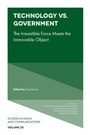
Technology vs. Government
The Irresistible Force Meets the Immovable Object
Published on 19. March 2024
Book
Hardback
280 pages
978-1-83867-952-1 (ISBN)
Description
Governmental entities in the United States have multiple, well publicized failures and challenges when it comes to procuring and integrating new technologies. A quick search will yield a treasure trove of technology procurement and implementation gone wrong. Projects seem to routinely suffer from significant cost overruns, poor fit, and implementation delays. Additionally, while the private sector keeps pace with technology changes and improvements, the government lags behind when it comes to integrating and deploying new technologies.
Technology vs. Government examines why government fails at technology acquisitions, innovation, and implementation, the impact on people, and the future opportunities and implications for government service, administration and policy. Underlying the issues discussed in the book is the question of Generation T, a term coined in this book to define the generation born in 2002 and later. Generation T is the first generation to grow up in a societal technology bubble. Their first response in most situations is to reach for technology. How will they work for and interact with government if government doesn't have the same technology first mindset?
Analyzing the relationship between the government in the US and technological adoption, this volume of Studies in Media and Communications provides lessons and principles that are applicable to governments with western-style democracies or similar forms of administration.
Technology vs. Government examines why government fails at technology acquisitions, innovation, and implementation, the impact on people, and the future opportunities and implications for government service, administration and policy. Underlying the issues discussed in the book is the question of Generation T, a term coined in this book to define the generation born in 2002 and later. Generation T is the first generation to grow up in a societal technology bubble. Their first response in most situations is to reach for technology. How will they work for and interact with government if government doesn't have the same technology first mindset?
Analyzing the relationship between the government in the US and technological adoption, this volume of Studies in Media and Communications provides lessons and principles that are applicable to governments with western-style democracies or similar forms of administration.
Reviews / Votes
An insightful exploration of the interplay between technology and governance, Lloyd Levine's book serves as a guiding beacon for public officials navigating the digital age. Drawing upon real-world examples, Levine astutely unravels the complexities of integrating innovation into the public sector. I find this work not only timely but also indispensable for policy makers striving to ensure a modern, inclusive government for California and across the country. -- Ambassador Eleni Kounalakis, Lieutenant Governor, State of California Lloyd Levine's timely and compelling volume explores the complex relationship between public policy and administration, and the challenging world of government technology. He uses careful analysis and real-world examples to highlight the challenges and opportunities of using modern technology in policy making and government operations. His interdisciplinary approach and combination of research and practical experience make this book a must-read for anyone interested in the future of effective governance in the digital age. -- Anil Deolalikar, Founding Dean Emeritus, UC Riverside School of Public Policy Technology in government has long been thought to be a "back room" function meant to ensure that government runs. That is no longer true. Technology now provides an unprecedented opportunity to revolutionize government from IoT sensors transforming service delivery, to the ability to reach all constituents in a ubiquitous, equitable way. But it will take all of government - from the legislature to the executive branch - to come together to enact the policy and administrative changes to make it happen. This book is a both a blueprint for governments to follow and a cautionary tale of what can happen if they don't. -- Teri Takai, Executive Director, eRepublic Center for Digital Government; Former CIO, US Department of Defense; Former Secretary, California Technology Agency; Former CIO State of Michigan Lloyd Levine and his colleagues have done the essential forensics on why governments so often get digital technology so wrong and why they blow it so often when they try to embrace these technologies. But take heart, because this book provides just the kind of prescriptive insights that policymakers and public administrators can adopt to exploit new, transformative technologies for good and effective purpose. -- Lee Raine, Former Director, Internet & Technology Research at Pew Research CenterMore details
Series
Language
English
Place of publication
Bingley
United Kingdom
Target group
Professional and scholarly
Dimensions
Height: 235 mm
Width: 157 mm
Thickness: 20 mm
Weight
560 gr
ISBN-13
978-1-83867-952-1 (9781838679521)
Copyright in bibliographic data and cover images is held by Nielsen Book Services Limited or by the publishers or by their respective licensors: all rights reserved.
Schweitzer Classification
Other editions
Additional editions
E-Book
03/2024
1st Edition
Emerald Publishing Limited
€105.99
Available for download
Person
Lloyd Levine is a Senior Policy Fellow at the University of California at Riverside School of Public Policy, USA, where he is the co-founder of the Center for Technology, Society and Policy. Levine is a former member of the California State Legislature where he chaired the Assembly Committee on Utilities and Commerce. As a legislator he authored several foundational pieces of legislation relating to broadband, telecommunications, and technology. He served as a member of Governor Arnold Schwarzenegger's Broadband Taskforce, and a founding board member of the California Emerging Technology Fund.
Content
Introduction; Lloyd Levine
Part 1. The Past - How and Why Government's Struggle with Purchasing and Integrating Technology
Chapter 1. Stumbling Blocks: The Structure and Imperatives of Government Agencies Lead to Technology Failures; John Thomas Flynn and Lloyd Levine
Chapter 2. Cybernetic Security and the Failures of Technological Governance in the New York Subway; Noah McClain
Chapter 3. Connect the Whole Community: Leadership Gaps Drive the Digital Divide and Fuel Disaster and Social Vulnerabilities; Catherine Sandoval and Patrick Lanthier
Part 2. The People - An Examination of eGovernment and the Disconnected
Chapter 4. Delivering Information and Services Using eGovernment: A Case study of Digital "Haves" and "Have Nots" using @CDC: Twitter, eGov, and COVID-19; Juliana Maria Trammel, Laura Robinson, and Lloyd Levine
Chapter 5. Health CareWork & Digital Inclusion as Super Social Determinant of Health; Cara A. Chiaraluce and Lloyd Levine
Part 3. The Future - Implications and Opportunities
Chapter 6. India's COVID-19 pandemic aggravates media vs. government tensions: Theorizing media agendamelding in the world's largest democracy; Deb Aikat
Chapter 7. Clearing the Air: Using Collaboration Technology to Build Local Engagement Panels on Air Quality; Kevin M. Esterling and Cesunica E. Ivey
Chapter 8. The Miner of Last Resort: Digital Currency, Shadow Money and the Role of the Central Bank; Graham S. Steele
Afterword; Lloyd Levine
Part 1. The Past - How and Why Government's Struggle with Purchasing and Integrating Technology
Chapter 1. Stumbling Blocks: The Structure and Imperatives of Government Agencies Lead to Technology Failures; John Thomas Flynn and Lloyd Levine
Chapter 2. Cybernetic Security and the Failures of Technological Governance in the New York Subway; Noah McClain
Chapter 3. Connect the Whole Community: Leadership Gaps Drive the Digital Divide and Fuel Disaster and Social Vulnerabilities; Catherine Sandoval and Patrick Lanthier
Part 2. The People - An Examination of eGovernment and the Disconnected
Chapter 4. Delivering Information and Services Using eGovernment: A Case study of Digital "Haves" and "Have Nots" using @CDC: Twitter, eGov, and COVID-19; Juliana Maria Trammel, Laura Robinson, and Lloyd Levine
Chapter 5. Health CareWork & Digital Inclusion as Super Social Determinant of Health; Cara A. Chiaraluce and Lloyd Levine
Part 3. The Future - Implications and Opportunities
Chapter 6. India's COVID-19 pandemic aggravates media vs. government tensions: Theorizing media agendamelding in the world's largest democracy; Deb Aikat
Chapter 7. Clearing the Air: Using Collaboration Technology to Build Local Engagement Panels on Air Quality; Kevin M. Esterling and Cesunica E. Ivey
Chapter 8. The Miner of Last Resort: Digital Currency, Shadow Money and the Role of the Central Bank; Graham S. Steele
Afterword; Lloyd Levine