

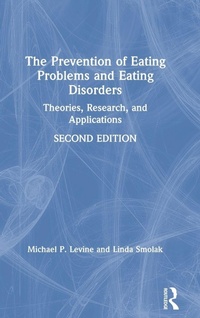
The Prevention of Eating Problems and Eating Disorders
Theories, Research, and Applications
2nd Edition
Published on 16. July 2020
Book
Hardback
460 pages
978-1-138-22509-1 (ISBN)
Description
In a detailed analysis of the field of eating problems and disorders, this book highlights the connections between the prevention of eating problems and disorders, and theory and research in the areas of prevention and health promotion. It also looks at models of risk development and prevention, specific issues and challenges, the status of current prevention research, and lessons for prevention program development.
In this unique text Levine and Smolak draw on a range of interdisciplinary perspectives, including prevention science, developmental psychology, public health, and neuroscience, to provide a thorough review, history, and critique of the topic in light of a range of empirical studies. The only authored volume with a broad, detailed and integrated view of theories, research, and practice, this expanded, fully revised, and updated new edition features new chapters on dissonance-based approaches, public health, biopsychiatry and neuroscience, gender, culture(s), technology, obesity, protective factors, and ecological approaches.
The Prevention of Eating Problems and Eating Disorders: Theories, Research, and Applications is essential reading for clinicians, academics, researchers, graduate students, upper-level undergraduates, and activists and advocates involved in work pertaining to eating disorders, disordered eating, prevention, health promotion, body image, obesity and biopsychosocial perspectives.
In this unique text Levine and Smolak draw on a range of interdisciplinary perspectives, including prevention science, developmental psychology, public health, and neuroscience, to provide a thorough review, history, and critique of the topic in light of a range of empirical studies. The only authored volume with a broad, detailed and integrated view of theories, research, and practice, this expanded, fully revised, and updated new edition features new chapters on dissonance-based approaches, public health, biopsychiatry and neuroscience, gender, culture(s), technology, obesity, protective factors, and ecological approaches.
The Prevention of Eating Problems and Eating Disorders: Theories, Research, and Applications is essential reading for clinicians, academics, researchers, graduate students, upper-level undergraduates, and activists and advocates involved in work pertaining to eating disorders, disordered eating, prevention, health promotion, body image, obesity and biopsychosocial perspectives.
More details
Edition
2nd edition
Language
English
Place of publication
London
United Kingdom
Publishing group
Taylor & Francis Ltd
Target group
Professional and scholarly
Postgraduate, Professional, and Professional Practice & Development
Illustrations
2 s/w Abbildungen, 2 s/w Zeichnungen, 35 s/w Tabellen
35 Tables, black and white; 2 Line drawings, black and white; 2 Illustrations, black and white
Dimensions
Height: 235 mm
Width: 157 mm
Thickness: 30 mm
Weight
834 gr
ISBN-13
978-1-138-22509-1 (9781138225091)
Copyright in bibliographic data and cover images is held by Nielsen Book Services Limited or by the publishers or by their respective licensors: all rights reserved.
Schweitzer Classification
Other editions
Additional editions
Michael P. Levine | Linda Smolak
The Prevention of Eating Problems and Eating Disorders
Theories, Research, and Applications
Book
07/2020
2nd Edition
Routledge
€95.30
Shipment within 10-20 days
Michael P. Levine | Linda Smolak
The Prevention of Eating Problems and Eating Disorders
Theories, Research, and Applications
E-Book
06/2020
2nd Edition
Routledge
€86.99
Available for download
Michael P. Levine | Linda Smolak
The Prevention of Eating Problems and Eating Disorders
Theories, Research, and Applications
E-Book
06/2020
2nd Edition
Routledge
€86.99
Available for download
Previous edition
Michael P. Levine | Linda Smolak
The Prevention of Eating Problems and Eating Disorders
Theory, Research, and Practice
Book
08/2005
1st Edition
Psychology Press
€193.13
Article exhausted; check for reprint
Persons
Michael P. Levine is Emeritus Professor of Psychology at Kenyon College, USA.
Linda Smolak is Emerita Professor of Psychology and Deputy Civil Rights/Title IX Coordinator at Kenyon College, USA.
Linda Smolak is Emerita Professor of Psychology and Deputy Civil Rights/Title IX Coordinator at Kenyon College, USA.
Content
Preface
Part I: INTRODUCTION
Introduction to Prevention
Defining Eating Disorders
Research Methods and Statistical Issues in Prevention
Part II: GUIDES TO PREVENTION: MODELS AND RISK FACTORS
Developmental Psychopathology
Risk Factors as a Guides to Prevention Program Designs
Cognitive and Behavioral Models I - Social Cognitive, Cognitive-Behavioral,
and Mindfulness-Acceptance Approaches
Cognitive and Behavioral Models II -- Dissonance-based Approaches
The Public Health Model
The Feminist-Empowerment Model: A Critical Social Perspective
The Biopsychiatric/Neuroscience Model
Part III: GUIDES TO PREVENTION: SPECIFIC ISSUES AND CHALLENGES
Gender
Culture
Media Literacy
Prevention, the Internet, and Other Forms of Technology
Obesity, Weight Stigma, and Health at Every Size
Protective Factors
Part IV; REVIEW OF PREVENTION RESEARCH
Prevention of Body Image Disturbances and Disordered Eating I: How We Got Here
Prevention of Body Image Disturbances and Disordered Eating II: A Review of the Research Post-2005
Part V: PREVENTION THEORY AND RESEARCH: LESSONS FROM THE FIELD
Program Development
Changing the Ecology
Deciding the Level of Prevention: Universal, Selective, or Targeted
Conclusions and Future Directions
Appendix
References
Part I: INTRODUCTION
Introduction to Prevention
Defining Eating Disorders
Research Methods and Statistical Issues in Prevention
Part II: GUIDES TO PREVENTION: MODELS AND RISK FACTORS
Developmental Psychopathology
Risk Factors as a Guides to Prevention Program Designs
Cognitive and Behavioral Models I - Social Cognitive, Cognitive-Behavioral,
and Mindfulness-Acceptance Approaches
Cognitive and Behavioral Models II -- Dissonance-based Approaches
The Public Health Model
The Feminist-Empowerment Model: A Critical Social Perspective
The Biopsychiatric/Neuroscience Model
Part III: GUIDES TO PREVENTION: SPECIFIC ISSUES AND CHALLENGES
Gender
Culture
Media Literacy
Prevention, the Internet, and Other Forms of Technology
Obesity, Weight Stigma, and Health at Every Size
Protective Factors
Part IV; REVIEW OF PREVENTION RESEARCH
Prevention of Body Image Disturbances and Disordered Eating I: How We Got Here
Prevention of Body Image Disturbances and Disordered Eating II: A Review of the Research Post-2005
Part V: PREVENTION THEORY AND RESEARCH: LESSONS FROM THE FIELD
Program Development
Changing the Ecology
Deciding the Level of Prevention: Universal, Selective, or Targeted
Conclusions and Future Directions
Appendix
References