

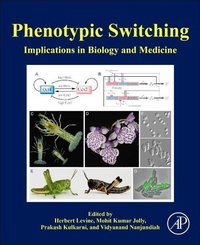
Phenotypic Switching
Implications in Biology and Medicine
Published on 8. June 2020
Book
Paperback/Softback
762 pages
978-0-12-817996-3 (ISBN)
Description
Phenotypic Switching: Implications in Biology and Medicine provides a comprehensive examination of phenotypic switching across biological systems, including underlying mechanisms, evolutionary significance, and its role in biomedical science. Contributions from international leaders discuss conceptual and theoretical aspects of phenotypic plasticity, its influence over biological development, differentiation, biodiversity, and potential applications in cancer therapy, regenerative medicine and stem cell therapy, among other treatments. Chapters discuss fundamental mechanisms of phenotypic switching, including transition states, cell fate decisions, epigenetic factors, stochasticity, protein-based inheritance, specific areas of human development and disease relevance, phenotypic plasticity in melanoma, prostate cancer, breast cancer, non-genetic heterogeneity in cancer, hepatitis C, and more.
This book is essential for active researchers, basic and translational scientists, clinicians, postgraduates and students in genetics, human genomics, pathology, bioinformatics, developmental biology, evolutionary biology and adaptive opportunities in yeast.
This book is essential for active researchers, basic and translational scientists, clinicians, postgraduates and students in genetics, human genomics, pathology, bioinformatics, developmental biology, evolutionary biology and adaptive opportunities in yeast.
Reviews / Votes
"This is a very high-quality book that targets a developing area of biological research and fully fleshes it out thanks to excellent authorship. The volume is intended for a fairly narrow and select audience. It provides a comprehensiveoverview of the field as it stands today." --Doody
More details
Language
English
Place of publication
San Diego
United States
Publishing group
Elsevier Science Publishing Co Inc
Target group
College/higher education
Professional and scholarly
Active researchers, basic and translational scientists, clinicians, postgraduates, and students in the areas of genetics, human genomics, pathology, bioinformatics, developmental biology, evolutionary biology, and pharmaceutical science; medical students, clinical and laboratory genetics trainees (residents and fellows)
Product notice
Paperback (trade)
Unsewn / adhesive bound
Illustrations
Approx. 250 illustrations (200 in full color)
Dimensions
Height: 236 mm
Width: 192 mm
Thickness: 40 mm
Weight
1614 gr
ISBN-13
978-0-12-817996-3 (9780128179963)
Copyright in bibliographic data and cover images is held by Nielsen Book Services Limited or by the publishers or by their respective licensors: all rights reserved.
Schweitzer Classification
Other editions
Additional editions
Herbert Levine | Mohit Kumar Jolly | Prakash Kulkarni
Phenotypic Switching
Implications in Biology and Medicine
E-Book
06/2020
Academic Press
€220.00
Available for download
Persons
Dr. Herbert Levine is Hasselmman Professor in Bioengineering at Rice University. He is also the co-director of Center for Theoretical Biological Physics (CTBP), a National Science Foundation (NSF) Physics Frontier Center devoted to applying concepts and methods from physical sciences to complex biological and biomedical problems. He is also the coordinator of an international research network of researchers in the Physics of Living Systems, under the auspices of the NSF Science Across Virtual Institutes (SAVI) initiative. Dr. Levine did his undergraduate work at MIT, and received his Ph.D. in physics from Princeton University in 1979. After a postdoctoral fellowship at Harvard and a position on the research staff of the corporate research lab of Schlumberger Inc., he was appointed in 1987 to the faculty at the University of California, San Diego. He rose to the ranks of distinguished professor before leaving in 2012 to accept his new post at Rice. He is an elected member of the National Academy of Sciences and a fellow of the American Academy of Arts and Sciences. Dr. Mohit Kumar Jolly obtained his B.Tech. and M. Tech. in Biological Sciences and Bioengineering at IIT Kanpur, India, and his Ph.D. in Bioengineering from Rice University, working at the interface of systems biology and cancer biology. After a short stint as independent postdoctoral fellowship in Computational Cancer Biology, he joined the Centre for BioSystems Science and Engineering at Indian Institute of Science (IISc) Bangalore, as an Assistant Professor. His work focuses on integrating mechanism-based mathematical models with experiments and clinical data to elucidate the mechanisms of cancer metastasis and therapy resistance. He won the 2016 iBiology Young Scientist Seminar Series - a coveted award for communicating one's research to diverse audience. Dr. Prakash Kulkarni is a Research Professor at the City of Hope National Medical Centre. After receiving his PhD in biochemistry from India, he completed his postdoctoral training in cell biology at New York University School of Medicine. He began his independent academic career as an Assistant Professor of urology and oncology at Johns Hopkins University School of Medicine, from where he moved to the protein biophysics laboratory at the Institute for Bioscience & Biotechnology Research at the University of Maryland, prior to taking up is current position. Prior to Johns Hopkins, Dr. Kulkarni held Staff Scientist positions in chemistry and biology at the California Institute of Technology, and in genetics at the Yale University School of Medicine. His main research interests are understanding how conformational dynamics of intrinsically disordered proteins (IDPs) contributes to non-genetic mechanisms underlying disease pathology and heterogeneity in cancer. Dr. Vidyanand Nanjundiah is an Honorary Professor in the Center for Human Genetics, Bengaluru. He earned his BS from the University of Bombay and PhD from the University of Chicago. He held post-doctoral positions at the Hubrecht Laboratorium Utrecht, The Netherlands, Max-Planck-Institut Tubingen, Germany, and Biozentrum, Basel, Switzerland. He began his career as an Assistant Professor and rose to the rank of Professor at the Centre for Theoretical Studies, Indian Institute of Science (IISc), Bangalore. He has been a member of the Molecular Biology Unit, Tata Institute of Fundamental Research Bombay; Department of Molecular Reproduction, Development and Genetics and Centre for Ecological Sciences, Indian Institute of Science, Bangalore; and at Jawaharlal Nehru Centre for Advanced Scientific Research, Bangalore. He is an elected member of the Indian National Science Academy.
Editor
Center for Theoretical Biological Physics and Department of Bioengineering, Rice University, Houston, TX USA
Indian Institute of Science (IISc), Bangalore, India
Research Professor, Department of Medical Oncology & Therapeutics Research, City of Hope National Medical Centre, Duarte, CA, USA
Honorary Professor, Center for Human Genetics, Bengaluru, India and Stellenbosch Institute for Advanced Study (STIAS),
Wallenberg Research Centre at Stellenbosch University, South Africa
Wallenberg Research Centre at Stellenbosch University, South Africa
Content
1. The fundamentals of phenotypic plasticity
2. Rethinking the role of chance in the explanation of cell differentiation
3. Random walk across the epigenetic landscape
4. Maneuvering protein functions and functional levels by structural excursions
5. Prion-mediated phenotypic diversity in fungi
6. Bistability in virus - host interaction networks underlies the succes of hepatitis C treatments
7. Quantifyinh Waddington landscapes, paths, and kinetics of cell fate decision making of differentiation/development
8. The physics of cell fate
9. Disentangling the environmentally induced and stochastic development components of phenotypic variation
10. The evolution of cell differentiation in animals: biomolecular condensates as amplification hubs of inherent cell functions
11. Phenotypic switching and its evolutionary consequences
12. Cell-state organization by exploratory sloppy dynamics
13. Emergence of metabolic heterogeneity in cell populations: lessons from budding yeast
14. Stochastic phenotypic switching in endothelial cell heterogeneity
15. Regulation of phenotypic plasticity from the perspective of evolutionary developmental biology
16. Phenotypic plasticity and the origins of novelty
17. Niche construction and the transition to herbivory: Phenotype switching and the organization of new nutritional modes
18. NAture, nurture, and noise in bird song ontogeny as determinants of phenotypic and functional variation among dialects
19. Domestication as a process generating phenotypic diversity
20. The glycobiology of ovarian cnacer progression: phenotypic switches an microenvironmental influences
21.Epithelia-mesenchymal transition in cancer
22. Phenotypic switching and prostate diseases: a model proposing a causal link benign prostatic hyperplasia and prostate cancer
23. Phenotypic plasticty and lineage switching in prostate cancer
24. Implications of non-genetic heterogeneity in cancer drug resistance and malignant progression
25. Phenotypic plasticity: the emergence of cancer stem cells and collective cell migration
26. Adaptive phenotypic switching in breast cancer in response to matric deprivation
27. Phenotypic instability induced by tissue disuption at the origin of cancer
28. Evolutionary strategies to overcome cancer cell resistance ot treatment
2. Rethinking the role of chance in the explanation of cell differentiation
3. Random walk across the epigenetic landscape
4. Maneuvering protein functions and functional levels by structural excursions
5. Prion-mediated phenotypic diversity in fungi
6. Bistability in virus - host interaction networks underlies the succes of hepatitis C treatments
7. Quantifyinh Waddington landscapes, paths, and kinetics of cell fate decision making of differentiation/development
8. The physics of cell fate
9. Disentangling the environmentally induced and stochastic development components of phenotypic variation
10. The evolution of cell differentiation in animals: biomolecular condensates as amplification hubs of inherent cell functions
11. Phenotypic switching and its evolutionary consequences
12. Cell-state organization by exploratory sloppy dynamics
13. Emergence of metabolic heterogeneity in cell populations: lessons from budding yeast
14. Stochastic phenotypic switching in endothelial cell heterogeneity
15. Regulation of phenotypic plasticity from the perspective of evolutionary developmental biology
16. Phenotypic plasticity and the origins of novelty
17. Niche construction and the transition to herbivory: Phenotype switching and the organization of new nutritional modes
18. NAture, nurture, and noise in bird song ontogeny as determinants of phenotypic and functional variation among dialects
19. Domestication as a process generating phenotypic diversity
20. The glycobiology of ovarian cnacer progression: phenotypic switches an microenvironmental influences
21.Epithelia-mesenchymal transition in cancer
22. Phenotypic switching and prostate diseases: a model proposing a causal link benign prostatic hyperplasia and prostate cancer
23. Phenotypic plasticty and lineage switching in prostate cancer
24. Implications of non-genetic heterogeneity in cancer drug resistance and malignant progression
25. Phenotypic plasticity: the emergence of cancer stem cells and collective cell migration
26. Adaptive phenotypic switching in breast cancer in response to matric deprivation
27. Phenotypic instability induced by tissue disuption at the origin of cancer
28. Evolutionary strategies to overcome cancer cell resistance ot treatment