

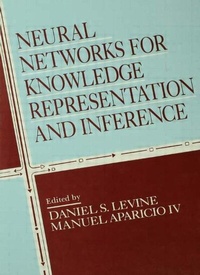
Neural Networks for Knowledge Representation and Inference
1st Edition
Will be published approx. on 1. October 1993
Book
Paperback/Softback
528 pages
978-0-8058-1159-9 (ISBN)
Description
The second published collection based on a conference sponsored by the Metroplex Institute for Neural Dynamics -- the first is Motivation, Emotion, and Goal Direction in Neural Networks (LEA, 1992) -- this book addresses the controversy between symbolicist artificial intelligence and neural network theory. A particular issue is how well neural networks -- well established for statistical pattern matching -- can perform the higher cognitive functions that are more often associated with symbolic approaches. This controversy has a long history, but recently erupted with arguments against the abilities of renewed neural network developments. More broadly than other attempts, the diverse contributions presented here not only address the theory and implementation of artificial neural networks for higher cognitive functions, but also critique the history of assumed epistemologies -- both neural networks and AI -- and include several neurobiological studies of human cognition as a real system to guide the further development of artificial ones.
Organized into four major sections, this volume:
* outlines the history of the AI/neural network controversy, the strengths and weaknesses of both approaches, and shows the various capabilities such as generalization and discreetness as being along a broad but common continuum;
* introduces several explicit, theoretical structures demonstrating the functional equivalences of neurocomputing with the staple objects of computer science and AI, such as sets and graphs;
* shows variants on these types of networks that are applied in a variety of spheres, including reasoning from a geographic database, legal decision making, story comprehension, and performing arithmetic operations;
* discusses knowledge representation process in living organisms, including evidence from experimental psychology, behavioral neurobiology, and electroencephalographic responses to sensory stimuli.
Organized into four major sections, this volume:
* outlines the history of the AI/neural network controversy, the strengths and weaknesses of both approaches, and shows the various capabilities such as generalization and discreetness as being along a broad but common continuum;
* introduces several explicit, theoretical structures demonstrating the functional equivalences of neurocomputing with the staple objects of computer science and AI, such as sets and graphs;
* shows variants on these types of networks that are applied in a variety of spheres, including reasoning from a geographic database, legal decision making, story comprehension, and performing arithmetic operations;
* discusses knowledge representation process in living organisms, including evidence from experimental psychology, behavioral neurobiology, and electroencephalographic responses to sensory stimuli.
Reviews / Votes
"Neural networkers will want to read this collection from cover to cover....wonderful, worthwhile collection."-AI Expert
"...the opening chapter by Aparicio and Levine is a first-rate exposition of the historical roots of the connectionist movement and paradigmatic struggles taking place within traditional interdisciplinary fields of AI and cognitive science....a unique and fascinating collection of applications of neural networks for modeling everyday sorts of reasoning."
-Contemporary Psychology
More details
Language
English
Place of publication
Philadelphia
United States
Publishing group
Taylor & Francis Inc
Target group
College/higher education
Professional and scholarly
Dimensions
Height: 229 mm
Width: 152 mm
Weight
1088 gr
ISBN-13
978-0-8058-1159-9 (9780805811599)
Copyright in bibliographic data and cover images is held by Nielsen Book Services Limited or by the publishers or by their respective licensors: all rights reserved.
Schweitzer Classification
Other editions
Additional editions
Daniel S. Levine | Manuel Aparicio IV
Neural Networks for Knowledge Representation and Inference
E-Book
04/2013
1st Edition
Psychology Press Ltd
€33.99
Available for download
Daniel S. Levine | Manuel Aparicio IV
Neural Networks for Knowledge Representation and Inference
E-Book
04/2013
1st Edition
Psychology Press Ltd
€33.99
Available for download
Daniel S. Levine | Manuel Aparicio IV
Neural Networks for Knowledge Representation and Inference
Book
10/1993
1st Edition
Psychology Press
€69.51
Shipment within 10-20 days
Persons
Daniel S. Levine, Manuel Aparicio IV
Content
Contents: Preface. Part I: Neurons and Symbols: Toward a Reconciliation.M. Aparicio IV, D.S. Levine, Why Are Neural Networks Relevant to Higher Cognitive Function? J.A. Barnden, On Using Analogy to Reconcile Connections and Symbols. S.J. Leven, Semiotics, Meaning, and Discursive Neural Networks. B. MacLennan, Continuous Symbol Systems: The Logic of Connectionism. Part II: Architectures for Knowledge Representation.A. Jagota, Representing Discrete Structures in a Hopfield-Style Network. W.P. Mounfield, Jr., L. Grujic, S. Guddanti, Modeling and Stability Analysis of a Truth Maintenance System Neural Network. G. Pinkas, Propositional Logic, Nonmonotonic Reasoning, and Symmetric Networks -- On Bridging the Gap Between Symbolic and Connectionist Knowledge Representation. T. Jackson, J. Austin, The Representation of Knowledge and Rules in Hierarchical Neural Networks. Part III: Applications of Connectionist Representation.R. Sun, Connectionist Models of Commonsense Reasoning. W.R.P. Raghupathi, D.S. Levine, R.S. Bapi, L.L. Schkade, Toward Connectionist Representation of Legal Knowledge. R.M. Golden, D.M. Rumelhart, J. Strickland, A. Ting, Markov Random Fields for Text Comprehension. J.A. Anderson, K.T. Spoehr, D.J. Bennett, A Study in Numerical Perversity: Teaching Arithmetic to a Neural Network. Part IV: Biological Foundations of Knowledge.G.E. Mobus, Toward A Theory of Learning and Representing Causal Inferences in Neural Networks. K.H. Pribram, Brain and the Structure of Narrative. W.J. Hudspeth, Neuroelectric Eigenstructures of Mental Representation. J.P. Banquet, S. El Ouardirhi, A. Spinakis, M. Smith, W. Guenther, Automatic Versus Controlled Processing in Variable Temporal Context and Stimulus-Response Mapping.