

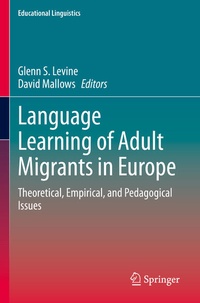
Language Learning of Adult Migrants in Europe
Theoretical, Empirical, and Pedagogical Issues
Published on 4. April 2023
Book
Paperback/Softback
VIII, 257 pages
978-3-030-79239-8 (ISBN)
Description
Glenn S. Levine is Professor of German at the University of California, Irvine. His research focuses on language learning of migrants in Europe, the role of the L1 in L2 learning and teaching, language use during study abroad, and theoretically and empirically informed approaches to language pedagogy and program direction.
David Mallows is an Associate Professor in the Centre for Applied Linguistics at the UCL Institute of Education in London where he is the programme leader for the MA TESOL Pre-service. He has directed national and transnational research projects in adult literacy, language and numeracy, drawing on qualitative and quantitative methods, covering the workplace, teacher education, family literacy, language support and assessment.
David Mallows is an Associate Professor in the Centre for Applied Linguistics at the UCL Institute of Education in London where he is the programme leader for the MA TESOL Pre-service. He has directed national and transnational research projects in adult literacy, language and numeracy, drawing on qualitative and quantitative methods, covering the workplace, teacher education, family literacy, language support and assessment.
More details
Series
Edition
2021 ed.
Language
English
Place of publication
Cham
Switzerland
Publishing group
Springer International Publishing
Target group
Professional and scholarly
Illustrations
1 s/w Abbildung
VIII, 257 p. 1 illus.
Dimensions
Height: 235 mm
Width: 155 mm
Thickness: 14 mm
Weight
460 gr
ISBN-13
978-3-030-79239-8 (9783030792398)
DOI
10.1007/978-3-030-79237-4
Schweitzer Classification
Other editions
Additional editions
Glenn S. Levine | David Mallows
Language Learning of Adult Migrants in Europe
Theoretical, Empirical, and Pedagogical Issues
Book
04/2022
Springer
€160.49
Shipment within 7-9 days
Persons
Glenn S. Levine is Professor of German at the University of California, Irvine. His research focuses on language learning of migrants in Europe, the role of the L1 in L2 learning and teaching, language use during study abroad, and theoretically and empirically informed approaches to language pedagogy and program direction.
David Mallows is an Associate Professor in the Centre for Applied Linguistics at the UCL Institute of Education in London where he is the programme leader for the MA TESOL Pre-service. He has directed national and transnational research projects in adult literacy, language and numeracy, drawing on qualitative and quantitative methods, covering the workplace, teacher education, family literacy, language support and assessment.
David Mallows is an Associate Professor in the Centre for Applied Linguistics at the UCL Institute of Education in London where he is the programme leader for the MA TESOL Pre-service. He has directed national and transnational research projects in adult literacy, language and numeracy, drawing on qualitative and quantitative methods, covering the workplace, teacher education, family literacy, language support and assessment.
Content
Preface.- Introduction.- Part I: Language Socialisation.- Migrant Mothers' Stories of Learning Language in Everyday Life; Minna Intke Hernández.- How Can We Better Support Refugee Families in Scotland through an Ecological, Multilingual Approach to Language Learning? Sara Cox.- On having 'a language that is no language, really': Language ideological attributions in a Dutch as L2 classroom for asylum seekers; Massimiliano Spotti.- Teaching the Hegemonic Language: Between "Enabling Violence" and "Paternalistic Benevolence"; Alisha M.B. Heinemann.- Part II: System.- Language Learning of Migrants: Empirical Evidence from the German Integration Course System; Anke Grotlüschen, Jana Wienberg, and Gregor Dutz.- Germany's Integration Courses: Sociolinguistic Composition and Language Learning Outcomes; Ibrahim Cindark, David Huenlich & Michaela Perlmann.- On How Refugees Acquire German: The Case of the Integration Course in Germany; Nina Rother, Anna Wieczorek, Giuseppe Pietrantuono, Johannes Croisier, Andreea Baier, and Lars Ninke.- Part III: Language and the Curriculum.- New Migrants, New Challenges? Activating Multilingual Resources for Understanding Mathematics: Institutional and Interactional Requirements; Arne Krause, Jonas Wagner, Meryem C¸elikkol, Angelika Redder, and Susanne Prediger.- After the Big Wave: Language Learning of Refugee University Students in Germany; Sandra McGury.- Part IV: Practice.- Digital Literacy Practices in the Adult L2 Classroom: The Case of Basic Literacy Education in Swedish; Annika Norlund Shaswar.- 'Wie soll ich das Kind bewerten?' German Teachers between Standardization and Differentiation in the Assessment of Refugee Students: A Qualitative Study; Sílvia Melo-Pfeifer and Mara Thölkes.- Part V: Identity.- Religion, Identity and Investment in Adult Migrants' English Language Learning in the UK; Amina Al-Dhaif, Graham Hall, and Rola Naeb.- Lessons for Today from Successful Women: Adult-Refugee Background Women from the former Yugoslavia Narrate Their Language Learning Stories; Vesna Busic, Kirk P.H. Sullivan and Christian Waldmann.- 'Nothing Enters in The Brain': When Asylum Seekers Talk about Language Learning in Mental Health Consultations; Vanessa Piccoli.