

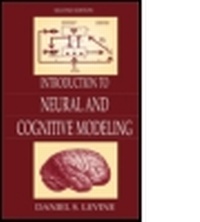
Introduction to Neural and Cognitive Modeling
2nd Edition
Published on 1. February 2000
Book
Hardback
512 pages
978-0-8058-2005-8 (ISBN)
Description
This thoroughly, thoughtfully revised edition of a very successful textbook makes the principles and the details of neural network modeling accessible to cognitive scientists of all varieties as well as to others interested in these models. Research since the publication of the first edition has been systematically incorporated into a framework of proven pedagogical value.
Features of the second edition include:
* A new section on spatiotemporal pattern processing
* Coverage of ARTMAP networks (the supervised version of adaptive resonance networks) and recurrent back-propagation networks
* A vastly expanded section on models of specific brain areas, such as the cerebellum, hippocampus, basal ganglia, and visual and motor cortex
* Up-to-date coverage of applications of neural networks in areas such as combinatorial optimization and knowledge representation
As in the first edition, the text includes extensive introductions to neuroscience and to differential and difference equations as appendices for students without the requisite background in these areas. As graphically revealed in the flowchart in the front of the book, the text begins with simpler processes and builds up to more complex multilevel functional systems.
For more information visit the author's personal Web site at www.uta.edu/psychology/faculty/levine/
Features of the second edition include:
* A new section on spatiotemporal pattern processing
* Coverage of ARTMAP networks (the supervised version of adaptive resonance networks) and recurrent back-propagation networks
* A vastly expanded section on models of specific brain areas, such as the cerebellum, hippocampus, basal ganglia, and visual and motor cortex
* Up-to-date coverage of applications of neural networks in areas such as combinatorial optimization and knowledge representation
As in the first edition, the text includes extensive introductions to neuroscience and to differential and difference equations as appendices for students without the requisite background in these areas. As graphically revealed in the flowchart in the front of the book, the text begins with simpler processes and builds up to more complex multilevel functional systems.
For more information visit the author's personal Web site at www.uta.edu/psychology/faculty/levine/
More details
Edition
2nd New edition
Language
English
Place of publication
Mahwah
United States
Publishing group
Taylor & Francis Inc
Target group
College/higher education
Professional and scholarly
Edition type
New edition
Dimensions
Height: 229 mm
Width: 152 mm
Weight
953 gr
ISBN-13
978-0-8058-2005-8 (9780805820058)
Copyright in bibliographic data and cover images is held by Nielsen Book Services Limited or by the publishers or by their respective licensors: all rights reserved.
Schweitzer Classification
Other editions
New editions

Book
10/2018
3rd Edition
Routledge
€208.10
Shipment within 3-4 weeks
Additional editions
Daniel S. Levine
Introduction to Neural and Cognitive Modeling
Book
02/2000
2nd Edition
Psychology Press
€85.60
Article exhausted; check for reprint

Daniel S. Levine
Introduction to Neural and Cognitive Modeling
E-Book
02/2000
2nd Edition
Psychology Press
€103.79
Available for download
Previous edition

Daniel S. Levine
Introduction to Neural and Cognitive Modeling
Book
08/1991
Lawrence Erlbaum Associates Inc
€94.22
Article exhausted; check for reprint
Person
Content
Contents: Preface. Preface to the Second Edition. Brain and Machine: The Same Principles? Historical Outline. Associative Learning and Synaptic Plasticity. Competition, Lateral Inhibition, and Short-Term Memory. Conditioning, Attention, and Reinforcement. Coding and Categorization. Optimization, Control, Decision, and Knowledge Representation. A Few Recent Technical Advances. Appendices: Basic Facts of Neurobiology. Difference and Differential Equations in Neural Networks.