

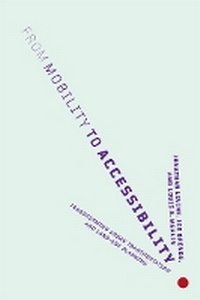
From Mobility to Accessibility
Transforming Urban Transportation and Land-Use Planning
Published on 15. November 2019
Book
Hardback
240 pages
978-1-5017-1607-2 (ISBN)
Description
Levine, Grengs, and Merlin marshal a compelling case to shift to accessibility-oriented planning, providing much needed conceptual clarity as to what accessibility is and is not. But their book also represents a major step toward transforming accessibility from a vaguely defined aspiration into concrete measures that can guide planning decisions. a* Journal of the American Planning Association
In From Mobility to Accessibility, an expert team of researchers flips the tables on the standard models for evaluating regional transportation performance. Jonathan Levine, Joe Grengs, and Louis A. Merlin argue for an "accessibility shift" whereby transportation planning, and the transportation dimensions of land-use planning, would be based on people's ability to reach destinations, rather than on their ability to travel fast.
Existing models for planning and evaluating transportation, which have taken vehicle speeds as the most important measure, would make sense if movement were the purpose of transportation. But it is the ability to reach destinations, not movement per se, that people seek from their transportation systems. While the concept of accessibility has been around for the better part of a century, From Mobility to Accessibility shows that the accessibility shift is compelled by the fundamental purpose of transportation. The book argues that the shift would be transformative to the practice of both transportation and land-use planning but is impeded by many conceptual obstacles regarding the nature of accessibility and its potential for guiding development of the built environment. By redefining success in transportation, the book provides city planners, decisionmakers, and scholars a path to reforming the practice of transportation and land-use planning in modern cities and metropolitan areas.
In From Mobility to Accessibility, an expert team of researchers flips the tables on the standard models for evaluating regional transportation performance. Jonathan Levine, Joe Grengs, and Louis A. Merlin argue for an "accessibility shift" whereby transportation planning, and the transportation dimensions of land-use planning, would be based on people's ability to reach destinations, rather than on their ability to travel fast.
Existing models for planning and evaluating transportation, which have taken vehicle speeds as the most important measure, would make sense if movement were the purpose of transportation. But it is the ability to reach destinations, not movement per se, that people seek from their transportation systems. While the concept of accessibility has been around for the better part of a century, From Mobility to Accessibility shows that the accessibility shift is compelled by the fundamental purpose of transportation. The book argues that the shift would be transformative to the practice of both transportation and land-use planning but is impeded by many conceptual obstacles regarding the nature of accessibility and its potential for guiding development of the built environment. By redefining success in transportation, the book provides city planners, decisionmakers, and scholars a path to reforming the practice of transportation and land-use planning in modern cities and metropolitan areas.
Reviews / Votes
Levine, Grengs, and Merlin marshal a compelling case to shift to accessibility-oriented planning, providing much needed conceptual clarity as to what accessibility is and is not. But their book also represents a major step toward transforming accessibility from a vaguely defined aspiration into concrete measures that can guide planning decisions.(Journal of the American Planning Association)
More details
Language
English
Place of publication
Ithaca
United States
Product notice
Paper over boards
Illustrations
4 maps, 25 charts - 4 Maps - 25 Charts
Dimensions
Height: 229 mm
Width: 152 mm
Thickness: 24 mm
Weight
907 gr
ISBN-13
978-1-5017-1607-2 (9781501716072)
Copyright in bibliographic data and cover images is held by Nielsen Book Services Limited or by the publishers or by their respective licensors: all rights reserved.
Schweitzer Classification
Other editions
Additional editions
Jonathan Levine | Joe Grengs | Louis A. Merlin
From Mobility to Accessibility
Transforming Urban Transportation and Land-Use Planning
E-Book
11/2019
Cornell University Press
€29.99
Available for download
Persons
Jonathan Levine researches and teaches transportation and land-use planning at the University of Michigan. He is the author of Zoned Out.
Joe Grengs is Chair and Associate Professor in Urban and Regional Planning at the University of Michigan.
Louis A. Merlin is an Assistant Professor in the School of Urban and Regional Planning at Florida Atlantic University. With previous degrees in Mathematics and Operations Research, Dr. Merlin's research specializes in the application of innovative quantitative methods to transportation and land use systems.
Joe Grengs is Chair and Associate Professor in Urban and Regional Planning at the University of Michigan.
Louis A. Merlin is an Assistant Professor in the School of Urban and Regional Planning at Florida Atlantic University. With previous degrees in Mathematics and Operations Research, Dr. Merlin's research specializes in the application of innovative quantitative methods to transportation and land use systems.
Content
Acknowledgments
List of Abbreviations
Introduction: The Accessibility Shift
1. What Is Transportation For?
2. Evolution of the Accessibility Concept
3. Accessibility in Everyday Planning
4. Accessibility and Urban Form
5. The Special Case of Public-Transport Accessibility
6. Accessibility in Social-Equity Evaluation
7. Nonwork Accessibility
Conclusion: Envisioning the Accessibility Shift
List of Abbreviations
Introduction: The Accessibility Shift
1. What Is Transportation For?
2. Evolution of the Accessibility Concept
3. Accessibility in Everyday Planning
4. Accessibility and Urban Form
5. The Special Case of Public-Transport Accessibility
6. Accessibility in Social-Equity Evaluation
7. Nonwork Accessibility
Conclusion: Envisioning the Accessibility Shift