

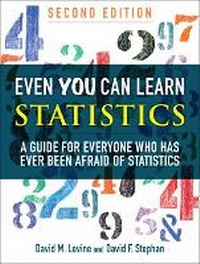
Even You Can Learn Statistics
A Guide for Everyone Who Has Ever Been Afraid of Statistics
2nd Edition
Published on 17. September 2009
Book
Paperback/Softback
384 pages
978-0-13-701059-2 (ISBN)
Description
Even You Can Learn Statistics: A Guide for Everyone Who Has Ever Been Afraid of Statisticsi s a practical, up-to-date introduction to statistics-for everyone! Thought you couldn't learn statistics? You can-and you will! One easy step at a time, this fully updated book teaches you all the statistical techniques you'll need for finance, quality, marketing, the social sciences, or anything else! Simple jargon-free explanations help you understand every technique. Practical examples and worked-out problems give you hands-on practice. Special sections present detailed instructions for developing statistical answers, using spreadsheet programs or any TI-83/TI-84 compatible calculator. This edition delivers new examples, more detailed problems and sample solutions, plus an all-new chapter on powerful multiple regression techniques. Hate math? No sweat. You'll be amazed at how little you need. Like math? Optional "Equation Blackboard" sections reveal the mathematical foundations of statistics right before your eyes! You'll learn how to:
* Construct and interpret statistical charts and tables with Excel or OpenOffice.org Calc 3
* Work with mean, median, mode, standard deviation, Z scores, skewness, and other descriptive statistics
* Use probability and probability distributions
* Work with sampling distributions and confidence intervals
* Test hypotheses with Z, t, chi-square, ANOVA, and other techniques
* Perform powerful regression analysis and modeling
* Use multiple regression to develop models that contain several independent variables
* Master specific statistical techniques for quality and Six Sigma programs
About the Web Site
Download practice files, templates, data sets, and sample spreadsheet models-including ready-to-use solutions for your own work! www.ftpress.com/youcanlearnstatistics2e
* Construct and interpret statistical charts and tables with Excel or OpenOffice.org Calc 3
* Work with mean, median, mode, standard deviation, Z scores, skewness, and other descriptive statistics
* Use probability and probability distributions
* Work with sampling distributions and confidence intervals
* Test hypotheses with Z, t, chi-square, ANOVA, and other techniques
* Perform powerful regression analysis and modeling
* Use multiple regression to develop models that contain several independent variables
* Master specific statistical techniques for quality and Six Sigma programs
About the Web Site
Download practice files, templates, data sets, and sample spreadsheet models-including ready-to-use solutions for your own work! www.ftpress.com/youcanlearnstatistics2e
More details
Edition
2nd edition
Language
English
Place of publication
Upper Saddle River
United States
Publishing group
Pearson Education (US)
Target group
College/higher education
Professional and scholarly
Dimensions
Height: 232 mm
Width: 179 mm
Thickness: 27 mm
Weight
750 gr
ISBN-13
978-0-13-701059-2 (9780137010592)
Copyright in bibliographic data and cover images is held by Nielsen Book Services Limited or by the publishers or by their respective licensors: all rights reserved.
Schweitzer Classification
Other editions
New editions
David Levine | David Stephan
Even You Can Learn Statistics and Analytics
An Easy to Understand Guide to Statistics and Analytics
Book
05/2015
3rd Edition
Pearson FT Press
€32.18
Shipment within 15-20 days
Previous edition
David M. Levine | David F. Stephan
Even You Can Learn Statistics
A Guide for Everyone Who Has Ever Been Afraid of Statistics
Book
09/2004
Financial TImes Prentice Hall
€22.27
Article exhausted; check for reprint
Persons
David M. Levine, a much-honored innovator in statistics education, is Professor Emeritus of Statistics and Computer Information Systems at Baruch College (CUNY). His bestselling books include Statistics for Managers Using Microsoft Excel, Basic Business Statistics, Business Statistics: A First Course, Statistics for Six Sigma Green Belts with Minitab and JMP, Six Sigma for Green Belts and Champions, and Design for Six Sigma for Green Belts and Champions.
David F. Stephan is an independent instructional technologist. As a computer information systems instructor at Baruch College (CUNY), he pioneered the use of computers in classrooms, devised interdisciplinary multimedia tools, and created techniques for teaching computer applications in a business context. The developer of PHStat2, the Pearson Education statistics add-in system for Microsoft Excel, he has coauthored several books with David M. Levine.
David F. Stephan is an independent instructional technologist. As a computer information systems instructor at Baruch College (CUNY), he pioneered the use of computers in classrooms, devised interdisciplinary multimedia tools, and created techniques for teaching computer applications in a business context. The developer of PHStat2, the Pearson Education statistics add-in system for Microsoft Excel, he has coauthored several books with David M. Levine.
Content
Acknowledgments. . . . . viii
About the Authors . . . . . ix
Introduction The Even You Can Learn Statistics Owners Manual. . . . xi
Chapter 1 Fundamentals of Statistics . . . . . 1
1.1 The First Three Words of Statistics. . . . . . . 2
1.2 The Fourth and Fifth Words . . . . 4
1.3 The Branches of Statistics . . . . . 5
1.4 Sources of Data . . . . . 6
1.5 Sampling Concepts . . . . 7
1.6 Sample Selection Methods. . . . . 9
Chapter 2 Presenting Data in Charts and Tables. . . . . 19
2.1 Presenting Categorical Variables. . . . . . 19
2.2 Presenting Numerical Variables. . . . .. 26
2.3 Misusing Charts. . . . . 32
Chapter 3 Descriptive Statistics . . . . 43
3.1 Measures of Central Tendency . . . . 43
3.2 Measures of Position. . . . . 47
3.3 Measures of Variation. . . . . . 51
3.4 Shape of Distributions . . . . . 57
Chapter 4 Probability . . . . . . 71
4.1 Events. . . . . . 71
4.2 More Definitions . . . . . . 72
4.3 Some Rules of Probability . . . . . 74
4.4 Assigning Probabilities . . . . 77
Chapter 5 Probability Distributions . . . . 83
5.1 Probability Distributions for Discrete Variables . . .. . 83
5.2 The Binomial and Poisson Probability Distributions. . . . 89
5.3 Continuous Probability Distributions and the Normal Distribution . . . 97
5.4 The Normal Probability Plot. . . . . 105
Chapter 6 Sampling Distributions and Confidence Intervals . . . . 119
6.1 Sampling Distributions. . . . . . . 119
6.2 Sampling Error and Confidence Intervals. . . . . . 123
6.3 Confidence Interval Estimate for the Mean Using the t Distribution (o Unknown) . . . . . 127
6.4 Confidence Interval Estimation for Categorical Variables. .. . . 131
Chapter 7 Fundamentals of Hypothesis Testing . . . 141
7.1 The Null and Alternative Hypotheses. . . . . . 141
7.2 Hypothesis Testing Issues . . . . . 143
7.3 Decision-Making Risks . . . . . . . 145
7.4 Performing Hypothesis Testing . . . . . 147
7.5 Types of Hypothesis Tests . . . . 148
Chapter 8 Hypothesis Testing: Z and t Tests . . . . 153
8.1 Testing for the Difference Between Two Proportions. . . . . . 153
8.2 Testing for the Difference Between the Means of Two Independent Groups .. . . . . . 160
8.3 The Paired t Test . . . . . 166
Chapter 9 Hypothesis Testing: Chi-Square Tests and the One-Way Analysis of Variance (ANOVA). . . . . .179
9.1 Chi-Square Test for Two-Way Cross-Classification Tables . . . . . 179
9.2 One-Way Analysis of Variance (ANOVA): Testing for the Differences Among the Means of More Than Two Groups . . . . 186
Chapter 10 Simple Linear Regression . . . . . ..207
10.1 Basics of Regression Analysis . . . . . . . 208
10.2 Determining the Simple Linear Regression Equation . . . . . . 209
10.3 Measures of Variation . . . . . . 217
10.4 Regression Assumptions. . . . . . . . . 222
10.5 Residual Analysis. . . . . . .223
10.6 Inferences About the Slope. . . . . 225
10.7 Common Mistakes Using Regression Analysis . . . . . 228
Chapter 11 Multiple Regression . . . . . ..245
11.1 The Multiple Regression Model . . . . . 245
11.2 Coefficient of Multiple Determination. . . . . . 248
11.3 The Overall F test. . . . . . . 249
11.4 Residual Analysis for the Multiple Regression Model . . . . . . 250
11.5 Inferences Concerning the Population Regression Coefficients . . . . 251
Chapter 12 Quality and Six Sigma Applications of Statistics . . . . 265
12.1 Total Quality Management . . . . . 265
12.2 Six Sigma. . . . . . . 267
12.3 Control Charts . . . . . 268
12.4 The p Chart. . . . . . .271
12.5 The Parable of the Red Bead Experiment: Understanding Process Variability . . . . . . . . 276
12.6 Variables Control Charts for the Mean and Range . . . . . 278
Appendix A Calculator and Spreadsheet Operation and Configuration . . . . ..295
A.C1 Calculator Operation Conventions ...... 295
A.C2 Calculator Technical Configuration ...... 297
A.C3 Using the A2MULREG Program ...... 298
A.C4 Using TI Connect ...... 298
A.S1 Spreadsheet Operation Conventions ..... 299
A.S2 Spreadsheet Technical Configurations..... 299
Appendix B Review of Arithmetic and Algebra . . . . .301
Assessment Quiz . . . . . . 301
Symbols. . . . . 304
Answers to Quiz. . . . . . . 310
Appendix C Statistical Tables . . . 311
Appendix D Spreadsheet Tips. . . . . . ..339
CT: Chart Tips . . . . . 339
FT: Function Tips . . . . .341
ATT: Analysis ToolPak Tips (Microsoft Excel only). . . . .343
Appendix E Advanced Techniques. . . . . . 347
E.1 Using PivotTables to Create Two-Way Cross-Classification Tables . . . . 347
E.2 Using the FREQUENCY Function to Create Frequency Distributions. . . . . . . 349
E.3 Calculating Quartiles . . . . . . 350
E.4 Using the LINEST Function to Calculate Regression Results. . . . . 351
Appendix F Documentation for Downloadable Files . . . . 353
F.1 Downloadable Data Files . . . . . . 353
F.2 Downloadable Spreadsheet Solution Files. . . . . . 357
Glossary . . . . ..359
Index . . . . .367
About the Authors . . . . . ix
Introduction The Even You Can Learn Statistics Owners Manual. . . . xi
Chapter 1 Fundamentals of Statistics . . . . . 1
1.1 The First Three Words of Statistics. . . . . . . 2
1.2 The Fourth and Fifth Words . . . . 4
1.3 The Branches of Statistics . . . . . 5
1.4 Sources of Data . . . . . 6
1.5 Sampling Concepts . . . . 7
1.6 Sample Selection Methods. . . . . 9
Chapter 2 Presenting Data in Charts and Tables. . . . . 19
2.1 Presenting Categorical Variables. . . . . . 19
2.2 Presenting Numerical Variables. . . . .. 26
2.3 Misusing Charts. . . . . 32
Chapter 3 Descriptive Statistics . . . . 43
3.1 Measures of Central Tendency . . . . 43
3.2 Measures of Position. . . . . 47
3.3 Measures of Variation. . . . . . 51
3.4 Shape of Distributions . . . . . 57
Chapter 4 Probability . . . . . . 71
4.1 Events. . . . . . 71
4.2 More Definitions . . . . . . 72
4.3 Some Rules of Probability . . . . . 74
4.4 Assigning Probabilities . . . . 77
Chapter 5 Probability Distributions . . . . 83
5.1 Probability Distributions for Discrete Variables . . .. . 83
5.2 The Binomial and Poisson Probability Distributions. . . . 89
5.3 Continuous Probability Distributions and the Normal Distribution . . . 97
5.4 The Normal Probability Plot. . . . . 105
Chapter 6 Sampling Distributions and Confidence Intervals . . . . 119
6.1 Sampling Distributions. . . . . . . 119
6.2 Sampling Error and Confidence Intervals. . . . . . 123
6.3 Confidence Interval Estimate for the Mean Using the t Distribution (o Unknown) . . . . . 127
6.4 Confidence Interval Estimation for Categorical Variables. .. . . 131
Chapter 7 Fundamentals of Hypothesis Testing . . . 141
7.1 The Null and Alternative Hypotheses. . . . . . 141
7.2 Hypothesis Testing Issues . . . . . 143
7.3 Decision-Making Risks . . . . . . . 145
7.4 Performing Hypothesis Testing . . . . . 147
7.5 Types of Hypothesis Tests . . . . 148
Chapter 8 Hypothesis Testing: Z and t Tests . . . . 153
8.1 Testing for the Difference Between Two Proportions. . . . . . 153
8.2 Testing for the Difference Between the Means of Two Independent Groups .. . . . . . 160
8.3 The Paired t Test . . . . . 166
Chapter 9 Hypothesis Testing: Chi-Square Tests and the One-Way Analysis of Variance (ANOVA). . . . . .179
9.1 Chi-Square Test for Two-Way Cross-Classification Tables . . . . . 179
9.2 One-Way Analysis of Variance (ANOVA): Testing for the Differences Among the Means of More Than Two Groups . . . . 186
Chapter 10 Simple Linear Regression . . . . . ..207
10.1 Basics of Regression Analysis . . . . . . . 208
10.2 Determining the Simple Linear Regression Equation . . . . . . 209
10.3 Measures of Variation . . . . . . 217
10.4 Regression Assumptions. . . . . . . . . 222
10.5 Residual Analysis. . . . . . .223
10.6 Inferences About the Slope. . . . . 225
10.7 Common Mistakes Using Regression Analysis . . . . . 228
Chapter 11 Multiple Regression . . . . . ..245
11.1 The Multiple Regression Model . . . . . 245
11.2 Coefficient of Multiple Determination. . . . . . 248
11.3 The Overall F test. . . . . . . 249
11.4 Residual Analysis for the Multiple Regression Model . . . . . . 250
11.5 Inferences Concerning the Population Regression Coefficients . . . . 251
Chapter 12 Quality and Six Sigma Applications of Statistics . . . . 265
12.1 Total Quality Management . . . . . 265
12.2 Six Sigma. . . . . . . 267
12.3 Control Charts . . . . . 268
12.4 The p Chart. . . . . . .271
12.5 The Parable of the Red Bead Experiment: Understanding Process Variability . . . . . . . . 276
12.6 Variables Control Charts for the Mean and Range . . . . . 278
Appendix A Calculator and Spreadsheet Operation and Configuration . . . . ..295
A.C1 Calculator Operation Conventions ...... 295
A.C2 Calculator Technical Configuration ...... 297
A.C3 Using the A2MULREG Program ...... 298
A.C4 Using TI Connect ...... 298
A.S1 Spreadsheet Operation Conventions ..... 299
A.S2 Spreadsheet Technical Configurations..... 299
Appendix B Review of Arithmetic and Algebra . . . . .301
Assessment Quiz . . . . . . 301
Symbols. . . . . 304
Answers to Quiz. . . . . . . 310
Appendix C Statistical Tables . . . 311
Appendix D Spreadsheet Tips. . . . . . ..339
CT: Chart Tips . . . . . 339
FT: Function Tips . . . . .341
ATT: Analysis ToolPak Tips (Microsoft Excel only). . . . .343
Appendix E Advanced Techniques. . . . . . 347
E.1 Using PivotTables to Create Two-Way Cross-Classification Tables . . . . 347
E.2 Using the FREQUENCY Function to Create Frequency Distributions. . . . . . . 349
E.3 Calculating Quartiles . . . . . . 350
E.4 Using the LINEST Function to Calculate Regression Results. . . . . 351
Appendix F Documentation for Downloadable Files . . . . 353
F.1 Downloadable Data Files . . . . . . 353
F.2 Downloadable Spreadsheet Solution Files. . . . . . 357
Glossary . . . . ..359
Index . . . . .367