

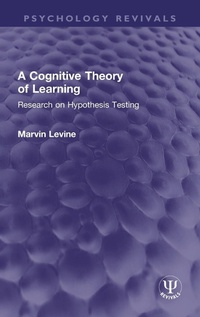
A Cognitive Theory of Learning
Research on Hypothesis Testing
1st Edition
Published on 1. November 2022
Book
Hardback
324 pages
978-1-032-32748-8 (ISBN)
Description
First published in 1975, A Cognitive Theory of Learning provides a history of hypothesis theory (H theory), along with the author's research from the previous decade. The first part introduces the reader to contributions of some major learning theorists. It traces the history of H theory, reviewing the confrontation with conditioning theory, with the stress on the emergence of H theory which came to predominate. The second part describes the author's work, presented as it emerged over time. It shows how the outcome of one experiment typically led to the next theoretical development or experiment. Originally part of The Experimental Psychology Series this reissue can now be read and enjoyed again in its historical context.
More details
Series
Language
English
Place of publication
London
United Kingdom
Publishing group
Taylor & Francis Ltd
Target group
College/higher education
Professional and scholarly
Postgraduate, Professional, and Undergraduate
Dimensions
Height: 240 mm
Width: 161 mm
Thickness: 22 mm
Weight
658 gr
ISBN-13
978-1-032-32748-8 (9781032327488)
Copyright in bibliographic data and cover images is held by Nielsen Book Services Limited or by the publishers or by their respective licensors: all rights reserved.
Schweitzer Classification
Other editions
Additional editions

Book
11/2024
1st Edition
Routledge
€46.50
Shipment within 10-20 days
E-Book
11/2022
1st Edition
Routledge
€40.99
Available for download
E-Book
11/2022
1st Edition
Routledge
€40.99
Available for download
Content
Preface. Part I: The Rise and Fall and Rise of Hypothesis Theory 1. The Beginning 2. The Reaction 3. The Transition: Conditioning Theory in the Fifties 4. The Transition: Foreshadowings in the Fifties 5. The Renaissance: Mathematical Learning Theories in the Early Sixties Part II: Visit to a Small Laboratory 6. The Analysis of Response Patterns by Human Adults 7. Probing for Hypotheses 8. Further Applications of Blank Trials 9. The Start of the Child Program 10. When S Fails to Learn 11. The Transfer Hypothesis 12. Summing Up. Epilogue. Appendix. References. Subject Index.