

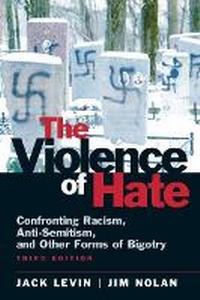
The Violence of Hate
Confronting Racism, Anti-Semitism, and Other Forms of Bigotry
3rd Edition
Published on 25. May 2010
Book
Paperback/Softback
224 pages
978-0-205-71084-3 (ISBN)
Description
This text explores two forms of hate and prejudice - racism in contemporary American society and the historical occurrence of anti-Semitism - under a single conceptual framework.
Jack Levin, is a well-known scholar, author, and lecturer on the subject of hate crimes. In this book he shows how support for both racism and anti-Semitism can be conceptualized as occurring among four groups: hatemongers, dabblers, sympathizers, and spectators. Levin argues that hate and prejudice continue at a very dangerous level in our society, and that hate typically emanates not from the ranting and raving of a few people at the margins of society, but from ordinary people in the mainstream.
Jim Nolan , new to this edition, is an Associate Professor at West Virginia University, and a former FBI agent, specializing in hate crimes and prejudice.
Jack Levin, is a well-known scholar, author, and lecturer on the subject of hate crimes. In this book he shows how support for both racism and anti-Semitism can be conceptualized as occurring among four groups: hatemongers, dabblers, sympathizers, and spectators. Levin argues that hate and prejudice continue at a very dangerous level in our society, and that hate typically emanates not from the ranting and raving of a few people at the margins of society, but from ordinary people in the mainstream.
Jim Nolan , new to this edition, is an Associate Professor at West Virginia University, and a former FBI agent, specializing in hate crimes and prejudice.
More details
Edition
3rd edition
Language
English
Place of publication
United States
Publishing group
Pearson Education (US)
Target group
Professional and scholarly
Dimensions
Height: 229 mm
Width: 152 mm
Weight
360 gr
ISBN-13
978-0-205-71084-3 (9780205710843)
Copyright in bibliographic data and cover images is held by Nielsen Book Services Limited or by the publishers or by their respective licensors: all rights reserved.
Schweitzer Classification
Other editions
New editions

Jack A. Levin | Jim Nolan
The Violence of Hate
Confronting Racism, Anti-Semitism, and Other Forms of Bigotry
Book
4th Edition
Pearson
€39.54
The article will not be published
Previous edition
Book
11/2006
2nd Edition
Pearson
€48.46
Article exhausted; check for reprint
Persons
JACK LEVIN, Ph.D. is the Irving and Betty Brudnick Professor of Sociology and Criminology and co-director of the Brudnick Center on Conflict and Violence at Northeastern University, where he teaches courses in prejudice and violence. He has authored or co-authored 30 books and hundreds of articles in professional journals and columns in newspapers, such asThe New York Times, Boston Globe, Dallas Morning News, Philadelphia Inquirer, Christian Science Monitor, Chicago Tribune, and USA Today. He appears frequently on national television programs, including 48 Hours, 20/20, Dateline NBC, The Today Show, Good Morning America, Oprah, Rivera Live, Larry King Live, and all network newscasts. Dr. Levin was honored by the Massachusetts Council for Advancement and Support of Education as its "Professor of the Year," and was the recipient of the American Sociological Association's 2009 Public Understanding of Sociology Award. He has spoken to a wide variety of community, academic, and professional groups, including the White House Conference on Hate Crimes, the Department of Justice, the Department of Education, and the International Association of Chiefs of Police.
JIM NOLAN is an associate professor in the Division of Sociology and Anthropology at West Virginia University where he teaches courses on the topic of deviance and hate crime. His research currently focuses on community policing, intergroup relations, and the measurement of hate crimes and other crimes that are reported to the police. Dr. Nolan's professional career began as a police officer in Wilmington, Delaware. He is a 1992 graduate of the Federal Bureau of Investigation (FBI) National Academy. Just prior to joining the faculty at West Virginia University, Dr. Nolan worked for the FBI as a unit chief in the Crime Analysis, Research and Development Unit that provided management oversight for the National Hate Crime Data Collection Program. He was recently involved in a project sponsored by the Organization for Security & Cooperation in Europe (OSCE) to implement hate crime reporting throughout Europe. His recent publications have appeared in the American Behavioral Scientist, Journal of Quantitative Criminology, Journal of Contemporary Criminal Justice, The Justice Professional, Policing & Society, Criminal Justice Studies, Homicide Studies, Journal of Criminal Justice, and The American Sociologist. Dr. Nolan earned a Ph.D. from Temple University. His graduate work focused on the study of group and social processes.
JIM NOLAN is an associate professor in the Division of Sociology and Anthropology at West Virginia University where he teaches courses on the topic of deviance and hate crime. His research currently focuses on community policing, intergroup relations, and the measurement of hate crimes and other crimes that are reported to the police. Dr. Nolan's professional career began as a police officer in Wilmington, Delaware. He is a 1992 graduate of the Federal Bureau of Investigation (FBI) National Academy. Just prior to joining the faculty at West Virginia University, Dr. Nolan worked for the FBI as a unit chief in the Crime Analysis, Research and Development Unit that provided management oversight for the National Hate Crime Data Collection Program. He was recently involved in a project sponsored by the Organization for Security & Cooperation in Europe (OSCE) to implement hate crime reporting throughout Europe. His recent publications have appeared in the American Behavioral Scientist, Journal of Quantitative Criminology, Journal of Contemporary Criminal Justice, The Justice Professional, Policing & Society, Criminal Justice Studies, Homicide Studies, Journal of Criminal Justice, and The American Sociologist. Dr. Nolan earned a Ph.D. from Temple University. His graduate work focused on the study of group and social processes.
Content
IN THIS SECTION:
1.) BRIEF
2.) COMPREHENSIVE
BRIEF TABLE OF CONTENTS:
Chapter 1 Perspectives on Hate and Violence
Chapter 2 Hate Crimes
Chapter 3 A Typology of Hate
Chapter 4 The Benefits of Bigotry
Chapter 5 The Production of Rebels, Deviants, and Other Decent People
COMPREHENSIVE TABLE OF CONTENTS:
Chapter 1 Perspectives on Hate and Violence
Hate, Prejudice, and Discrimination
Hate as a Justification for Violence
Is Hate on the Decline?
Is the Significance of Hate on the Decline?
Chapter 2 Hate Crimes
Motive Matters
The Hate Crime Statistics Act
Why Now?
Pros and Cons of Hate Crime Laws
Hate Crime Laws Today
Policing Hate Crimes
Hate Crimes in Europe
Chapter 3 A Typology of Hate
Hatemongers
Dabblers
Sympathizers
Spectators
Chapter 4 The Benefits of Bigotry
Protest by Proxy
Psychological Advantages
Economic and Status Advantages
Chapter 5 The Production of Rebels, Deviants, and Other Decent People
The Power of the Situation
Intergroup Contact
Follow the Leader
The Impact of Deviance
Human Agency: The Ability to Create "Good" Situations
1.) BRIEF
2.) COMPREHENSIVE
BRIEF TABLE OF CONTENTS:
Chapter 1 Perspectives on Hate and Violence
Chapter 2 Hate Crimes
Chapter 3 A Typology of Hate
Chapter 4 The Benefits of Bigotry
Chapter 5 The Production of Rebels, Deviants, and Other Decent People
COMPREHENSIVE TABLE OF CONTENTS:
Chapter 1 Perspectives on Hate and Violence
Hate, Prejudice, and Discrimination
Hate as a Justification for Violence
Is Hate on the Decline?
Is the Significance of Hate on the Decline?
Chapter 2 Hate Crimes
Motive Matters
The Hate Crime Statistics Act
Why Now?
Pros and Cons of Hate Crime Laws
Hate Crime Laws Today
Policing Hate Crimes
Hate Crimes in Europe
Chapter 3 A Typology of Hate
Hatemongers
Dabblers
Sympathizers
Spectators
Chapter 4 The Benefits of Bigotry
Protest by Proxy
Psychological Advantages
Economic and Status Advantages
Chapter 5 The Production of Rebels, Deviants, and Other Decent People
The Power of the Situation
Intergroup Contact
Follow the Leader
The Impact of Deviance
Human Agency: The Ability to Create "Good" Situations