

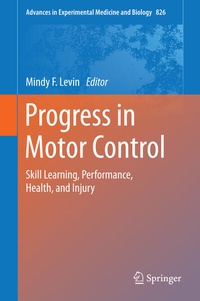
Progress in Motor Control
Skill Learning, Performance, Health, and Injury
Published on 21. October 2014
Book
Hardback
XVII, 286 pages
978-1-4939-1337-4 (ISBN)
Description
This volume is the most recent installment of the Progress in Motor Control series. It contains contributions based on presentations by invited speakers at the Progress in Motor Control IX meeting held in at McGill University, Montreal, in July, 2013. Progress in Motor Control is the official scientific meeting of the International Society of Motor Control (ISMC). The Progress in Motor Control IXI meeting, and consequently this volume, provide a broad perspective on the latest research on motor control in humans and other species.
Reviews / Votes
From the book reviews:
"This is an excellent review of current and past research on cerebral cortical control of actions and movements from the motor control standpoint. . I will endorse this book to physiologists, motor control students and experts alike. Graduate students, medical students, and fellows will find this work valuable for their research." (Joseph J. Grenier, Amazon.com, November, 2014)More details
Series
Edition
2014 ed.
Language
English
Place of publication
New York
United States
Target group
Professional and scholarly
Research
Illustrations
44 farbige Abbildungen, 36 s/w Abbildungen
XVII, 286 p. 80 illus., 44 illus. in color.
Dimensions
Height: 241 mm
Width: 160 mm
Thickness: 22 mm
Weight
623 gr
ISBN-13
978-1-4939-1337-4 (9781493913374)
DOI
10.1007/978-1-4939-1338-1
Schweitzer Classification
Other editions
Additional editions
Book
09/2016
Springer
€213.99
Shipment within 15-20 days
E-Book
10/2014
1st Edition
Springer New York
€213.99
Available for download
Content
Introduction and Scope of the Text.- Motor Control.- Reconfiguration of the Electrical Properties of Motoneurons to Match the Diverse Demands of Motor Behavior.- The Regulation of Limb Stiffness in the Context of Locomotor Tasks.- Sub-cortical Visuomotor Control of Human Limb Movement.- Rethinking the Role of Motor Simulation in Perceptual Decisions.- Use of Uncontrolled Manifold (UCM) Approach to Understand Motor Variability, Motor Equivalence and Self-Motion.- Acquisition of Novel and Complex Motor Skills.- The Dynamical Analysis of Inter-trial Fluctuations Near Goal Equivalent Manifolds.- Motor Control in Action.- Apollo's Curse.- Motor Control in the Injured and Healthy Artist.- Adaptations to Neck/Shoulder Fatigue and Injury.- Deficits in Spatial Threshold Control of Muscle Activation as a Window for Rehabilitation After Brain Injury.- Enhancing Postural Stability and Adaptability in Multiple Sclerosis.