

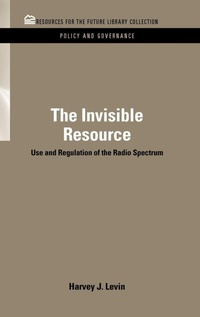
The Invisible Resource
Use and Regulation of the Radio Spectrum
1st Edition
Published on 19. January 2011
Book
Hardback
460 pages
978-1-61726-070-4 (ISBN)
Description
This book both describes and criticizes the regulatory policies of the Federal Communications Commission (F.C.C.). If accepted, these criticisms would result in a comprehensive alteration of current F.C.C. policies.
Originally published in 1971
Originally published in 1971
Reviews / Votes
'...very useful data for students of public policy...will stand for some time as the authoritative treatment of its specialized subject.'American Political Science Review
More details
Series
Language
English
Place of publication
Washington
United States
Publishing group
Taylor & Francis Inc
Target group
Professional and scholarly
Dimensions
Height: 240 mm
Width: 161 mm
Thickness: 29 mm
Weight
851 gr
ISBN-13
978-1-61726-070-4 (9781617260704)
Copyright in bibliographic data and cover images is held by Nielsen Book Services Limited or by the publishers or by their respective licensors: all rights reserved.
Schweitzer Classification
Other editions
Additional editions
E-Book
10/2013
1st Edition
RFF Press
€251.99
Available for download
E-Book
10/2013
1st Edition
RFF Press
€251.99
Available for download
Person
Content
Introduction; One: The Spectrum System; I: Economic and Physical Character of the Radio Spectrum; II: Major Components of the Spectrum System; III: The Goals of National Spectrum Management; Two: Alternatives in Spectrum Allocation and Management; IV: Freely Transferable Rights; V: Toward a Regulated Market-Type System with Prices; VI: New Administrative Techniques; VII: The Case for Secondary Rights; Three: The Level of Spectrum Development; VIII: Spectrum Scarcity and Technological Change; IX: Government's Role in Spectrum Development: The Record; Four: Allocation, Regulation, Prices, and Service; X: The Rationale of Competitive Alternatives in Common Carrier Rate Regulation; XI: Competitive Alternatives in Practice; XII: Broadcast Allocations in Theory and Fact; XIII: The Effects of Broadcast Licensing; Four: Conclusion