

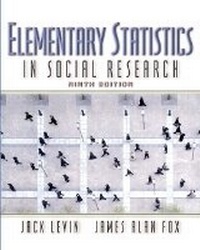
Elementary Statistics in Social Research
9th Edition
Published on 28. August 2002
Book
Hardback
496 pages
978-0-205-36270-7 (ISBN)
Description
Designed for a first course in undergraduate statistics in the social sciences, including sociology, criminal justice, political science, and social work. This best-selling introduction to statistical analysis in the social sciences provides the right balance of conceptual understanding and step-by-step computational techniques. - New conceptual problems help deepen student understanding of statistical methods. - All formulas, exercises, and answers have been thoroughly checked by the authors and re-checked with two additional independent edits for accuracy. - Exercises and examples have been updated throughout. - TECHNOLOGY ADVANTAGE - New! Free Companion Website with data sets for use with the student workbook, and a downloadable Excel Calculator that can be used for solving problems from the text and student workbook - New! Student SPSS Software optional booklet can be value-packed with the text. - Written to be understandable to a broad range of students, particularly those without a strong background in mathematics. - Provides clear, logical explanations for the rationale and use of statistical methods in social research.
- Detailed step-by-step illustrations of statistical procedures are located at important points throughout the text. - Optional Student Workbook provides supplemental exercises.
- Detailed step-by-step illustrations of statistical procedures are located at important points throughout the text. - Optional Student Workbook provides supplemental exercises.
More details
Edition
9th edition
Language
English
Place of publication
United States
Publishing group
Pearson Education (US)
Target group
Professional and scholarly
Dimensions
Height: 243 mm
Width: 196 mm
Thickness: 27 mm
Weight
957 gr
ISBN-13
978-0-205-36270-7 (9780205362707)
Copyright in bibliographic data and cover images is held by Nielsen Book Services Limited or by the publishers or by their respective licensors: all rights reserved.
Schweitzer Classification
Other editions
New editions
Jack A. Levin | James Alan Fox
Elementary Statistics in Social Research
Book
11/2005
10th Edition
Pearson
€79.41
Article exhausted; check for reprint
Previous edition
Jack A. Levin | James Alan Fox
Elementary Statistics in Social Research
Book
02/2000
8th Edition
Pearson
€37.13
Article exhausted; check for reprint
Content
1. Why the Social Researcher Uses Statistics.
The Nature of Social Research.
Why Test Hypotheses?
The Stages of Social Research.
Using Series of Numbers to Do Social Research.
Functions of Statistics.
Looking at the Larger Picture: A Student Survey.
I. DESCRIPTION.
2. Organizing the Data.
Frequency Distributions of Nominal Data.
Comparing Distributions.
Proportions and Percentages.
Ratios and Rates.
Simple Frequency Distributions of Ordinal and Interval Data.
Grouped Frequency Distributions of Interval Data.
Cumulative Distributions.
Percentile Ranks.
Dealing with Decimal Data.
Flexible Class Intervals.
Cross-Tabulations.
Graphic Presentations.
3. Measures of Central Tendency.
The Mode.
The Median.
The Mean.
Taking One Step at a Time.
Comparing the Mode, Median, and Mean.
Obtaining the Mode, Median, and Mean from a Simple Frequency Distribution.
Obtaining the Mode, Median, and Mean from a Grouped Frequency Distribution.
Step-by-Step Study Guide: Mode, Median, and Mean for Raw Scores.
4. Measures of Variability.
The Range.
The Mean Deviation.
The Variance and Standard Deviation.
The Raw-Score Formula for Variance and Standard Deviation.
The Meaning of the Standard Deviation.
Comparing Measures of Variability.
Obtaining the Variance and Standard Deviation from a Simple Frequency Distribution.
Obtaining the Variance and Standard Deviation from a Grouped Frequency Distribution.
Step-by-Step Study Guide: Variance and Standard Deviation for Raw Scores.
Looking at the Larger Picture: Describing Data.
II. FROM DESCRIPTION TO DECISION MAKING.
5. Probability and the Normal Curve.
Rules of Probability.
Probability Distributions.
The Normal Curve as a Probability Distribution.
Characteristics of the Normal Curve.
The Model and the Reality of the Normal Curve.
The Area Under the Normal Curve.
Standard Scores and the Normal Curve.
Finding Probability Under the Normal Curve.
Obtaining Percentile Ranks from the Normal Curve.
Step-by-Step Study Guide: Probability Under the Normal Curve.
Step-by-Step Study Guide: Percentile Ranks from the Normal Curve.
6. Samples and Populations.
Sampling Methods.
Sampling Error.
Sampling Distribution of Means.
Standard Error of the Mean.
Confidence Intervals.
The t Distribution.
Estimating Proportions.
Step-by-Step Study Guide: Confidence Interval for the Mean Using z.
Step-by-Step Study Guide: Confidence Interval for the Mean Using t.
Step-by-Step Study Guide: Confidence Interval for the Proportion.
Looking at the Larger Picture: Generalizing from Samples to Populations.
III. DECISION MAKING.
7. Testing Differences Between Means.
The Null Hypothesis: No Difference Between Means.
The Research Hypothesis: A Difference Between Means.
Sampling Distribution of Differences Between Means.
Testing Hypotheses with the Distribution of Differences Between Means.
Levels of Significance.
Standard Error of the Difference Between Means.
Testing the Difference Between Means.
Comparing the Same Sample Measured Twice.
Two Sample Tests of Proportions.
One-Tailed Tests.
Requirements for Testing the Difference Between Means.
Step-by-Step Study Guide: Test of Differences Between Means for Independent Groups.
Step-by-Step Study Guide: Test of Differences Between Means for the Same Sample Measured Twice.
Step-by-Step Study Guide: Test of Differences Between Proportions.
8. Analysis of Variance.
The Logic of Analysis of Variance.
The Sum of Squares.
Mean Square.
The F Ratio.
A Multiple Comparison of Means.
Requirements for Using the F Ratio.
Step-by-Step Study Guide: Test of Differences Between Means for Several Independent Groups Using Analysis of Variance.
9. Nonparametric Tests of Significance.
One-Way Chi-Square Test.
Two-Way Chi-Square Test.
The Median Test.
The Mann-Whitney U Test.
Kruskal-Wallis One-Way Analysis of Variance by Ranks.
Step-by-Step Study Guide: Test of Differences Between Groups for Nominal-Level Data Using Chi-Square.
Step-by-Step Study Guide: Test of Differences Between Groups for Ordinal-Level Data Using the Mann-Whitney U Test.
Step-by-Step Study Guide: Test of Differences Between Several Groups for Ordinal-Level Data Using the Kruskal-Wallis Test.
Looking at the Larger Picture: Testing for Differences.
IV. FROM DECISION MAKING TO ASSOCIATION.
10. Correlation.
Strength of Correlation.
Direction of Correlation.
Curvilinear Correlation.
The Correlation Coefficient.
Pearson's Correlation Coefficient.
The Importance of Scatter Plots.
Partial Correlation.
Step-by-Step Study Guide: Testing the Strength of Association Between Interval-Level Variables Using Pearson's Correlation.
11. Regression Analysis.
The Regression Model.
Interpreting the Regression Line.
Prediction Errors.
Regression and Pearson's Correlation.
Regression and Analysis of Variance.
Multiple Regression.
Step-by-Step Study Guide: Testing the Effect of an Independent Variable on a Dependent Variable Using Regression Analysis.
12. Nonparametric Measures of Correlation.
Spearman's Rank-Order Correlation Coefficient.
Goodman's and Kruskal's Gamma.
Correlation Coefficient for Nominal Data Arranged in a 2 x 2 Table.
Correlation Coefficients for Nominal Data in Larger than 2 x 2 Tables.
Lambda.
Elaboration.
Step-by-Step Study Guide: Testing the Strength of Association Between Ordinal-Level Variables Using Spearman's Rank-Order Correlation.
Step-by-Step Study Guide: Testing the Strength of Association Between Cross-Tabulated, Ordinal-Level Variables Using Goodman's and Kruskal's Gamma.
13. Applying Statistical Procedures to Research Problems.
Research Situations.
Research Solutions.
APPENDIXES.
Appendix A: Social Science Data on the Internet.
Appendix B: A Review of Some Fundamentals of Mathematics.
Appendix C: Tables.
Appendix D: List of Formulas.
Glossary.
Answers to Problems.
Index.
The Nature of Social Research.
Why Test Hypotheses?
The Stages of Social Research.
Using Series of Numbers to Do Social Research.
Functions of Statistics.
Looking at the Larger Picture: A Student Survey.
I. DESCRIPTION.
2. Organizing the Data.
Frequency Distributions of Nominal Data.
Comparing Distributions.
Proportions and Percentages.
Ratios and Rates.
Simple Frequency Distributions of Ordinal and Interval Data.
Grouped Frequency Distributions of Interval Data.
Cumulative Distributions.
Percentile Ranks.
Dealing with Decimal Data.
Flexible Class Intervals.
Cross-Tabulations.
Graphic Presentations.
3. Measures of Central Tendency.
The Mode.
The Median.
The Mean.
Taking One Step at a Time.
Comparing the Mode, Median, and Mean.
Obtaining the Mode, Median, and Mean from a Simple Frequency Distribution.
Obtaining the Mode, Median, and Mean from a Grouped Frequency Distribution.
Step-by-Step Study Guide: Mode, Median, and Mean for Raw Scores.
4. Measures of Variability.
The Range.
The Mean Deviation.
The Variance and Standard Deviation.
The Raw-Score Formula for Variance and Standard Deviation.
The Meaning of the Standard Deviation.
Comparing Measures of Variability.
Obtaining the Variance and Standard Deviation from a Simple Frequency Distribution.
Obtaining the Variance and Standard Deviation from a Grouped Frequency Distribution.
Step-by-Step Study Guide: Variance and Standard Deviation for Raw Scores.
Looking at the Larger Picture: Describing Data.
II. FROM DESCRIPTION TO DECISION MAKING.
5. Probability and the Normal Curve.
Rules of Probability.
Probability Distributions.
The Normal Curve as a Probability Distribution.
Characteristics of the Normal Curve.
The Model and the Reality of the Normal Curve.
The Area Under the Normal Curve.
Standard Scores and the Normal Curve.
Finding Probability Under the Normal Curve.
Obtaining Percentile Ranks from the Normal Curve.
Step-by-Step Study Guide: Probability Under the Normal Curve.
Step-by-Step Study Guide: Percentile Ranks from the Normal Curve.
6. Samples and Populations.
Sampling Methods.
Sampling Error.
Sampling Distribution of Means.
Standard Error of the Mean.
Confidence Intervals.
The t Distribution.
Estimating Proportions.
Step-by-Step Study Guide: Confidence Interval for the Mean Using z.
Step-by-Step Study Guide: Confidence Interval for the Mean Using t.
Step-by-Step Study Guide: Confidence Interval for the Proportion.
Looking at the Larger Picture: Generalizing from Samples to Populations.
III. DECISION MAKING.
7. Testing Differences Between Means.
The Null Hypothesis: No Difference Between Means.
The Research Hypothesis: A Difference Between Means.
Sampling Distribution of Differences Between Means.
Testing Hypotheses with the Distribution of Differences Between Means.
Levels of Significance.
Standard Error of the Difference Between Means.
Testing the Difference Between Means.
Comparing the Same Sample Measured Twice.
Two Sample Tests of Proportions.
One-Tailed Tests.
Requirements for Testing the Difference Between Means.
Step-by-Step Study Guide: Test of Differences Between Means for Independent Groups.
Step-by-Step Study Guide: Test of Differences Between Means for the Same Sample Measured Twice.
Step-by-Step Study Guide: Test of Differences Between Proportions.
8. Analysis of Variance.
The Logic of Analysis of Variance.
The Sum of Squares.
Mean Square.
The F Ratio.
A Multiple Comparison of Means.
Requirements for Using the F Ratio.
Step-by-Step Study Guide: Test of Differences Between Means for Several Independent Groups Using Analysis of Variance.
9. Nonparametric Tests of Significance.
One-Way Chi-Square Test.
Two-Way Chi-Square Test.
The Median Test.
The Mann-Whitney U Test.
Kruskal-Wallis One-Way Analysis of Variance by Ranks.
Step-by-Step Study Guide: Test of Differences Between Groups for Nominal-Level Data Using Chi-Square.
Step-by-Step Study Guide: Test of Differences Between Groups for Ordinal-Level Data Using the Mann-Whitney U Test.
Step-by-Step Study Guide: Test of Differences Between Several Groups for Ordinal-Level Data Using the Kruskal-Wallis Test.
Looking at the Larger Picture: Testing for Differences.
IV. FROM DECISION MAKING TO ASSOCIATION.
10. Correlation.
Strength of Correlation.
Direction of Correlation.
Curvilinear Correlation.
The Correlation Coefficient.
Pearson's Correlation Coefficient.
The Importance of Scatter Plots.
Partial Correlation.
Step-by-Step Study Guide: Testing the Strength of Association Between Interval-Level Variables Using Pearson's Correlation.
11. Regression Analysis.
The Regression Model.
Interpreting the Regression Line.
Prediction Errors.
Regression and Pearson's Correlation.
Regression and Analysis of Variance.
Multiple Regression.
Step-by-Step Study Guide: Testing the Effect of an Independent Variable on a Dependent Variable Using Regression Analysis.
12. Nonparametric Measures of Correlation.
Spearman's Rank-Order Correlation Coefficient.
Goodman's and Kruskal's Gamma.
Correlation Coefficient for Nominal Data Arranged in a 2 x 2 Table.
Correlation Coefficients for Nominal Data in Larger than 2 x 2 Tables.
Lambda.
Elaboration.
Step-by-Step Study Guide: Testing the Strength of Association Between Ordinal-Level Variables Using Spearman's Rank-Order Correlation.
Step-by-Step Study Guide: Testing the Strength of Association Between Cross-Tabulated, Ordinal-Level Variables Using Goodman's and Kruskal's Gamma.
13. Applying Statistical Procedures to Research Problems.
Research Situations.
Research Solutions.
APPENDIXES.
Appendix A: Social Science Data on the Internet.
Appendix B: A Review of Some Fundamentals of Mathematics.
Appendix C: Tables.
Appendix D: List of Formulas.
Glossary.
Answers to Problems.
Index.