

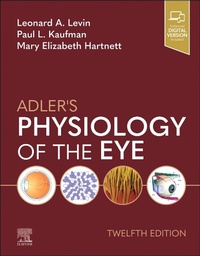
Adler's Physiology of the Eye
12th Edition
Published on 25. June 2024
Book
Hardback
816 pages
978-0-323-83406-3 (ISBN)
Description
**Selected for 2026 Doody's Core Titles as an Essential Purchase in Ophthalmology**
Written and designed to enhance your understanding of ocular function, structure, and anatomy, Adler's Physiology of the Eye is a classic, best-selling text that makes critical information easier to learn and retain. The fully revised 12th Edition continues the successful Adler's approach that connects basic science and clinical aspects in a user-friendly, highly visual format-ideal for study, review, and exam preparation. It captures the latest molecular, genetic, and biochemical discoveries and offers you unparalleled knowledge and insight into the physiology of the eye and its structures.
Covers the full structure and function of the eye and its related anatomy and makes the connection between physiology and clinical practice
Includes major updates throughout, including new information on OCT/OCTA imaging, new drug delivery methods, ocular biomechanics, and evolving gene therapies
Organizes content by function, rather than anatomy, to help you make a stronger connection between physiological principles and clinical practice
Explains the physiological principles that underlie visual acuity, intraocular pressure, ocular circulation, the extraocular muscles, and much more
Features approximately 1,000 illustrations throughout, including medical artwork; schematics, charts, and graphs; clinical photographs; and more
An eBook version is included with purchase. The eBook allows you to access all of the text, figures, and references, with the ability to search, customize your content, make notes and highlights, and have content read aloud
Written and designed to enhance your understanding of ocular function, structure, and anatomy, Adler's Physiology of the Eye is a classic, best-selling text that makes critical information easier to learn and retain. The fully revised 12th Edition continues the successful Adler's approach that connects basic science and clinical aspects in a user-friendly, highly visual format-ideal for study, review, and exam preparation. It captures the latest molecular, genetic, and biochemical discoveries and offers you unparalleled knowledge and insight into the physiology of the eye and its structures.
Covers the full structure and function of the eye and its related anatomy and makes the connection between physiology and clinical practice
Includes major updates throughout, including new information on OCT/OCTA imaging, new drug delivery methods, ocular biomechanics, and evolving gene therapies
Organizes content by function, rather than anatomy, to help you make a stronger connection between physiological principles and clinical practice
Explains the physiological principles that underlie visual acuity, intraocular pressure, ocular circulation, the extraocular muscles, and much more
Features approximately 1,000 illustrations throughout, including medical artwork; schematics, charts, and graphs; clinical photographs; and more
An eBook version is included with purchase. The eBook allows you to access all of the text, figures, and references, with the ability to search, customize your content, make notes and highlights, and have content read aloud
Reviews / Votes
"...now in its 12th edition and, as someone who studied ophthalmology using a much earlier edition, it is easy to appreciate how this has evolved into a veritable masterwork.... an excellent reference and an outstanding platform for the study of ophthalmology and eyecare to be built upon. It is also relatively easy to dip into, with reasonably sized chapters that are generally easy to read and with references that are typically up-to-date.... the printed work is a handsome volume, glossy, hardbound and printed on high-quality paper and is a pleasure to have on one's desk.... I can honestly say I'd recommend this current edition to anyone embarking on a career in ophthalmology, optometry or visual science. It really is a treasure chest combining hard science, engaging writing and practical tips that provides a comprehensive single source for those wishing to understand the physiology of the eye." Review by Professor Charles McGhee, NZ Optics, December 2025"...serves as an easy-to-digest review and update of ocular anatomy and physiology for clinicians, researchers, and students. The book is organized by function... [which] allows for seamless integration of basic science information with clinical knowledge in a way that enhances and refreshes foundational information.... The purpose of this book is to enhance understanding of structure and functional relationships within the eye and ocular adnexa.... [It] provides a unique approach to understanding ocular anatomy and physiology... [and] breaks down broad topics...to smaller segments in a straightforward manner, allowing visualization of the relationship and significance of the structure to the function.... This book is a great resource to refresh or supplement knowledge on a wide range of ocular elements." (c)Doody's Book Review Service, 2025, Rachel Grant, OD (Southern College of Optometry) Doody's Score: 95, 4 Stars!
More details
Edition
12th edition
Language
English
Place of publication
Philadelphia
United States
Target group
Professional and scholarly
Illustrations
Approx. 1225 illustrations (650 in full color); Illustrations
Dimensions
Height: 281 mm
Width: 224 mm
Thickness: 39 mm
Weight
2538 gr
ISBN-13
978-0-323-83406-3 (9780323834063)
Copyright in bibliographic data and cover images is held by Nielsen Book Services Limited or by the publishers or by their respective licensors: all rights reserved.
Schweitzer Classification
Other editions
Previous edition
Leonard A. Levin | Siv F. E. Nilsson | James Ver Hoeve
Adler's Physiology of the Eye
Expert Consult - Online and Print
Book
03/2011
11th Edition
Saunders
€84.31
Article exhausted; check for reprint
Persons
Editor
Distinguished James McGill Professor of Ophthalmology and Visual Sciences, Neurology & Neurosurgery, McGill University, Montreal, Quebec, Canada
Professor of Ophthalmology & Visual Sciences, Ernst H. Barany Professor of Ocular Pharmacology, Department Chair Emeritus, Department of Ophthalmology & Visual Sciences, School of Medicine & Public Health, University of Wisconsin-Madison, Madison, Wisconsin, USA
Michael F. Marmor, M.D., Professor of Retinal Science and Disease, Vitreoretinal Surgery and Diseases, Director of Pediatric Retina, Principal Investigator, Harnett Laboratory of Angiogenesis, Byers Eye Institute at Stanford University, Palo Alto, California, USA
Content
SECTION 1 Focusing of an Image on the Retina
1. Optics
2. Optical Aberrations and Wavefront Sensing
3. Accommodation
SECTION 2 Physiology of Optical Media
4. Cornea and Sclera
5. The Lens
6. Vitreous
SECTION 3 Direction of Gaze
7. The Extraocular Muscles
8. Neural Control of Eye Movements
9. Three-Dimensional Eye Movements: Kinematics, Control, and Perceptual Consequences
SECTION 4 Nutrition of the Eye
10. Production and Flow of Aqueous Humor
11. Ocular Circulation
12. Metabolic Interactions Between Neurons and Glial Cells
13. The Function of the Retinal Pigment Epithelium
SECTION 5 Protection of the Eye
14. Functions of the Orbit and Eyelids
15. Formation and Function of the Tear Film
16. Sensory Innervation of the Eye
17. Outward-Directed Transport
SECTION 6 Photoreception
18. Biochemical Cascade of Phototransduction
19. Photoresponses of Rods and Cones
20. Light Adaptation in Photoreceptors
SECTION 7 Visual Processing in the Retina
21. The Synaptic Organization of the Retina
22. Signal Processing in the Outer Retina
23. Visual Processing in the Inner Retina
24. Electroretinogram
SECTION 8 Non-Perceptive Vision
25. Regulation of Light Through the Pupil
26. Ganglion-Cell Photoreceptors
SECTION 9 Visual Processing in the Brain
27. Overview of the Central Visual Pathways
28. Optic Nerve
29. Processing in the Lateral Geniculate Nucleus
30. Primary Visual Cortex
31. Extrastriate Visual Cortex
SECTION 10 Visual Perception
32. Visual Processing of Spatial Form
33. Visual Acuity
34. Color Vision
35. The Visual Field
36. Binocular Vision
37. Temporal Properties of Vision
SECTION 11 Development and Deprivation of Vision
38. Development of Vision in Infancy
39. Development of Retinogeniculate Projections
40. Developmental Visual Deprivation
41. The Effects of Visual Deprivation After Infancy
1. Optics
2. Optical Aberrations and Wavefront Sensing
3. Accommodation
SECTION 2 Physiology of Optical Media
4. Cornea and Sclera
5. The Lens
6. Vitreous
SECTION 3 Direction of Gaze
7. The Extraocular Muscles
8. Neural Control of Eye Movements
9. Three-Dimensional Eye Movements: Kinematics, Control, and Perceptual Consequences
SECTION 4 Nutrition of the Eye
10. Production and Flow of Aqueous Humor
11. Ocular Circulation
12. Metabolic Interactions Between Neurons and Glial Cells
13. The Function of the Retinal Pigment Epithelium
SECTION 5 Protection of the Eye
14. Functions of the Orbit and Eyelids
15. Formation and Function of the Tear Film
16. Sensory Innervation of the Eye
17. Outward-Directed Transport
SECTION 6 Photoreception
18. Biochemical Cascade of Phototransduction
19. Photoresponses of Rods and Cones
20. Light Adaptation in Photoreceptors
SECTION 7 Visual Processing in the Retina
21. The Synaptic Organization of the Retina
22. Signal Processing in the Outer Retina
23. Visual Processing in the Inner Retina
24. Electroretinogram
SECTION 8 Non-Perceptive Vision
25. Regulation of Light Through the Pupil
26. Ganglion-Cell Photoreceptors
SECTION 9 Visual Processing in the Brain
27. Overview of the Central Visual Pathways
28. Optic Nerve
29. Processing in the Lateral Geniculate Nucleus
30. Primary Visual Cortex
31. Extrastriate Visual Cortex
SECTION 10 Visual Perception
32. Visual Processing of Spatial Form
33. Visual Acuity
34. Color Vision
35. The Visual Field
36. Binocular Vision
37. Temporal Properties of Vision
SECTION 11 Development and Deprivation of Vision
38. Development of Vision in Infancy
39. Development of Retinogeniculate Projections
40. Developmental Visual Deprivation
41. The Effects of Visual Deprivation After Infancy