

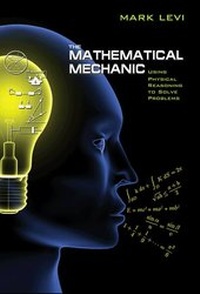
The Mathematical Mechanic
Using Physical Reasoning to Solve Problems
Published on 26. July 2009
Book
Hardback
200 pages
978-0-691-14020-9 (ISBN)
Description
Everybody knows that mathematics is indispensable to physics--imagine where we'd be today if Einstein and Newton didn't have the math to back up their ideas. But how many people realize that physics can be used to produce many astonishing and strikingly elegant solutions in mathematics? Mark Levi shows how in this delightful book, treating readers to a host of entertaining problems and mind-bending puzzlers that will amuse and inspire their inner physicist. Levi turns math and physics upside down, revealing how physics can simplify proofs and lead to quicker solutions and new theorems, and how physical solutions can illustrate why results are true in ways lengthy mathematical calculations never can. Did you know it's possible to derive the Pythagorean theorem by spinning a fish tank filled with water? Or that soap film holds the key to determining the cheapest container for a given volume? Or that the line of best fit for a data set can be found using a mechanical contraption made from a rod and springs? Levi demonstrates how to use physical intuition to solve these and other fascinating math problems.
More than half the problems can be tackled by anyone with precalculus and basic geometry, while the more challenging problems require some calculus. This one-of-a-kind book explains physics and math concepts where needed, and includes an informative appendix of physical principles. The Mathematical Mechanic will appeal to anyone interested in the little-known connections between mathematics and physics and how both endeavors relate to the world around us.
More than half the problems can be tackled by anyone with precalculus and basic geometry, while the more challenging problems require some calculus. This one-of-a-kind book explains physics and math concepts where needed, and includes an informative appendix of physical principles. The Mathematical Mechanic will appeal to anyone interested in the little-known connections between mathematics and physics and how both endeavors relate to the world around us.
Reviews / Votes
One of Amazon.com science editors' Top 10 list for Science, Best for 2009 One of Choice's Outstanding Academic Titles for 2009 "The Mathematical Mechanic documents novel ways of viewing physics as a method of understanding mathematics. Levi uses physical arguments as tools to conjecture about mathematical concepts before providing rigorous proofs... The Mathematical Mechanic is an excellent display of creative, interdisciplinary problem-solving strategies. The author has explained complex concepts with simplicity, yet the mathematics is accurate."--Mathematics Teacher "A most interesting book... Many of the ideas in it could be used as motivational or illustrative examples to support the teaching of non-specialists, especially physicists and engineers. In conclusion--a thoroughly enjoyable and thought-provoking read."--Nigel Steele, London Mathematical Society Newsletter "The Mathematical Mechanic reverses the usual interaction of mathematics and physics... Careful study of Levi's book may train readers to think of physical companions to mathematical problems... Mathematicians will find The Mathematical Mechanic provides exercise in new ways of thinking. Instructors will find it contains material to supplement mathematics courses, helping physically-minded students approach mathematics and helping mathematically-minded students appreciate physics."--John D. Cook, MAA Reviews "Mark Levi reverses the old stereotype that math is merely a tool to aid physicists by showing that many questions in mathematics can be easily solved by interpreting them as physical problems... Some sections of the book require readers to brush up on their calculus but Levi's clear explanations, witty footnotes, and fascinating insights make the extra effort painless."--SEED Magazine "The book is chock-full of these seemingly magical physical thought experiments involving bicycle wheels, pistons, springs, soap films, pendulums, and electric circuits, with applications to geometry, maximization and minimization problems, inequalities, optics, integrals, and complex functions... I highly recommend it to anyone who is (even slightly) interested in physics, and appreciates mathematical elegance and cleverness. It would make a great gift for almost anyone, whether a high school student or university professor, armchair physicist or professional mathematician."--Boris Yorgey, The Math Less Traveled "The Mathematical Mechanic is a pleasant surprise."--E. Kincanon, Choice "This is a delightful and unusual book that is a welcome addition to the literature. Certainly, any calculus teacher and many others of us as well will want to have it on the shelf for ready reference. It not only will enhance our teaching experience but will also teach us (the instructors) something in the process."--Steven G. Krantz, UMAP JournalMore details
Language
English
Place of publication
New Jersey
United States
Product notice
Trade binding
Illustrations
56 halftones. 66 line illus. 1 table.
Dimensions
Height: 229 mm
Width: 152 mm
Weight
510 gr
ISBN-13
978-0-691-14020-9 (9780691140209)
Copyright in bibliographic data and cover images is held by Nielsen Book Services Limited or by the publishers or by their respective licensors: all rights reserved.
Schweitzer Classification
Other editions
New editions
Book
07/2012
Princeton University Press
€18.50
Shipment within 10-20 days
Additional editions
Book
07/2012
Princeton University Press
€18.50
Shipment within 10-20 days
Person
Mark Levi is professor of mathematics at Pennsylvania State University and the author of "Why Cats Land on Their Feet" (Princeton).