

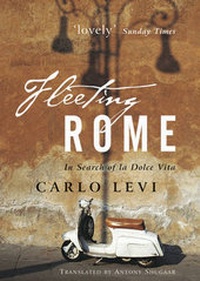
Fleeting Rome
In Search of La Dolce Vita
Published on 24. March 2005
Book
Paperback/Softback
318 pages
978-0-470-87184-3 (ISBN)
Description
Only a renaissance man could have described this glorious city in its heyday. And only Carlo Levi, writer, painter, politician and one of the last centurya s most celebrated talents, could depict Rome at the height of its optimism and vitality after World War II. In Fleeting Rome, the era of post war a La Dolce Vitaa is brought magnificently to life in the daily bustle of Romea s street traders, housewives and students at work and play, the colourful festivities of Ferragosto and San Giovanni, the little theatre of Pulcinella al Pincio; all vibrant sights and sounds of this ancient, yet vital city.
More details
Language
English
Place of publication
Chichester
United Kingdom
Publishing group
John Wiley and Sons Ltd
Dimensions
Height: 192 mm
Width: 138 mm
Thickness: 17 mm
Weight
344 gr
ISBN-13
978-0-470-87184-3 (9780470871843)
Copyright in bibliographic data and cover images is held by Nielsen Book Services Limited or by the publishers or by their respective licensors: all rights reserved.
Schweitzer Classification
Other editions
Additional editions
E-Book
01/2006
1st Edition
Wiley
€7.99
Available for download
Persons
Carlo Levi (1902--1972), writer, painter and politician, was one of the great Italian talents of the twentieth century. He was interned in the South of Italy as an anti--fascist during the Second World war, where he wrote his masterpiece, Cristo si e Fermato a Eboli (Christ Stopped at Eboli). The work was subsequently turned into a film and became recognized as one of the great works of twentieth--century literature. Subsequent works have included a wide range of fiction and non--fiction, including La Orologio (1950), Le parole sono pietre (1955), Le mille patrie, Lo specchio and Scritti di critica da arte. From 1963 to 1972 he was Senator of the Republic.
Content
Preface. Introduction: Eternal and Fleeting. Translatora s Note. I. The People of Rome. II. The Solitude of Rome. III. The Two--Cent Coin. IV. Sunday Stroll. V. The Helicopter. VI. Apparitions in Rome. VII. The Duty of the Comet. VIII. Elegy to the Mid--August Holidays. IX. Hyperbolic Tourism. X. Killing Time. XI. Points of View. XII. The Power of the Poor. XIII. Brigands and Peasants. XIV. Plants and Seeds. XV. The Steps of Rome. XVI. The Empty Cities. XVII. Girls and Trees. XVIII. A Dawn in Rome. XIX. Summer Journey. XX. The New Moon. XXI. San Lorenzo and San Paolo. XXII. A Child in Flight. XXIII. After the Party. XXIV. Substance and Chance. XXV. Clothes Moths. XXVI. Japanese Toys. XXVII. Football and Men of Letters. XXVIII. The Drainage Ditch and the Measles. XXIX. A Boy Steals a Car Radio in the Piazza Navona. XXX. The Labyrinth. XXXI. City of Brothers. XXXII. Summer Dissolves in Mists. XXXIII. Fleeting Rome. Notes to the Text. Basic Chronology of Carlo Levia s Life. Index.