

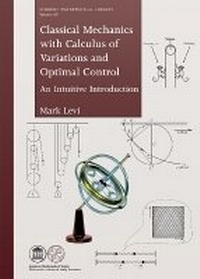
Classical Mechanics with Calculus of Variations and Optimal Control
An Intuitive Introduction
Published on 30. March 2014
Book
Paperback/Softback
299 pages
978-0-8218-9138-4 (ISBN)
Description
This is an intuitively motivated presentation of many topics in classical mechanics and related areas of control theory and calculus of variations. All topics throughout the book are treated with zero tolerance for unrevealing definitions and for proofs which leave the reader in the dark.
Some areas of particular interest are: an extremely short derivation of the ellipticity of planetary orbits; a statement and an explanation of the "tennis racket paradox''; a heuristic explanation (and a rigorous treatment) of the gyroscopic effect; a revealing equivalence between the dynamics of a particle and statics of a spring; a short geometrical explanation of Pontryagin's Maximum Principle, and more.
In the last couple of chapters, aimed at more advanced readers, the Hamiltonian and the momentum are compared to forces in a certain static problem. This gives a palpable physical meaning to some seemingly abstract concepts and theorems. With minimal prerequisites consisting of basic calculus and basic undergraduate physics, this book is suitable for courses from an undergraduate to a beginning graduate level, and for a mixed audience of mathematics, physics and engineering students. Much of the enjoyment of the subject lies in solving almost 200 problems in this book.
This book is published in cooperation with Mathematics Advanced Study Semesters.
Some areas of particular interest are: an extremely short derivation of the ellipticity of planetary orbits; a statement and an explanation of the "tennis racket paradox''; a heuristic explanation (and a rigorous treatment) of the gyroscopic effect; a revealing equivalence between the dynamics of a particle and statics of a spring; a short geometrical explanation of Pontryagin's Maximum Principle, and more.
In the last couple of chapters, aimed at more advanced readers, the Hamiltonian and the momentum are compared to forces in a certain static problem. This gives a palpable physical meaning to some seemingly abstract concepts and theorems. With minimal prerequisites consisting of basic calculus and basic undergraduate physics, this book is suitable for courses from an undergraduate to a beginning graduate level, and for a mixed audience of mathematics, physics and engineering students. Much of the enjoyment of the subject lies in solving almost 200 problems in this book.
This book is published in cooperation with Mathematics Advanced Study Semesters.
Reviews / Votes
This book can be recommended to students and also to everyone involved in preparing an introductory course in advanced classical mechanics, due to the well-selected material and, even more so, the clear presentation." - Zentralblatt Math"One of the most valuable aspects of the book - unfortunately rare among textbooks - is that we see an author in command of his subject who shares not just the bare facts but how he thinks about them and how all the pieces fit together." - MAA Reviews
More details
Series
Language
English
Place of publication
Providence
United States
Target group
Professional and scholarly
Weight
380 gr
ISBN-13
978-0-8218-9138-4 (9780821891384)
Copyright in bibliographic data and cover images is held by Nielsen Book Services Limited or by the publishers or by their respective licensors: all rights reserved.
Schweitzer Classification
Person
Mark Levi, Pennsylvania State University, University Park, PA, USA
Content
Preface
One degree of freedom
More degrees of freedom
Rigid body motion
Variational principles of mechanics
Classical problems of calculus of variations
The conditions of Legendre and Jacobi for a minimum
Optimal control
Heuristic foundations of Hamiltonian mechanics
Bibliography
Index
One degree of freedom
More degrees of freedom
Rigid body motion
Variational principles of mechanics
Classical problems of calculus of variations
The conditions of Legendre and Jacobi for a minimum
Optimal control
Heuristic foundations of Hamiltonian mechanics
Bibliography
Index