

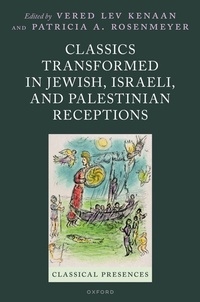
Classics Transformed in Jewish, Israeli, and Palestinian Receptions
Published on 20. March 2025
Book
Hardback
448 pages
978-0-19-887896-4 (ISBN)
Description
Classics Transformed in Jewish, Israeli, and Palestinian Receptions invites the reader to view classical antiquity through the writings of poets, translators, and scholars emerging from modern Jewish diasporas, Mandatory Palestine, and the State of Israel who engaged with Greek and Roman literary precedents. Whereas these voices have up to now been mostly studied independently of one another as separate fields of research, this volume brings some of these distinct voices, who nevertheless share a connection to Greco-Roman antiquity, into conversation with one another. Taking its cue from the crisis of humanism following the Holocaust, the chapters take as their themes the destruction of home, displacement, and different forms of wandering and homecomings, drawing connections to acts of translation and transmission of the classics to form a picture of cultural and textual states of alterity. The volume shows that Jewish, Israeli, and Palestinian responses to the classics are entangled and even complementary despite their different trajectories. The chapters included here focus particularly on critical moments in Jewish and Palestinian existence when the reception of classical humanism is closely linked to issues of survival. On offer here is a historically grounded investigation into the ways Jews, Israelis, and Palestinians have used classical antiquity and classical philology to validate their identity in a rapidly changing society.
More details
Series
Language
English
Place of publication
Oxford
United Kingdom
Target group
Professional and scholarly
College/higher education
Product notice
sewn/stitched
Cloth over boards
Dimensions
Height: 229 mm
Width: 155 mm
Thickness: 36 mm
Weight
885 gr
ISBN-13
978-0-19-887896-4 (9780198878964)
Copyright in bibliographic data and cover images is held by Nielsen Book Services Limited or by the publishers or by their respective licensors: all rights reserved.
Schweitzer Classification
Persons
Vered Lev Kenaan is Professor of Classics and Comparative Literature at the University of Haifa. Her work focuses on the connections between classical studies, comparative literature, reception studies, and psychoanalysis. Among her numerous publications, she is the author of The Ancient Unconscious: Psychoanalysis and the Ancient Text (OUP, 2019), and Pandora's Senses: The Feminine Character of the Ancient Text (Wisconsin University Press 2008).
Patricia A. Rosenmeyer is Paddison Distinguished Professor of Classics and Director of the Carolina Center for Jewish Studies at the University of North Carolina-Chapel Hill. She taught previously at Michigan, Yale, and Wisconsin. Her books include The Poetics of Imitation: Anacreon and the Anacreontic Tradition (Cambridge, 1992), Ancient Epistolary Fictions (Cambridge, 2001), Ancient Greek Literary Letters (Routledge, 2006), Epistolary Narratives in Ancient Greek Literature ( Brill, 2013;), and The Language of Ruins: Greek and Latin Inscriptions on the Memnon Colossus (OUP, 2018).
Patricia A. Rosenmeyer is Paddison Distinguished Professor of Classics and Director of the Carolina Center for Jewish Studies at the University of North Carolina-Chapel Hill. She taught previously at Michigan, Yale, and Wisconsin. Her books include The Poetics of Imitation: Anacreon and the Anacreontic Tradition (Cambridge, 1992), Ancient Epistolary Fictions (Cambridge, 2001), Ancient Greek Literary Letters (Routledge, 2006), Epistolary Narratives in Ancient Greek Literature ( Brill, 2013;), and The Language of Ruins: Greek and Latin Inscriptions on the Memnon Colossus (OUP, 2018).
Content
Vered Lev Kenaan and Patricia A. Rosenmeyer: Classical Transformations
Part I. Classical Scholarship in Times of Crisis
1: Patricia A. Rosenmeyer: After Lights Out: Studying Classics in a Second World War Internment Camp
2: Vered Lev Kenaan: Shlomo Dykman's Aeneid: A Journey from Holocaust to Revival
3: Simon Goldhill: Resisting Reception: The Treachery of the Self
Part II. Philosophical Wanderings
4: James I. Porter: The Genesis of Rachel Bespaloff 's De l'Iliade
5: Galili Shahar: The Odyssey, Otherwise
6: Miriam Leonard: Cholent and the 'False Divinity' of Greece: Hannah Arendt's Hellenism
Part III. Translation and Survival
7: Donna Shalev: Yiddish Translations of Classical Texts: Plato in the Mamalushn and the Metropolis
8: Richard H. Armstrong: Ay de mi Alhama: Impossible Chronologies of Love, Loss, and Learning in Freud and Moshe Ha-Elion
9: Vered Lev Kenaan and Ahlam Nubani: Translation in Exile: Ma.hm=ud al-Gh=ul's Aeneid
Part IV. Classics and the Secularization of Modern Hebrew
10: Yotam Cohen: The Classical Turn in Hebrew Literature in the Early Twentieth Century: The Role of the Literary Editor
11: Aminadav Dykman: The Reception of Classical Literature in Hebrew: A Very Brief Survey
12: Tsafi Sebba-Elran: Knowledge, Power, and Control in Modern Jewish Folktales of Alexander the Great
Part V. Mediterranean Classics: Receptions by Israeli and Palestinian Poets
13: Giacomo Loi: From Enemy to Ruins: Roman Empire and Decadence in the Poetry of Dan Pagis and Haim Gouri
14: Kawthar Aslah and Haim Dorchin: Homeric Memory in Israeli and Palestinian Poetry: Meir Wieseltier and Mahmoud Darwish
15: Daniel Behar: 'Because of What Is Frozen': Back to the Classics in the Poetry of Israel Pincas and Walid Khazendar
Part I. Classical Scholarship in Times of Crisis
1: Patricia A. Rosenmeyer: After Lights Out: Studying Classics in a Second World War Internment Camp
2: Vered Lev Kenaan: Shlomo Dykman's Aeneid: A Journey from Holocaust to Revival
3: Simon Goldhill: Resisting Reception: The Treachery of the Self
Part II. Philosophical Wanderings
4: James I. Porter: The Genesis of Rachel Bespaloff 's De l'Iliade
5: Galili Shahar: The Odyssey, Otherwise
6: Miriam Leonard: Cholent and the 'False Divinity' of Greece: Hannah Arendt's Hellenism
Part III. Translation and Survival
7: Donna Shalev: Yiddish Translations of Classical Texts: Plato in the Mamalushn and the Metropolis
8: Richard H. Armstrong: Ay de mi Alhama: Impossible Chronologies of Love, Loss, and Learning in Freud and Moshe Ha-Elion
9: Vered Lev Kenaan and Ahlam Nubani: Translation in Exile: Ma.hm=ud al-Gh=ul's Aeneid
Part IV. Classics and the Secularization of Modern Hebrew
10: Yotam Cohen: The Classical Turn in Hebrew Literature in the Early Twentieth Century: The Role of the Literary Editor
11: Aminadav Dykman: The Reception of Classical Literature in Hebrew: A Very Brief Survey
12: Tsafi Sebba-Elran: Knowledge, Power, and Control in Modern Jewish Folktales of Alexander the Great
Part V. Mediterranean Classics: Receptions by Israeli and Palestinian Poets
13: Giacomo Loi: From Enemy to Ruins: Roman Empire and Decadence in the Poetry of Dan Pagis and Haim Gouri
14: Kawthar Aslah and Haim Dorchin: Homeric Memory in Israeli and Palestinian Poetry: Meir Wieseltier and Mahmoud Darwish
15: Daniel Behar: 'Because of What Is Frozen': Back to the Classics in the Poetry of Israel Pincas and Walid Khazendar