

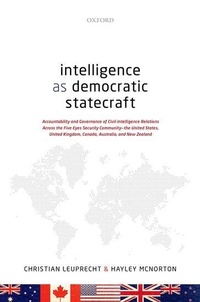
Intelligence as Democratic Statecraft
Accountability and Governance of Civil-Intelligence Relations Across the Five Eyes Security Community - the United States, United Kingdom, Canada, Australia, and New Zealand
Published on 16. September 2021
Book
Hardback
262 pages
978-0-19-289394-9 (ISBN)
Description
This book features a comparative study in intelligence accountability and governance across the Five Eyes: the imperative for member countries of the world's most powerful intelligence alliance to reconcile democracy and security through transparent standards, guidelines, legal frameworks, executive directives, and international law. It argues that intelligence accountability is best understood not as an end in itself but as a means that is integral democratic governance. On the one hand, to assure the executive of government and the public that the activities of intelligence agencies are lawful and, if not, to identify breaches in compliance. On the other hand, to raise awareness of and appreciation for the intelligence function, and whether it is being carried out in the most effective, efficient, and innovative way possible to achieve its objective. The analysis shows how the addition of legislative and judicial components to executive and administrative accountability has been shaping evolving institutions, composition, practices, characteristics, and cultures of intelligence oversight and review in the United States, the United Kingdom, Canada, Australia, and New Zealand using a most-similar systems design. Democracies are engaged in an asymmetric struggle against unprincipled adversaries. Technological change is enabling unprecedented social and political disruption. These threat vectors have significantly affected, altered, and expanded the role, powers and capabilities of intelligence organizations. Accountability aims to reassure sceptics that intelligence and security practices are indeed aligned with the rules and values that democracies claim to defend.
Reviews / Votes
An invaluable vade mecum to all who are curious about how democratic countries might improve the ways in which they collect and act upon intelligence. This book is a model of its kind. * David Haglund, Queen's University, Canadian Journal of Political Science * To protect themselves, democracies have created intelligence agencies to monitorthe world for threats. Technology allows these agencies to mine the data andsurveil the movement of citizens and non-citizens with ease and in secrecy.The question then becomes who watches the watchers, how can democracieshold these agencies accountable? Christian Leuprecht and Hayley McNortonsearch for answers in an excellent comparative study of the Five Eyes. * Harvey M. Sapolsky, Professor Emeritus MIT and Former Director of the MIT Security Studies Program * A highly readable book which is a very useful narrative and up-to-date descriptionof intelligence and security organizations in the UK, the US, Canada, New Zealand,and Australia. Its central theme is the evolving challenge of making theseorganizations responsible and accountable in various ways to electeddemocratic governments. * Jennifer Stoddart, PhD, O.C., AdE, Sixth Privacy Commissioner of Canada & Strategic Advisor, Privacy and Security Group, Fasken Law. * Democratic governments seeking to act ethically in their own defence dailyconfront adversaries that play by very different rules. Christian Leuprechtand Hayley McNorton well document how effective accountability and oversightmechanisms have developed for the Five Eyes intelligence partners that can giveconfidence that in keeping us safe they are nevertheless abiding by the ruleof law and democratic values. * Sir David Omand, Professor, King's College London; Vice-President, Royal United Services institute; former Director, Government CommunicationsHeadquarters (GCHQ), Permanent Secretary to the Home Office andSecurity and Intelligence Coordinator in the Cabinet Office. * Intelligence as Democratic Statecraft thus constitutes an important contribution to the literature on intelligence oversight by offering a comparative description of the Five Eyes alliance and by suggesting a link between domestic structures and significant intelligence cooperation. * Professor James J. Wirtz, Department of National Security Affairs, Naval Postgraduate School * The authors provide a useful and sufficiently detailed sketch of the ISA governance complexes in each country and discover several interesting trends as well as novel exceptions worthy of deeper exploration. * George Greanias, H-War *More details
Edition
1
Language
English
Place of publication
Oxford
United Kingdom
Target group
Professional and scholarly
Product notice
sewn/stitched
Cloth over boards
Dimensions
Height: 237 mm
Width: 167 mm
Thickness: 25 mm
Weight
565 gr
ISBN-13
978-0-19-289394-9 (9780192893949)
Copyright in bibliographic data and cover images is held by Nielsen Book Services Limited or by the publishers or by their respective licensors: all rights reserved.
Schweitzer Classification
Other editions
Additional editions
Christian Leuprecht | Hayley Mcnorton
Intelligence as Democratic Statecraft
Accountability and Governance of Civil-Intelligence Relations Across the Five Eyes Security Community - the United States, United Kingdom, Canada, Australia, and New Zealand
E-Book
08/2021
1st Edition
OUP eBook
€62.99
Available for download
Christian Leuprecht | Hayley Mcnorton
Intelligence as Democratic Statecraft
Accountability and Governance of Civil-Intelligence Relations Across the Five Eyes Security Community - the United States, United Kingdom, Canada, Australia, and New Zealand
E-Book
08/2021
1st Edition
OUP eBook
€62.99
Available for download
Persons
Christian Leuprecht is Class of 1965 Professor in Leadership, Department of Political Science and Economics, Royal Military College; Director of the Institute of Intergovernmental Relations, School of Policy Studies, Queen's University; and Adjunct Research Professor, Australian Graduate School of Policing and Security, Charles Sturt University.
Ms. Hayley McNorton is a fellow at the Centre for International and Defence Policy at Queen's University of which she is also a graduate.
Ms. Hayley McNorton is a fellow at the Centre for International and Defence Policy at Queen's University of which she is also a graduate.
Author
Class of 1965 Professor in Leadership, Royal Military College; Director, Institute of Intergovernmental Relations, Queen's University; Adjunct Research Professor, Australian Graduate School of Policing and Security, Charles Sturt University
Fellow at the Centre for International and Defence Policy, Queen's University
Content
1: Introduction: The Democratic-Intelligence Paradox
2: Comparing Intelligence Accountability: Analytical Framework, Theories and Trends
3: United States of America
4: United Kingdom
5: Canada
6: Australia
7: New Zealand
8: Varieties of Intelligence Accountability: The Institutional Foundations of Comparative Democratic Advantage
9: Foundations of Intelligence Accountability in Democratic Regimes
2: Comparing Intelligence Accountability: Analytical Framework, Theories and Trends
3: United States of America
4: United Kingdom
5: Canada
6: Australia
7: New Zealand
8: Varieties of Intelligence Accountability: The Institutional Foundations of Comparative Democratic Advantage
9: Foundations of Intelligence Accountability in Democratic Regimes