

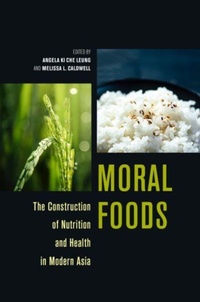
Moral Foods
The Construction of Nutrition and Health in Modern Asia
Will be published approx. on 30. November 2019
Book
Hardback
360 pages
978-0-8248-7670-8 (ISBN)
Description
Moral Foods: The Construction of Nutrition and Health in Modern Asia investigates how foods came to be established as moral entities, how moral food regimes reveal emerging systems of knowledge and enforcement, and how these developments have contributed to new Asian nutritional knowledge regimes. The collection's focus on cross-cultural and transhistorical comparisons across Asia brings into view a broad spectrum of modern Asia that extends from East Asia, Southeast Asia, to South Asia, as well as into global communities of Western knowledge, practice, and power outside Asia.
The first section, "Good Foods," focuses on how food norms and rules have been established in modern Asia. Ideas about good foods and good bodies shift at different moments, in some cases privileging local foods and knowledge systems, and in other cases privileging foreign foods and knowledge systems. The second section, "Bad Foods," focuses on what makes foods bad and even dangerous. Bad foods are not simply unpleasant or undesirable for aesthetic or sensory reasons, but they can hinder the stability and development of persons and societies. Bad foods are symbolically polluting, as in the case of foreign foods that threaten not only traditional foods, but also the stability and strength of the nation and its people. The third section, "Moral Foods," focuses on how themes of good versus bad are embedded in projects to make modern persons, subjects, and states, with specific attention to the ambiguities and malleability of foods and health. The malleability of moral foods provides unique opportunities for understanding Asian societies' dynamic position within larger global flows, connections, and disconnections.
Collectively, the chapters raise intriguing questions about how foods and the bodies that consume them have been valued politically, economically, culturally, and morally, and about how those values originated and evolved. Consumers in modern Asia are not simply eating to satisfy personal desires or physiological needs, but they are also conscripted into national and global statemaking projects through acts of ingestion. Eating, then, has become about fortifying both the person and the nation.
The first section, "Good Foods," focuses on how food norms and rules have been established in modern Asia. Ideas about good foods and good bodies shift at different moments, in some cases privileging local foods and knowledge systems, and in other cases privileging foreign foods and knowledge systems. The second section, "Bad Foods," focuses on what makes foods bad and even dangerous. Bad foods are not simply unpleasant or undesirable for aesthetic or sensory reasons, but they can hinder the stability and development of persons and societies. Bad foods are symbolically polluting, as in the case of foreign foods that threaten not only traditional foods, but also the stability and strength of the nation and its people. The third section, "Moral Foods," focuses on how themes of good versus bad are embedded in projects to make modern persons, subjects, and states, with specific attention to the ambiguities and malleability of foods and health. The malleability of moral foods provides unique opportunities for understanding Asian societies' dynamic position within larger global flows, connections, and disconnections.
Collectively, the chapters raise intriguing questions about how foods and the bodies that consume them have been valued politically, economically, culturally, and morally, and about how those values originated and evolved. Consumers in modern Asia are not simply eating to satisfy personal desires or physiological needs, but they are also conscripted into national and global statemaking projects through acts of ingestion. Eating, then, has become about fortifying both the person and the nation.
More details
Series
Language
English
Place of publication
Honolulu, HI
United States
Target group
Professional and scholarly
Product notice
sewn/stitched
Cloth over boards
Illustrations
6 black & white illustrations, 1 map
Dimensions
Height: 231 mm
Width: 152 mm
Thickness: 28 mm
Weight
635 gr
ISBN-13
978-0-8248-7670-8 (9780824876708)
Copyright in bibliographic data and cover images is held by Nielsen Book Services Limited or by the publishers or by their respective licensors: all rights reserved.
Schweitzer Classification
Persons
Angela Ki Che Leung is Director of the Hong Kong Institute for the Humanities and Social Sciences, Chair Professor of History, and Joseph Needham-Philip Mao Professor at the University of Hong Kong.
Melissa L. Caldwell is professor of anthropology at the University of California, Santa Cruz, and editor of Gastronomica: The Journal of Critical Food Studies.
Robert Ji-Song Ku is associate professor of Asian and Asian American studies at Binghamton University of the State University of New York.
Christine R. Yano is professor of anthropology at the University of Hawai'i at Manoa.
Melissa L. Caldwell is professor of anthropology at the University of California, Santa Cruz, and editor of Gastronomica: The Journal of Critical Food Studies.
Robert Ji-Song Ku is associate professor of Asian and Asian American studies at Binghamton University of the State University of New York.
Christine R. Yano is professor of anthropology at the University of Hawai'i at Manoa.