

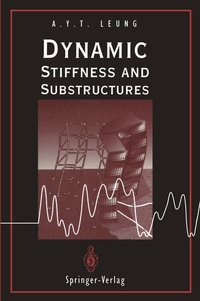
Dynamic Stiffness and Substructures
Published on 4. December 2011
Book
Paperback/Softback
VIII, 242 pages
978-1-4471-2028-5 (ISBN)
Description
Dynamic Stiffness and Substructures
models a complex dynamic system and offers a solution to the advanced dynamical problem associated with the effects of wind and earthquakes on structures. Since the system matrices are inevitably frequency dependant, those are exclusively considered in this publication. The relation between the frequency matrices by the Leung's theorem is most important in the development of efficient algorithms for the natural modes. This new approach was developed by the author over the past 15 years. It offers practising engineers and researchers a wide choice for structural modelling and analysis. Abundant numerical examples enable the reader to understand the theorem and to apply the methods.
More details
Edition
Softcover reprint of the original 1st ed. 1993
Language
English
Place of publication
London
United Kingdom
Target group
Professional and scholarly
Research
Illustrations
VIII, 242 p.
Dimensions
Height: 235 mm
Width: 155 mm
Thickness: 14 mm
Weight
388 gr
ISBN-13
978-1-4471-2028-5 (9781447120285)
DOI
10.1007/978-1-4471-2026-1
Schweitzer Classification
Other editions
Additional editions
Andrew Y.T. Leung
Dynamic Stiffness and Substructures
Book
10/1993
Springer
€85.55
Article exhausted; check different version
Content
1 Harmonic Analysis.- 1.1 Steady State.- 1.2 Multiple Degrees of Freedom.- 1.3 Modal Analysis and Acceleration.- 2 Finite Elements and Continuum Elements.- 2.1 Formulation.- 2.2 Bar Elements.- 2.3 Beam Elements.- 2.4 Continuous Mass Model.- 2.5 Rectangular Plate.- 2.6 Interaction Between Beams and Plates.- 2.7 Leung's Theorem.- 2.8 Simpson's Hypothesis.- 2.9 Sturm's Theorem.- 2.10 Wittrick-Williams Algorithm.- 2.11 Derivatives of the Dynamic Stiffness.- 3 Dynamic Substructures.- 3.1 Exact Dynamic Condensation.- 3.2 Dynamic Substructures.- 3.3 Dynamic Flexibility.- 3.4 Dynamic Transformation.- 3.5 Damped Substructures.- 3.6 Multilevel Substructures.- 3.7 Non-conservative Substructures.- 3.8 Substructure Response.- 3.9 Periodic Structures.- 3.10 Derivatives of Substructure.- 4 Dynamic Stiffness.- 4.1 Follower Force.- 4.2 Parametrically Excited Members.- 4.3 Effects of In-Plane Moment.- 4.4 Reponse Analysis.- 4.5 Non-conservative Modal Analysis.- 4.6 Exponentially Varying Harmonic Excitations.- 5 General Formulation.- 5.1 Initial Stress Formulation.- 5.2 Finite Element Method.- 5.3 Dynamic Stiffness Method.- 5.4 Thin-Walled Beam.- 5.5 Shear Deformable Thin-Walled Beam.- 5.6 Analytical Dynamic Stiffness.- 5.7 Curved Thin-Walled Beam.- 5.8 Helix.- 5.9 Curvature Effect.- 5.10 Extensions.- 5.11 Symmetry of the Dynamic Stiffness Matrix.