

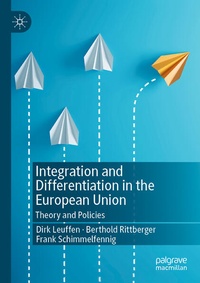
Integration and Differentiation in the European Union
Description
Far from displaying a uniform pattern, European integration varies significantly across policy areas and individual countries. Why do some member states choose to opt out of specific EU policies? Why are some policies deeply integrated whereas others remain intergovernmental? In this updated second edition, the authors introduce the most important theoretical approaches to European integration and apply these to the trajectories of key EU policy areas. Arguing that no single theory offers a completely convincing explanation of integration and differentiation in the EU, this thought-provoking book provides a new synthesis of integration theory and an original way of thinking about what the EU is and how it works.
Reviews / Votes
" Differentiated Integration offers a pathbreaking, and highly successful, attempt to make sense of the increasingly complex nature of European integration. Leuffen, Rittberger, and Schimmelfennig provide a clear and original theoretical framework for understanding both 'vertical' and 'horizontal' differentiation, and apply it to the most important areas of EU policy. This second edition, moreover, engages the many European crises and the politicization of the past decade, demonstrating that differentiation has only become more central to the politics of the European Union." (Mark Pollack, Temple University, USA)"This book deconstructs the conventional view of the European Union as moving towards an ever closer union. It demonstrates how and why the EU has not only become ever more integrated but also more differentiated across policy areas and member states. The book is an indispensable read for anyone who seeks a comprehensive understandingof why the EU has always been more than any international organization without heading towards state-building." ( Tanja Börzel , Free University Berlin, Germany)
"Differentiation is one of the signal characteristics of the European Union, and one that is critical for its future development. This book provides a comprehensive, sophisticated, and accessible discussion of the nature of differentiation, its causes, and its consequences. It is required reading for students of European politics." ( Gary Marks, University of North Carolina at Chapel Hill (USA) and European University Institute, Florence (Italy))
"This book offers as good an introduction to the theory and policy of the European Union as currently exists-embedded within is a subtle and sophisticated understanding of crises that have hit the EU over the past decade." ( Andrew Moravcsik, Princeton University, USA)
More details
Other editions
Additional editions
Persons
Dirk Leuffen
is Professor of International Politics at the Department of Politics and Public Administration, University of Konstanz, Germany.
Berthold Rittberger
is Professor of International Relations at the Geschwister-Scholl-Institute of Political Science, University of Munich, Germany.
Frank Schimmelfennig
is Professor of European Politics at ETH Zurich, Center for Comparative and International Studies, Switzerland.