

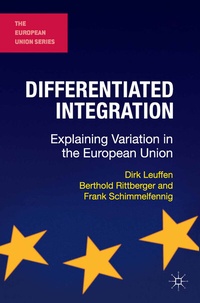
Differentiated Integration
Explaining Variation in the European Union
Published on 3. October 2012
Book
Paperback/Softback
XXIX, 287 pages
978-0-230-24644-7 (ISBN)
Description
Far from displaying a uniform pattern of integration, the European Union varies significantly across policy areas, institutional development and individual countries. Why do some policies such as the Single Market attract non-EU member states, while some member states choose to opt out of other EU policies? In answering these questions, this innovative new text provides a state-of-the-art introduction to the study of European integration.
The authors introduce the most important theories of European integration and apply these to the trajectories of key EU policy areas - including the single market, monetary policy, foreign and security policy, and justice and home affairs. Arguing that no single theory offers a completely convincing explanation of integration and differentiation in the EU, the authors put forward a new analytical perspective for describing and explaining the institutions and policies of the EU and their development over time. Written by a team of prominent scholars in the field, this thought-provoking book provides a new synthesis of integration theory and an original way of thinking about what the EU is and how it works.
The authors introduce the most important theories of European integration and apply these to the trajectories of key EU policy areas - including the single market, monetary policy, foreign and security policy, and justice and home affairs. Arguing that no single theory offers a completely convincing explanation of integration and differentiation in the EU, the authors put forward a new analytical perspective for describing and explaining the institutions and policies of the EU and their development over time. Written by a team of prominent scholars in the field, this thought-provoking book provides a new synthesis of integration theory and an original way of thinking about what the EU is and how it works.
Reviews / Votes
'A superb book, highly recommended. It offers a pathfinding - and highly successful - attempt to make sense of the differentiation of European integration providing a clear and original theoretical framework and applying it empirically in some of the most important areas of EU policy.' - Mark Pollack, Temple University, USA 'Both profound and accessible. Drawing on the major theories of European integration and their own research, the authors have provided a comprehensive and illuminating overview of the major issues in the study of the European Union.' - Gary Marks, University of North Carolina at Chapel Hill, USAMore details
Series
Edition
2012
Language
English
Place of publication
London
United Kingdom
Publishing group
Bloomsbury Publishing PLC
Target group
College/higher education
Illustrations
XXIX, 287 p.
Dimensions
Height: 23.5 cm
Width: 15.5 cm
Weight
4861 gr
ISBN-13
978-0-230-24644-7 (9780230246447)
DOI
10.1007/978-1-137-28501-0
Schweitzer Classification
Other editions
Additional editions
Dirk Leuffen | Berthold Rittberger | Frank Schimmelfennig
Differentiated Integration
Explaining Variation in the European Union
Book
10/2012
Red Globe Press
€135.88
Article exhausted; check different version
Persons
Dirk Leuffen is Professor of International Politics at the Department of Politics and Public Administration, University of Konstanz, Germany.
Berthold Rittberger is Professor of International Relations at the Geschwister-Scholl-Institute of Political Science, University of Munich, Germany.
Frank Schimmelfennig is Professor of European Politics at ETH Zurich, Center for Comparative and International Studies, Switzerland.
Berthold Rittberger is Professor of International Relations at the Geschwister-Scholl-Institute of Political Science, University of Munich, Germany.
Frank Schimmelfennig is Professor of European Politics at ETH Zurich, Center for Comparative and International Studies, Switzerland.
Content
Introduction.- The European Union as a System of Differentiated Integration.- PART I: THEORY Intergovernmentalism.- Supranationalism.- Constructivism.- PART II: POLICIES The Single Market.- Economic and Monetary Union.- Security and Defence.- The Area of Freedom, Security, and Justice.- Conclusions: Integration and differentiation in the European Union.