

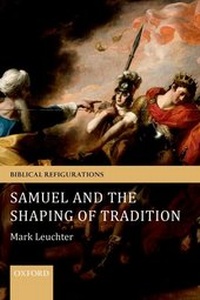
Samuel and the Shaping of Tradition
Published on 21. March 2013
Book
Hardback
168 pages
978-0-19-965934-0 (ISBN)
Description
Samuel stands out in many important biblical texts as the figure who facilitated ancient Israel's transition from a tribal league to a monarchic state.
On the surface of the text, this transition appears clear and linear, as does Samuel's role in bringing Israel together as a nation and selecting its first kings. Beneath this surface, however, is a far more complicated network of memories, sources and agendas, each presenting a very different picture of Samuel and his social, religious and ideological function. In some sources, Samuel serves as a symbol of Israel's developing priesthood and its system of social ethics, demonstrating the tensions within the priestly ranks. In others, Samuel's prophetic status is utilized to periodize Israel's history into distinct categories, positioning prophets over monarchs as national authorities. Elsewhere, Samuel is recruited to qualify - and disqualify - different forms of political organization in pre-monarchic Israel and systems of social hierarchy. Finally, the Jewish and Christian exegetical traditions return to the figure of Samuel and mine the texts in which he appears to re-structure Israel's national identity and the later communities that claimed descent from it.
Mark Leuchter explores how the Samuel of these sources differs from the Samuel of the final form of the text, how the different writers used him to shape their ideas and transmit their messages, and how Samuel functions as a vehicle for the creation of a more elaborate literary superstructure drawn from discreet sources.
On the surface of the text, this transition appears clear and linear, as does Samuel's role in bringing Israel together as a nation and selecting its first kings. Beneath this surface, however, is a far more complicated network of memories, sources and agendas, each presenting a very different picture of Samuel and his social, religious and ideological function. In some sources, Samuel serves as a symbol of Israel's developing priesthood and its system of social ethics, demonstrating the tensions within the priestly ranks. In others, Samuel's prophetic status is utilized to periodize Israel's history into distinct categories, positioning prophets over monarchs as national authorities. Elsewhere, Samuel is recruited to qualify - and disqualify - different forms of political organization in pre-monarchic Israel and systems of social hierarchy. Finally, the Jewish and Christian exegetical traditions return to the figure of Samuel and mine the texts in which he appears to re-structure Israel's national identity and the later communities that claimed descent from it.
Mark Leuchter explores how the Samuel of these sources differs from the Samuel of the final form of the text, how the different writers used him to shape their ideas and transmit their messages, and how Samuel functions as a vehicle for the creation of a more elaborate literary superstructure drawn from discreet sources.
More details
Series
Language
English
Place of publication
Oxford
United Kingdom
Target group
College/higher education
Professional and scholarly
Dimensions
Height: 210 mm
Width: 141 mm
Thickness: 18 mm
Weight
312 gr
ISBN-13
978-0-19-965934-0 (9780199659340)
Copyright in bibliographic data and cover images is held by Nielsen Book Services Limited or by the publishers or by their respective licensors: all rights reserved.
Schweitzer Classification
Other editions
Additional editions
Mark Leuchter
Samuel and the Shaping of Tradition
E-Book
03/2013
1st Edition
OUP eBook
€25.99
Available for download
Mark Leuchter
Samuel and the Shaping of Tradition
Book
03/2013
Oxford University Press
€45.00
Shipment within 15-20 days
Person
Mark Leuchter (PhD, University of Toronto, 2003) is associate professor of Religion and director of Jewish Studies at Temple University in Philadelphia. His research focuses on the history and development of the Israelite priesthood, ethno-mythology in ancient Israel, and scribal methods in the production of the Hebrew Bible and early rabbinic literature.
Content
Introduction ; 1. Viewing Samuel through a Deuteronomistic Lens ; 2. Samuel as a Levite ; 3. Samuel as a Prophet ; 4. Samuel as a Judge ; Conclusion