

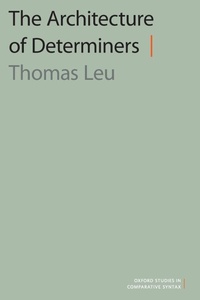
The Architecture of Determiners
Published on 15. January 2015
Book
Paperback/Softback
240 pages
978-0-19-994525-2 (ISBN)
Description
Work in morphology is typically concerned with productive word formation and regular inflection, in any event with open class categories such as verbs, nouns, and adjectives, and their various forms. The Architecture of Determiners, by contrast, is devoted to a set of function words: the closed class of determiners. While it is traditionally assumed that function words are syntactically atomic, Thomas Leu shows that a comparative perspective on a series of determiners - each insistently vivisected into its minimal morphotactic segments - reveals an anatomy with properties analogous to clausal syntax, including a lexical, an inflectional, and left peripheral layer, as well as transformational relations among subconstituents. Leu argues that determiners are extended adjectival projections with a closed class minimal stem.
Leu focuses on Swiss German and German, using other Germanic and non-Germanic languages as a comparative domain. His discussion of the internal structure of determiners includes demonstratives (ch.2), distributive quantifiers (ch.4), possessive and negative determiners (ch.5), and interrogative determiners such as 'was fuer' (ch.6). His main claim - that all of these involve extended adjectival projections - connects naturally to a discussion of adjectival / determiner inflection in German. Chapter 3 addresses the oft-debated strong versus weak agreement alternation in a novel way, proposing that the adjective moves within its own extended projection, in a way akin to verb movement to C in the clause. This accounts for the central facts of nominative and accusative inflection. Chapter 7, then, addresses dative and genitive morphology, setting them syntactically apart from adjectival / determiner inflection in a way that leads to a surprising account of most of the systematic (meta-) syncretism patterns in German adjectival inflection.
Leu focuses on Swiss German and German, using other Germanic and non-Germanic languages as a comparative domain. His discussion of the internal structure of determiners includes demonstratives (ch.2), distributive quantifiers (ch.4), possessive and negative determiners (ch.5), and interrogative determiners such as 'was fuer' (ch.6). His main claim - that all of these involve extended adjectival projections - connects naturally to a discussion of adjectival / determiner inflection in German. Chapter 3 addresses the oft-debated strong versus weak agreement alternation in a novel way, proposing that the adjective moves within its own extended projection, in a way akin to verb movement to C in the clause. This accounts for the central facts of nominative and accusative inflection. Chapter 7, then, addresses dative and genitive morphology, setting them syntactically apart from adjectival / determiner inflection in a way that leads to a surprising account of most of the systematic (meta-) syncretism patterns in German adjectival inflection.
More details
Series
Language
English
Place of publication
New York
United States
Target group
College/higher education
Professional and scholarly
Dimensions
Height: 234 mm
Width: 156 mm
Thickness: 14 mm
Weight
405 gr
ISBN-13
978-0-19-994525-2 (9780199945252)
Copyright in bibliographic data and cover images is held by Nielsen Book Services Limited or by the publishers or by their respective licensors: all rights reserved.
Schweitzer Classification
Other editions
Additional editions
Thomas Leu
The Architecture of Determiners
Book
01/2015
Oxford University Press Inc
€210.30
Shipment within 15-20 days
Thomas Leu
The Architecture of Determiners
E-Book
11/2014
1st Edition
OUP eBook
€24.99
Available for download
Person
Thomas Leu is Professor of Linguistics at the Universite du Quebec a Montreal. He is a co-editor of An Annotated Syntax Reader: Lasting Insights and Questions (2013).
Content
1. Introduction ; 2. Definite demonstratives ; 3. xAP ; 4. Definite quantifiers ; 5. Ein-determiners ; 6. ADJ and INV variants among Wh- and S-determiners ; 7. Case and syncretism ; 8. Conclusion ; References