

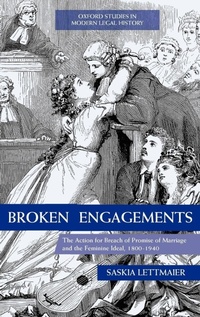
Broken Engagements
The Action for Breach of Promise of Marriage and the Feminine Ideal, 1800-1940
1st Edition
Published on 11. February 2010
Book
Hardback
240 pages
978-0-19-956997-7 (ISBN)
Description
The common law action for breach of promise of marriage originated in the mid-seventeenth century, but it was not until the nineteenth century that it rose to prominence and became a regular feature in law courts and gossip columns. By 1940 the action was defunct, it was inconceivable for a respectable woman to bring such a case before the courts. What accounts for this dramatic rise and fall?
This book ties the story of the action's prominence and decline between 1800 and 1940 to changes in the prevalent conception of woman, her ideal role in society, sexual relations, and the family. It argues that the idiosyncratic breach-of-promise suit and Victorian notions of ideal femininity were inextricably, and fatally, entwined. It presents the nineteenth-century breach-of-promise action as a codification of the Victorian ideal of true womanhood and explores the longer-term implications of this infusion of mythologized femininity for the law, in particular for the position of plaintiffs.
Surveying three consecutive time periods - the early nineteenth century, the high Victorian and the post-Victorian periods - and adopting an interdisciplinary approach that combines the perspectives of legal history, social history, and literary analysis, it argues that the feminizing process, by shaping a cause of action in accordance with an ideal at odds with the very notion of women going to law, imported a fatal structural inconsistency that at first remained obscured, but ultimately vulgarized and undid the cause of action. Alongside more than two hundred and fifty real-life breach-of-promise cases, the book examines literary and cinematic renditions of the breach-of-promise theme, by artists ranging from Charles Dickens to P.G. Wodehouse, to expose the subtle yet unmistakable ways in which what happened (and what changed) in the breach-of-promise courtroom influenced the changing representation of the breach-of-promise plaintiff in nineteenth- and early twentieth-century literature and film.
This book ties the story of the action's prominence and decline between 1800 and 1940 to changes in the prevalent conception of woman, her ideal role in society, sexual relations, and the family. It argues that the idiosyncratic breach-of-promise suit and Victorian notions of ideal femininity were inextricably, and fatally, entwined. It presents the nineteenth-century breach-of-promise action as a codification of the Victorian ideal of true womanhood and explores the longer-term implications of this infusion of mythologized femininity for the law, in particular for the position of plaintiffs.
Surveying three consecutive time periods - the early nineteenth century, the high Victorian and the post-Victorian periods - and adopting an interdisciplinary approach that combines the perspectives of legal history, social history, and literary analysis, it argues that the feminizing process, by shaping a cause of action in accordance with an ideal at odds with the very notion of women going to law, imported a fatal structural inconsistency that at first remained obscured, but ultimately vulgarized and undid the cause of action. Alongside more than two hundred and fifty real-life breach-of-promise cases, the book examines literary and cinematic renditions of the breach-of-promise theme, by artists ranging from Charles Dickens to P.G. Wodehouse, to expose the subtle yet unmistakable ways in which what happened (and what changed) in the breach-of-promise courtroom influenced the changing representation of the breach-of-promise plaintiff in nineteenth- and early twentieth-century literature and film.
Reviews / Votes
On the whole, Lettmaiers study provides fascinating insights into the construction of an ideal of femininity and its ramifications in legal practice. * Jochen Petzold, Zeitschrift fuer Anglistik und Amerikanistik Redaktion * ...knowledgable and wide-ranging investigation into the history of the common law action for breach of promise of marriage...she [Lettmaier] has convincingly straddled the disciplinary divide between legal history and literary criticism. * Silvia Mergenthal, Archiv *More details
Series
Language
English
Place of publication
Oxford
United Kingdom
Target group
College/higher education
Scholars in Women's (Legal) History, Legal Historians, Scholars and Students in Law and Literature, Literary Historians, Nineteenth Century Social Historians
Dimensions
Height: 240 mm
Width: 161 mm
Thickness: 17 mm
Weight
514 gr
ISBN-13
978-0-19-956997-7 (9780199569977)
Copyright in bibliographic data and cover images is held by Nielsen Book Services Limited or by the publishers or by their respective licensors: all rights reserved.
Schweitzer Classification
Person
Saskia Lettmaier is a jurist trained in both Anglo-American and German law. She obtained her B.A. in Jurisprudence from Oxford University in 2002, being awarded a First as well as the St. Anne's College Law Prize. She holds a German law degree, an LL.M. degree from Harvard University (2003) and a doctorate in Cultural Studies from the University of Bamberg (summa cum laude, 2007). She has lectured in law and in Victorian culture at the universities of Bamberg, Erlangen-Nuremberg, and Cork, and published articles on law as well as on the intersection between law and literature. She is currently a Research Fellow at the University of Regensburg and an S.J.D. Candidate and Fritz Thyssen Scholar at the Harvard Law School, where she also serves on the Harvard Journal of Law and Gender.
Content
Introduction ; I. Situating the Project: Law, Cultural Ideology, and Nineteenth-Century Women's History ; II. Tools of Analysis: Empiricism and Literature ; 1. Codifying Womanhood: The Nineteenth-Century Action for Breach of Promise of Marriage as the Legal Expression of the Ideal of True Womanhood ; 2. A Structural Inconsistency: The True Woman and the Breach-of-Promise Plaintiff ; 3. Breach of Promise in the Early Nineteenth Century (1800-50): Strategies of Containment, a Created Inconsistency, and the Aesthetic of the Grotesque ; 4. Breach of Promise in the High Victorian Period (1850-1900): The Inconsistency Unveiled, Pinchbeck Angels, and the Dominance of Satire ; 5. Breach of Promise in the Post-Victorian Period (1900-40): A Changing Ideal, the Action>'s Decline, and the Symbolism of Breach of Promise ; Epilogue: The Power of the Image