

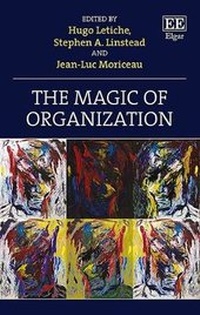
The Magic of Organization
Published on 18. September 2020
Book
Hardback
320 pages
978-1-83910-672-9 (ISBN)
Description
Exploring magic as a creative necessity in contemporary business, this book clarifies the differences between magic as an organizational resource and magic as fakery, pretence and manipulation. Using this lens, it highlights insights into the relationship between anthropology and business, and organizational studies.
The Magic of Organization looks at our economy and its dependence on magic, as success depends on innovation and creativity to produce the unexpected and amazing; but perhaps also the bogus and deceitful. Exposing the unpredictability of magic, the book reveals clear links between magic and uncontrollable and non-linear ways of organizing. Chapters discuss the double-edged sword of magic: while organizations, economies and finance depend on magical thought and actions for inspiration and surprise, they also fear them; what if the magic is real?
With its clarity on how the turn-to-ontology in anthropology is significant for organizational studies, this book will be an illuminating read for students of creativity and innovation.
The Magic of Organization looks at our economy and its dependence on magic, as success depends on innovation and creativity to produce the unexpected and amazing; but perhaps also the bogus and deceitful. Exposing the unpredictability of magic, the book reveals clear links between magic and uncontrollable and non-linear ways of organizing. Chapters discuss the double-edged sword of magic: while organizations, economies and finance depend on magical thought and actions for inspiration and surprise, they also fear them; what if the magic is real?
With its clarity on how the turn-to-ontology in anthropology is significant for organizational studies, this book will be an illuminating read for students of creativity and innovation.
More details
Language
English
Place of publication
Cheltenham
United Kingdom
Target group
Professional and scholarly
Dimensions
Height: 234 mm
Width: 156 mm
ISBN-13
978-1-83910-672-9 (9781839106729)
Copyright in bibliographic data and cover images is held by Nielsen Book Services Limited or by the publishers or by their respective licensors: all rights reserved.
Schweitzer Classification
Persons
Edited by Hugo Letiche, Professor of Organization and Education, ISTEC, Paris, France, Visiting Fellow, Nyenrode Business University, Breukelen, the Netherlands and member of LITEM, a research lab of the Universite Paris-Saclay, France, Stephen A. Linstead, Professor of Management Humanities, The York Management School, University of York, UK and Jean-Luc Moriceau, Professor of Research Methods and Accountability, Institut Mines-Telecom Business School, member of LITEM (University of Paris Saclay), Evry/Paris, France
Content
Contents:
List of contributors vii
1 Introduction 1
Hugo Letiche, Stephen A. Linstead and Jean-Luc Moriceau
PART I MAGIC AND IMAGINATION
2 Introductory chapter to Part I - magic and imagination:
taking strategy into the unknown 26
Per Olof Berg
3 The return of the Magi: image magic and the
institutionalisation of kitsch therapeutic fantasy 59
James Fairhead
4 The persistence of magic: management and the new alchemy 82
Iain Munro
5 The intra-act of accounting 99
Ivo De Loo, Alan Lowe and Philip Smith
6 Risk management and the magical arts: rituals of risk
calculation in the banking industry 125
Peter Case and Peter Pelzer
7 Markets and machines: the magic of predicting, obscuring
and securing value 143
Geoff Lightfoot and Simon Lilley
PART II MAGIC AND ITS TRANSGRESSIONS
8 Introductory chapter to Part II - magic being re-understood 160
Hugo Letiche
9 Grammarye, grammatization, grammatology:
interviewing technique as a magic trick 190
Jean-Luc Moriceau
10 Artaud's dissolute magic: some thoughts on ambivalent desires 207
Heather Hoepfl
11 Magification as bunny(-fication) 224
Hugo Letiche
12 Magic or the presence of absence 239
Michael Lazarin
13 Schwung magic: aesthetic subversion of organization in
the philosophy of Deleuze and Guattari 263
Pierre Guillet de Monthoux
Afterword 275
Hugo Letiche, Stephen A. Linstead and Jean-Luc Moriceau
List of contributors vii
1 Introduction 1
Hugo Letiche, Stephen A. Linstead and Jean-Luc Moriceau
PART I MAGIC AND IMAGINATION
2 Introductory chapter to Part I - magic and imagination:
taking strategy into the unknown 26
Per Olof Berg
3 The return of the Magi: image magic and the
institutionalisation of kitsch therapeutic fantasy 59
James Fairhead
4 The persistence of magic: management and the new alchemy 82
Iain Munro
5 The intra-act of accounting 99
Ivo De Loo, Alan Lowe and Philip Smith
6 Risk management and the magical arts: rituals of risk
calculation in the banking industry 125
Peter Case and Peter Pelzer
7 Markets and machines: the magic of predicting, obscuring
and securing value 143
Geoff Lightfoot and Simon Lilley
PART II MAGIC AND ITS TRANSGRESSIONS
8 Introductory chapter to Part II - magic being re-understood 160
Hugo Letiche
9 Grammarye, grammatization, grammatology:
interviewing technique as a magic trick 190
Jean-Luc Moriceau
10 Artaud's dissolute magic: some thoughts on ambivalent desires 207
Heather Hoepfl
11 Magification as bunny(-fication) 224
Hugo Letiche
12 Magic or the presence of absence 239
Michael Lazarin
13 Schwung magic: aesthetic subversion of organization in
the philosophy of Deleuze and Guattari 263
Pierre Guillet de Monthoux
Afterword 275
Hugo Letiche, Stephen A. Linstead and Jean-Luc Moriceau