

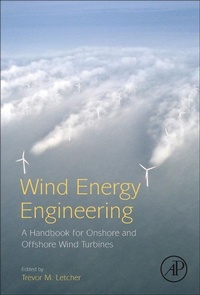
Wind Energy Engineering
A Handbook for Onshore and Offshore Wind Turbines
Published on 16. May 2017
Book
Hardback
622 pages
978-0-12-809451-8 (ISBN)
Description
Wind Energy Engineering: A Handbook for Onshore and Offshore Wind Turbines is the most advanced, up-to-date and research-focused text on all aspects of wind energy engineering. Wind energy is pivotal in global electricity generation and for achieving future essential energy demands and targets. In this fast moving field this must-have edition starts with an in-depth look at the present state of wind integration and distribution worldwide, and continues with a high-level assessment of the advances in turbine technology and how the investment, planning, and economic infrastructure can support those innovations.
Each chapter includes a research overview with a detailed analysis and new case studies looking at how recent research developments can be applied. Written by some of the most forward-thinking professionals in the field and giving a complete examination of one of the most promising and efficient sources of renewable energy, this book is an invaluable reference into this cross-disciplinary field for engineers.
Each chapter includes a research overview with a detailed analysis and new case studies looking at how recent research developments can be applied. Written by some of the most forward-thinking professionals in the field and giving a complete examination of one of the most promising and efficient sources of renewable energy, this book is an invaluable reference into this cross-disciplinary field for engineers.
More details
Language
English
Place of publication
San Diego
United States
Publishing group
Elsevier Science Publishing Co Inc
Target group
Professional and scholarly
Energy engineers, researchers, graduate students, professors and lecturers in Engineering, scientists and engineers working in energy, industrialists and engineers working in future energy developments
Product notice
sewn/stitched
Cloth over boards
Illustrations
Illustrated
Dimensions
Height: 236 mm
Width: 156 mm
Thickness: 38 mm
Weight
1117 gr
ISBN-13
978-0-12-809451-8 (9780128094518)
Copyright in bibliographic data and cover images is held by Nielsen Book Services Limited or by the publishers or by their respective licensors: all rights reserved.
Schweitzer Classification
Other editions
New editions
Book
05/2023
2nd Edition
Academic Press
€191.50
Shipment within 15-20 days
Additional editions
E-Book
05/2017
1st Edition
Academic Press
€138.00
Available for download
Person
Professor Trevor Letcher is an Emeritus Professor at the University of KwaZulu-Natal, South Africa, and living in the United Kingdom. He was previously Professor of Chemistry, and Head of Department, at the University of the Witwatersrand, Rhodes University, and Natal, in South Africa (1969-2004). He has published over 300 papers on areas such as chemical thermodynamic and waste from landfill in peer reviewed journals, and 100 papers in popular science and education journals. Prof. Letcher has edited and/or written 32 major books, of which 22 were published by Elsevier, on topics ranging from future energy, climate change, storing energy, waste, tyre waste and recycling, wind energy, solar energy, managing global warming, plastic waste, renewable energy, and environmental disasters. He has been awarded gold medals by the South African Institute of Chemistry and the South African Association for the Advancement of Science, and the Journal of Chemical Thermodynamics honoured him with a Festschrift in 2018. He is a life member of both the Royal Society of Chemistry (London) and the South African Institute of Chemistry. He is on the editorial board of the Journal of Chemical Thermodynamics, and is a Director of the Board of the International Association of Chemical Thermodynamics since 2002.
Content
A. INTRODUCTION
B. WIND RESOURCE
How is wind generated?
Wind speeds, wind force, wind power
Theory of wind energy
Wind power density
Theoretical power captured by a wind turbine
Wind distribution world-wide
C. WIND TURBINE TECHNOLOGY
History of harnessing wind power
Design of horizontal axis wind turbines (power control, stall, generator torque, Yawing, electrical and mechanical braking, turbine size, generator type, blade design, material and count, tower height)
Design of vertical axis wind turbines (including Savonius type, designs, advantages)
Aerodynamics (drag, lift, maximum power, axial momentum, angular momentum, wake rotation, blade element and momentum theory)
Turbine blade size and maximum power output
Wind Turbine components (blades, gearbox, rotor shaft, brake, magnets, etc)
Variable speed drives
Speed
Power generation, synchronous and asynchronous generators
Operation and Maintenance
Wind energy measurements
D. GENERATION OF ELECTRICITY
Wind farms
Integration into National Grids
Small scale wind turbines
Storing energy from wind turbines
E. PLANNING and EXECUTION OF WIND PROJECTS
Development
Politics and public opinion
Prospecting
Financing
Time frame
Commissioning
Installation
F. WIND ENERGY WORLD WIDE
Comparison of on-shore and off-shore
Countries investing in on-shore wind power
Countries developing and producing wind turbines
G. ENVIRONMENTAL IMPACTS OF WIND ENERGY
Life cycle of energy input and output
Impact on wild life, impact on livestock
Impact on humans, noise, landscape and aesthetics, community benefits and incentives, safety
Land use
Rare earth use (magnets)
H. FINANCIAL MODELING/WIND ENERGY ECONOMICS
Net energy gain
Energy return on investment (EROI)
Incentives
Revenue
I. REGULATIONS
J. GROWTH TRENDS AND THE FUTURE OF WIND ENERGY
B. WIND RESOURCE
How is wind generated?
Wind speeds, wind force, wind power
Theory of wind energy
Wind power density
Theoretical power captured by a wind turbine
Wind distribution world-wide
C. WIND TURBINE TECHNOLOGY
History of harnessing wind power
Design of horizontal axis wind turbines (power control, stall, generator torque, Yawing, electrical and mechanical braking, turbine size, generator type, blade design, material and count, tower height)
Design of vertical axis wind turbines (including Savonius type, designs, advantages)
Aerodynamics (drag, lift, maximum power, axial momentum, angular momentum, wake rotation, blade element and momentum theory)
Turbine blade size and maximum power output
Wind Turbine components (blades, gearbox, rotor shaft, brake, magnets, etc)
Variable speed drives
Speed
Power generation, synchronous and asynchronous generators
Operation and Maintenance
Wind energy measurements
D. GENERATION OF ELECTRICITY
Wind farms
Integration into National Grids
Small scale wind turbines
Storing energy from wind turbines
E. PLANNING and EXECUTION OF WIND PROJECTS
Development
Politics and public opinion
Prospecting
Financing
Time frame
Commissioning
Installation
F. WIND ENERGY WORLD WIDE
Comparison of on-shore and off-shore
Countries investing in on-shore wind power
Countries developing and producing wind turbines
G. ENVIRONMENTAL IMPACTS OF WIND ENERGY
Life cycle of energy input and output
Impact on wild life, impact on livestock
Impact on humans, noise, landscape and aesthetics, community benefits and incentives, safety
Land use
Rare earth use (magnets)
H. FINANCIAL MODELING/WIND ENERGY ECONOMICS
Net energy gain
Energy return on investment (EROI)
Incentives
Revenue
I. REGULATIONS
J. GROWTH TRENDS AND THE FUTURE OF WIND ENERGY