

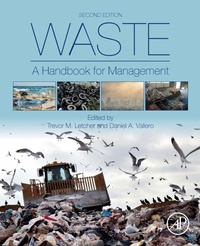
Waste
A Handbook for Management
2nd Edition
Published on 5. March 2019
Book
Paperback/Softback
803 pages
978-0-12-815060-3 (ISBN)
Description
Waste: A Handbook for Management, Second Edition, provides information on a wide range of hot topics and developing areas, such as hydraulic fracturing, microplastics, waste management in developing countries, and waste-exposure-outcome pathways. Beginning with an overview of the current waste landscape, including green engineering, processing principles and regulations, the book then outlines waste streams and treatment methods for over 25 different types of waste and reviews best practices and management, challenges for developing countries, risk assessment, contaminant pathways and risk tradeoffs.
With an overall focus on waste recovery, reuse, prevention and lifecycle analysis, the book draws on the experience of an international team of expert contributors to provide reliable guidance on how best to manage wastes for scientists, managers, engineers and policymakers in both the private and public sectors.
With an overall focus on waste recovery, reuse, prevention and lifecycle analysis, the book draws on the experience of an international team of expert contributors to provide reliable guidance on how best to manage wastes for scientists, managers, engineers and policymakers in both the private and public sectors.
More details
Edition
2nd edition
Language
English
Place of publication
San Diego
United States
Publishing group
Elsevier Science Publishing Co Inc
Target group
Professional and scholarly
Scientists, engineers, legislators and collaborators in all areas of waste management, including environmental scientists and engineers in both academia and industry, government officials, waste managers, technicians, and maintenance personnel
Product notice
Paperback (trade)
Dimensions
Height: 233 mm
Width: 189 mm
Thickness: 50 mm
Weight
1624 gr
ISBN-13
978-0-12-815060-3 (9780128150603)
Copyright in bibliographic data and cover images is held by Nielsen Book Services Limited or by the publishers or by their respective licensors: all rights reserved.
Schweitzer Classification
Other editions
New editions
Book
approx. 11/2026
3rd Edition
Elsevier
€184.50
Not yet published
Additional editions
E-Book
03/2019
2nd Edition
Academic Press
€113.00
Available for download
Previous edition
Book
03/2011
Academic Press
€86.65
Article exhausted; check for reprint
Persons
Professor Trevor Letcher is an Emeritus Professor at the University of KwaZulu-Natal, South Africa, and living in the United Kingdom. He was previously Professor of Chemistry, and Head of Department, at the University of the Witwatersrand, Rhodes University, and Natal, in South Africa (1969-2004). He has published over 300 papers on areas such as chemical thermodynamic and waste from landfill in peer reviewed journals, and 100 papers in popular science and education journals. Prof. Letcher has edited and/or written 32 major books, of which 22 were published by Elsevier, on topics ranging from future energy, climate change, storing energy, waste, tyre waste and recycling, wind energy, solar energy, managing global warming, plastic waste, renewable energy, and environmental disasters. He has been awarded gold medals by the South African Institute of Chemistry and the South African Association for the Advancement of Science, and the Journal of Chemical Thermodynamics honoured him with a Festschrift in 2018. He is a life member of both the Royal Society of Chemistry (London) and the South African Institute of Chemistry. He is on the editorial board of the Journal of Chemical Thermodynamics, and is a Director of the Board of the International Association of Chemical Thermodynamics since 2002. Professor Daniel A. Vallero is a renowned environmental scientist and engineer with four decades of experience. He has advised U.S. government agencies on critical issues like PBTs, climate change, acid rain, and chemical risks. At Duke University, he led the Engineering Ethics program and taught courses on air pollution, sustainable design, and ethics. Vallero has served on the National Academy of Engineering's Online Ethics Committee and the National Institute of Engineering Ethics. An expert in emerging technologies, he focuses on societal, ethical, and public health challenges related to nanotechnology and environmental biotechnology. His work also encompasses emergency response and homeland security, making him a leading voice in environmental risk and ethics.
Content
A. INTRODUCTION
1. Introduction to Waste Management
2. A Systems Approach to Waste Management
3. Regulation of Wastes
4. Waste Collection
5. Waste and Biogeochemical Cycling
B. WASTE STREAMS (and their treatment)
6. Mine Waste: A Brief Overview of Origins, Quantities, and Methods of Storage
7. Coal Waste Streams
8. Effect of Waste on Ecosystems
9. Oil and Gas Exploration and Production Wastes
10. Metal Waste
11. Radioactive Waste Management
12. The Municipal Landfill
13. Wastewater
14. Recovered Paper
15. Glass Waste
16. End-of-life textiles
17. Chemicals in Waste: Household Hazardous Waste
18. Reusing Non-hazardous Industrial Waste Across Business Clusters
19. Current and emerging construction waste management status, trends and approaches
20. Thermal Waste
21. Microplastics: emerging contaminants requiring multilevel management
22. Marine Plastic Pollution: other than micro-plastic
23. Plastic Waste: How Plastic has become Part of the Earth's Geological Cycle
24. Air Pollution: Atmospheric Wastes
25. Waste: Electrical and Electronic Equipment
26. Tyre Recycling
27. Medical Waste
28. Agricultural Waste and Pollution
29. Waste from Military Operations
30. Space waste
31. Hazardous Waste
32. Land Pollution
C. BEST PRACTICE AND MANAGEMENT
33. Waste Governance
34. Waste Constituent Pathways
35. Waste Management Accountability: Risk, Reliability and Resilience
36. Evaluating the feasibility of Public Projects
1. Introduction to Waste Management
2. A Systems Approach to Waste Management
3. Regulation of Wastes
4. Waste Collection
5. Waste and Biogeochemical Cycling
B. WASTE STREAMS (and their treatment)
6. Mine Waste: A Brief Overview of Origins, Quantities, and Methods of Storage
7. Coal Waste Streams
8. Effect of Waste on Ecosystems
9. Oil and Gas Exploration and Production Wastes
10. Metal Waste
11. Radioactive Waste Management
12. The Municipal Landfill
13. Wastewater
14. Recovered Paper
15. Glass Waste
16. End-of-life textiles
17. Chemicals in Waste: Household Hazardous Waste
18. Reusing Non-hazardous Industrial Waste Across Business Clusters
19. Current and emerging construction waste management status, trends and approaches
20. Thermal Waste
21. Microplastics: emerging contaminants requiring multilevel management
22. Marine Plastic Pollution: other than micro-plastic
23. Plastic Waste: How Plastic has become Part of the Earth's Geological Cycle
24. Air Pollution: Atmospheric Wastes
25. Waste: Electrical and Electronic Equipment
26. Tyre Recycling
27. Medical Waste
28. Agricultural Waste and Pollution
29. Waste from Military Operations
30. Space waste
31. Hazardous Waste
32. Land Pollution
C. BEST PRACTICE AND MANAGEMENT
33. Waste Governance
34. Waste Constituent Pathways
35. Waste Management Accountability: Risk, Reliability and Resilience
36. Evaluating the feasibility of Public Projects