

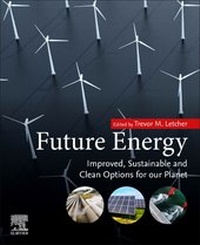
Future Energy
Improved, Sustainable and Clean Options for Our Planet
3rd Edition
Published on 16. January 2020
Book
Paperback/Softback
820 pages
978-0-08-102886-5 (ISBN)
Description
Future Energy: Improved, Sustainable and Clean Options for Our Planet, Third Edition provides scientists and decision-makers with the knowledge they need to understand the relative importance and magnitude of various energy production methods in order to make the energy decisions necessary for sustaining development and dealing with climate change. The third edition of Future Energy looks at the present energy situation and extrapolates to future scenarios related to global warming and the increase of carbon dioxide and other greenhouse gases in the atmosphere.
This thoroughly revised and updated edition contains over 40 chapters on all aspects of future energy, with each chapter updated and expanded by expert scientists and engineers in their respective fields.
This thoroughly revised and updated edition contains over 40 chapters on all aspects of future energy, with each chapter updated and expanded by expert scientists and engineers in their respective fields.
More details
Edition
3rd edition
Language
English
Place of publication
London
United Kingdom
Publishing group
Elsevier Health Sciences
Target group
College/higher education
Primary: Researchers working in the field of future energy, Government decision makers, Investors looking for new investments, Engineers and scientists working in the field of energySecondary: Students in environmental sciences and engineering (usually 3rd year or 4th year students as well as MSc and PhD students working in the area)
Illustrations
Approx. 200 illustrations (100 in full color)
Dimensions
Height: 235 mm
Width: 191 mm
Weight
1720 gr
ISBN-13
978-0-08-102886-5 (9780081028865)
Copyright in bibliographic data and cover images is held by Nielsen Book Services Limited or by the publishers or by their respective licensors: all rights reserved.
Schweitzer Classification
Other editions
Additional editions
E-Book
01/2020
3rd Edition
Elsevier
€143.00
Available for download
Previous edition
Book
12/2013
2nd Edition
Elsevier
€94.09
Shipment within 15-20 days
Person
Professor Trevor Letcher is an Emeritus Professor at the University of KwaZulu-Natal, South Africa, and living in the United Kingdom. He was previously Professor of Chemistry, and Head of Department, at the University of the Witwatersrand, Rhodes University, and Natal, in South Africa (1969-2004). He has published over 300 papers on areas such as chemical thermodynamic and waste from landfill in peer reviewed journals, and 100 papers in popular science and education journals. Prof. Letcher has edited and/or written 32 major books, of which 22 were published by Elsevier, on topics ranging from future energy, climate change, storing energy, waste, tyre waste and recycling, wind energy, solar energy, managing global warming, plastic waste, renewable energy, and environmental disasters. He has been awarded gold medals by the South African Institute of Chemistry and the South African Association for the Advancement of Science, and the Journal of Chemical Thermodynamics honoured him with a Festschrift in 2018. He is a life member of both the Royal Society of Chemistry (London) and the South African Institute of Chemistry. He is on the editorial board of the Journal of Chemical Thermodynamics, and is a Director of the Board of the International Association of Chemical Thermodynamics since 2002.
Content
Part I Introduction
1. Introduction with a Focus on Atmospheric Carbon Dioxide and Climate Change
Part II FOSSIL FUELS (ENERGY SOURCES)
2. Coal: Past, Present and Future Sustainable Use
3. Unconventional Oil and Gas: Oilsands
4. Shale Gas, Tight Oil, Shale Oil and Hydraulic Fracturing
5. Coal bed Methane: Reserves, Production, and Future Outlook
6. Natural Gas Hydrates: Status of Potential as an Energy Resource
Part III NUCLEAR POWER (ENERGY SOURCES)
7. Nuclear Fission- new Generation Reactors
8. Small Modular Nuclear Reactors
Part IV TRANSPORT ENERGY (ENERGY SOURCES)
9. Biofuels for Transport
10. Transport Fuel: Biomass-, coal-, gas- and waste-to-liquids processes
11. The Electric Vehicle Revolution
Part V ENERGY STORAGE
12. The use of Batteries in Storing Electricity
13. The use of Flow Batteries in Storing Electricity for National Grids
14. Compressed Air Energy Storage
Part VI RENEWABLES (ENERGY SOURCES)
15. Hydroelectric Power
16. Wind Energy
17. Tidal Current Energy: Origins and challenges
18. Solar Energy - Photovoltaics, including new technologies (thin film) and a discussion on panel efficiency
19. Concentrating Solar Power
20. Geothermal Energy
21. Energy from Biomass
Part VII NEW POSSIBLE ENERGY OPTIONS
22. Hydrogen: An Energy Carrier
23. Fuel Cells: Energy Conversion Technology
24. Space Solar
25. Nuclear Fusion
26. Synthetic Fuel Development
Part VIII ENVIRONMENTAL AND RELATED ISSUES
27. Energy and the Environment
28. Sustainable Energy and Energy Efficient Technologies
Part IX THE CURRENT SITUATION AND THE TRANSITION TO THE FUTURE
29. The Life Cycle Assessment of various Energy Technologies
30. Integration of high penetrations of intermittent renewable generation in future electricity networks, using storage
31. Carbon Capture and Storage
32. Energy Options and Predictions for China
33. Metals and Elements needed to support Future Energy
34. A Global Overview of Future Energy
1. Introduction with a Focus on Atmospheric Carbon Dioxide and Climate Change
Part II FOSSIL FUELS (ENERGY SOURCES)
2. Coal: Past, Present and Future Sustainable Use
3. Unconventional Oil and Gas: Oilsands
4. Shale Gas, Tight Oil, Shale Oil and Hydraulic Fracturing
5. Coal bed Methane: Reserves, Production, and Future Outlook
6. Natural Gas Hydrates: Status of Potential as an Energy Resource
Part III NUCLEAR POWER (ENERGY SOURCES)
7. Nuclear Fission- new Generation Reactors
8. Small Modular Nuclear Reactors
Part IV TRANSPORT ENERGY (ENERGY SOURCES)
9. Biofuels for Transport
10. Transport Fuel: Biomass-, coal-, gas- and waste-to-liquids processes
11. The Electric Vehicle Revolution
Part V ENERGY STORAGE
12. The use of Batteries in Storing Electricity
13. The use of Flow Batteries in Storing Electricity for National Grids
14. Compressed Air Energy Storage
Part VI RENEWABLES (ENERGY SOURCES)
15. Hydroelectric Power
16. Wind Energy
17. Tidal Current Energy: Origins and challenges
18. Solar Energy - Photovoltaics, including new technologies (thin film) and a discussion on panel efficiency
19. Concentrating Solar Power
20. Geothermal Energy
21. Energy from Biomass
Part VII NEW POSSIBLE ENERGY OPTIONS
22. Hydrogen: An Energy Carrier
23. Fuel Cells: Energy Conversion Technology
24. Space Solar
25. Nuclear Fusion
26. Synthetic Fuel Development
Part VIII ENVIRONMENTAL AND RELATED ISSUES
27. Energy and the Environment
28. Sustainable Energy and Energy Efficient Technologies
Part IX THE CURRENT SITUATION AND THE TRANSITION TO THE FUTURE
29. The Life Cycle Assessment of various Energy Technologies
30. Integration of high penetrations of intermittent renewable generation in future electricity networks, using storage
31. Carbon Capture and Storage
32. Energy Options and Predictions for China
33. Metals and Elements needed to support Future Energy
34. A Global Overview of Future Energy