

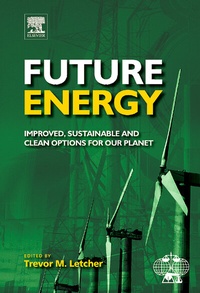
Future Energy
Improved, Sustainable and Clean Options for our Planet
Published on 30. July 2008
Book
Hardback
400 pages
978-0-08-054808-1 (ISBN)
Description
Future Energy will allow us to make reasonable, logical and correct decisions on our future energy as a result of two of the most serious problems that the civilized world has to face; the looming shortage of oil (which supplies most of our transport fuel) and the alarming rise in atmospheric carbon dioxide over the past 50 years (resulting from the burning of oil, gas and coal and the loss of forests) that threatens to change the world's climate through global warming.
Future Energy focuses on all the types of energy available to us, taking into account a future involving a reduction in oil and gas production and the rapidly increasing amount of carbon dioxide in our atmosphere. It is unique in the genre of books of similar title in that each chapter has been written by a scientist or engineer who is an expert in his or her field. The book is divided into four sections:
Traditional Fossil Fuel and Nuclear Energy
Renewable Energy
Potentially Important New Types of Energy
New Aspects to Future Energy Usage
Each chapter highlights the basic theory and implementation, scope, problems and costs associated with a particular type of energy. The traditional fuels are included because they will be with us for decades to come - but, we hope, in a cleaner form. The renewable energy types includes wind power, wave power, tidal energy, two forms of solar energy, bio-mass, hydroelectricity, geothermal and the hydrogen economy. Potentially important new types of energy include: pebble bed nuclear reactors, nuclear fusion, methane hydrates and recent developments in fuel cells and batteries.
Future Energy focuses on all the types of energy available to us, taking into account a future involving a reduction in oil and gas production and the rapidly increasing amount of carbon dioxide in our atmosphere. It is unique in the genre of books of similar title in that each chapter has been written by a scientist or engineer who is an expert in his or her field. The book is divided into four sections:
Traditional Fossil Fuel and Nuclear Energy
Renewable Energy
Potentially Important New Types of Energy
New Aspects to Future Energy Usage
Each chapter highlights the basic theory and implementation, scope, problems and costs associated with a particular type of energy. The traditional fuels are included because they will be with us for decades to come - but, we hope, in a cleaner form. The renewable energy types includes wind power, wave power, tidal energy, two forms of solar energy, bio-mass, hydroelectricity, geothermal and the hydrogen economy. Potentially important new types of energy include: pebble bed nuclear reactors, nuclear fusion, methane hydrates and recent developments in fuel cells and batteries.
More details
Language
English
Place of publication
Oxford
United Kingdom
Publishing group
Elsevier Science & Technology
Target group
College/higher education
Professional and scholarly
Students, professionals and researchers in energy engineering and the energy industry, as well as policymakers in government
Dimensions
Height: 240 mm
Width: 165 mm
Weight
960 gr
ISBN-13
978-0-08-054808-1 (9780080548081)
Copyright in bibliographic data and cover images is held by Nielsen Book Services Limited or by the publishers or by their respective licensors: all rights reserved.
Schweitzer Classification
Other editions
New editions
Book
12/2013
2nd Edition
Elsevier
€94.09
Shipment within 15-20 days
Additional editions
E-Book
05/2014
1st Edition
Elsevier
€71.95
Available for download
Person
Professor Trevor Letcher is an Emeritus Professor at the University of KwaZulu-Natal, South Africa, and living in the United Kingdom. He was previously Professor of Chemistry, and Head of Department, at the University of the Witwatersrand, Rhodes University, and Natal, in South Africa (1969-2004). He has published over 300 papers on areas such as chemical thermodynamic and waste from landfill in peer reviewed journals, and 100 papers in popular science and education journals. Prof. Letcher has edited and/or written 32 major books, of which 22 were published by Elsevier, on topics ranging from future energy, climate change, storing energy, waste, tyre waste and recycling, wind energy, solar energy, managing global warming, plastic waste, renewable energy, and environmental disasters. He has been awarded gold medals by the South African Institute of Chemistry and the South African Association for the Advancement of Science, and the Journal of Chemical Thermodynamics honoured him with a Festschrift in 2018. He is a life member of both the Royal Society of Chemistry (London) and the South African Institute of Chemistry. He is on the editorial board of the Journal of Chemical Thermodynamics, and is a Director of the Board of the International Association of Chemical Thermodynamics since 2002.
Content
PART I FOSSIL FUEL and NUCLEAR ENERGY
1. The Future of Oil and Gas Fossil Fuels
2. The Future of Clean Coal
3. Nuclear Power (Fission)
4. The Alberta Oil Sands: Reserves and Supply Outlook
5. The Future of Methane and Coal to Petrol and Diesel Technologies
PART II RENEWABLE ENERGY
6. Wind Energy
7. Tidal Current Energy: Origins and Challenges
8. Wave Energy
9. Bio-Mass
10. Concentrating Solar Power
11. Hydroelectric Power
12. Geothermal Energy
13. Solar Energy: Photovoltaics
PART III POTENTIALLY IMPORTANT NEW TYPESOF ENERGY
14. The Pebble Bed Modular Reactor
15. Fuel Cells and Batteries
16. Methane Hydrates
17. Nuclear Fusion
PART IV NEW ASPECTS TO FUTURE ENERGY
18. Carbon Capture and Storage for Greenhouse effect Mitigation
19. Smart Energy Houses of the Future - self supporting in energy and zero emission
1. The Future of Oil and Gas Fossil Fuels
2. The Future of Clean Coal
3. Nuclear Power (Fission)
4. The Alberta Oil Sands: Reserves and Supply Outlook
5. The Future of Methane and Coal to Petrol and Diesel Technologies
PART II RENEWABLE ENERGY
6. Wind Energy
7. Tidal Current Energy: Origins and Challenges
8. Wave Energy
9. Bio-Mass
10. Concentrating Solar Power
11. Hydroelectric Power
12. Geothermal Energy
13. Solar Energy: Photovoltaics
PART III POTENTIALLY IMPORTANT NEW TYPESOF ENERGY
14. The Pebble Bed Modular Reactor
15. Fuel Cells and Batteries
16. Methane Hydrates
17. Nuclear Fusion
PART IV NEW ASPECTS TO FUTURE ENERGY
18. Carbon Capture and Storage for Greenhouse effect Mitigation
19. Smart Energy Houses of the Future - self supporting in energy and zero emission